Q8L627
Gene name |
SRD2 (At1g28560, F1K23.20, F3M18.1) |
Protein name |
snRNA-activating protein complex subunit |
Names |
SNAPc subunit, Protein SHOOT REDIFFERENTIATION DEFECTIVE 2 |
Species |
Arabidopsis thaliana (Mouse-ear cress) |
KEGG Pathway |
ath:AT1G28560 |
EC number |
|
Protein Class |
|
Descriptions
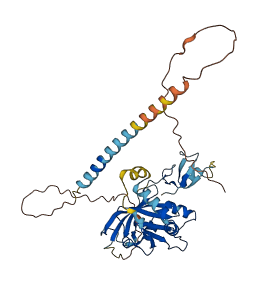
The autoinhibited protein was predicted that may have potential autoinhibitory elements via cis-regPred.
Autoinhibitory domains (AIDs)
Target domain |
|
Relief mechanism |
|
Assay |
cis-regPred |
Accessory elements
No accessory elements
Autoinhibited structure

Activated structure
1 structures for Q8L627
| Entry ID | Method | Resolution | Chain | Position | Source |
|---|---|---|---|---|---|
| AF-Q8L627-F1 | Predicted | AlphaFoldDB |
48 variants for Q8L627
| Variant ID(s) | Position | Change | Description | Diseaes Association | Provenance |
|---|---|---|---|---|---|
| ENSVATH04659870 | 10 | D>N | No | 1000Genomes | |
| tmp_1_10040250_T_G,C | 11 | Y>C | No | 1000Genomes | |
| tmp_1_10040250_T_G,C | 11 | Y>S | No | 1000Genomes | |
| tmp_1_10040248_G_C | 12 | L>V | No | 1000Genomes | |
| ENSVATH04659869 | 13 | S>Y | No | 1000Genomes | |
| ENSVATH04659868 | 18 | E>K | No | 1000Genomes | |
| tmp_1_10040214_A_G | 23 | V>A | No | 1000Genomes | |
| tmp_1_10039878_A_G | 30 | L>S | No | 1000Genomes | |
| tmp_1_10039872_C_T | 32 | G>E | No | 1000Genomes | |
| tmp_1_10039841_A_T | 42 | N>K | No | 1000Genomes | |
| tmp_1_10039833_A_G | 45 | V>A | No | 1000Genomes | |
| tmp_1_10039831_T_C | 46 | K>E | No | 1000Genomes | |
| tmp_1_10039819_G_C | 50 | L>V | No | 1000Genomes | |
| tmp_1_10039811_A_C | 52 | N>K | No | 1000Genomes | |
| tmp_1_10039798_T_G | 57 | K>Q | No | 1000Genomes | |
| tmp_1_10039794_A_C | 58 | M>R | No | 1000Genomes | |
| ENSVATH12233860 | 66 | A>D | No | 1000Genomes | |
| tmp_1_10039598_A_G | 69 | V>A | No | 1000Genomes | |
| ENSVATH04659861 | 79 | Q>H | No | 1000Genomes | |
| ENSVATH12233858 | 86 | A>T | No | 1000Genomes | |
| tmp_1_10039383_T_A | 112 | Q>L | No | 1000Genomes | |
| tmp_1_10039350_T_C | 123 | Y>C | No | 1000Genomes | |
| tmp_1_10039203_G_A | 137 | P>S | No | 1000Genomes | |
| ENSVATH01119280 | 155 | K>R | No | 1000Genomes | |
| tmp_1_10039041_A_C | 159 | F>L | No | 1000Genomes | |
| ENSVATH04659856 | 177 | A>P | No | 1000Genomes | |
| tmp_1_10038952_T_A | 189 | D>V | No | 1000Genomes | |
| tmp_1_10038950_G_A | 190 | P>S | No | 1000Genomes | |
| ENSVATH04659852 | 201 | H>D | No | 1000Genomes | |
| tmp_1_10038786_A_T | 214 | Y>N | No | 1000Genomes | |
| tmp_1_10038726_C_T | 234 | V>I | No | 1000Genomes | |
| tmp_1_10038706_C_A | 240 | Q>H | No | 1000Genomes | |
| ENSVATH00048789 | 245 | L>V | No | 1000Genomes | |
| ENSVATH13991523 | 247 | L>V | No | 1000Genomes | |
| tmp_1_10038684_C_T | 248 | G>S | No | 1000Genomes | |
| ENSVATH04659851 | 250 | A>V | No | 1000Genomes | |
| tmp_1_10038654_A_T | 258 | Y>N | No | 1000Genomes | |
| ENSVATH04659850 | 265 | S>T | No | 1000Genomes | |
| ENSVATH12233855 | 269 | C>R | No | 1000Genomes | |
| ENSVATH12233744 | 290 | T>M | No | 1000Genomes | |
| tmp_1_10038421_C_G | 302 | E>Q | No | 1000Genomes | |
| ENSVATH04659847 | 307 | R>I | No | 1000Genomes | |
| ENSVATH12233742 | 313 | M>I | No | 1000Genomes | |
| ENSVATH12233741 | 320 | I>V | No | 1000Genomes | |
| ENSVATH13991521 | 324 | G>C | No | 1000Genomes | |
| ENSVATH13991521 | 324 | G>R | No | 1000Genomes | |
| ENSVATH13991520 | 351 | V>I | No | 1000Genomes | |
| tmp_1_10038213_T_C | 371 | D>G | No | 1000Genomes |
No associated diseases with Q8L627
No regional properties for Q8L627
| Type | Name | Position | InterPro Accession |
|---|---|---|---|
| No domain, repeats, and functional sites for Q8L627 | |||
2 GO annotations of cellular component
| Name | Definition |
|---|---|
| nucleus | A membrane-bounded organelle of eukaryotic cells in which chromosomes are housed and replicated. In most cells, the nucleus contains all of the cell's chromosomes except the organellar chromosomes, and is the site of RNA synthesis and processing. In some species, or in specialized cell types, RNA metabolism or DNA replication may be absent. |
| snRNA-activating protein complex | A protein complex that recognizes the proximal sequence element of RNA polymerase II and III snRNA promoters. |
2 GO annotations of molecular function
| Name | Definition |
|---|---|
| bent DNA binding | Binding to DNA in a bent conformation. |
| RNA polymerase III type 3 promoter sequence-specific DNA binding | Binding to a sequence of DNA that is a part of a type 3 promoter that controls transcription by RNA polymerase III (Pol III). A type 3 Pol III promoter is composed of elements upstream of the transcription start site, including a TATA box. The human U6 snRNA gene has a type 3 promoter. Type 3 Pol III promoters have not been observed in S. cerevisiae. |
14 GO annotations of biological process
| Name | Definition |
|---|---|
| auxin polar transport | The unidirectional movement of auxin in the stem from tip to base along the vector of gravity or basipetally. |
| auxin-activated signaling pathway | The series of molecular signals generated by the binding of the plant hormone auxin to a receptor, and ending with modulation of a downstream cellular process, e.g. transcription. |
| cell cycle switching | The process in which a cell switches cell cycle mode. |
| cell dedifferentiation | The process in which a specialized cell loses the structural or functional features that characterize it in the mature organism, or some other relatively stable phase of the organism's life history. Under certain conditions, these cells can revert back to the features of the stem cells that were their ancestors. |
| cellular response to auxin stimulus | Any process that results in a change in state or activity of a cell (in terms of movement, secretion, enzyme production, gene expression, etc.) as a result of an auxin stimulus. |
| cellular response to cytokinin stimulus | Any process that results in a change in state or activity of a cell (in terms of movement, secretion, enzyme production, gene expression, etc.) as a result of a cytokinin stimulus. |
| lateral root formation | The process that gives rise to a lateral root. This process pertains to the initial formation of a structure from unspecified parts. A lateral root primordium represents an organized group of cells derived from the root pericycle that will differentiate into a new root, as opposed to the initiation of the main root from the embryo proper. |
| longitudinal axis specification | The establishment, maintenance and elaboration of the longitudinal axis. In plants, this is the axis that runs from the shoot to the root. |
| meristem initiation | Initiation of a region of tissue in a plant that is composed of one or more undifferentiated cells capable of undergoing mitosis and differentiation, thereby effecting growth and development of a plant by giving rise to more meristem or specialized tissue. |
| plant organ morphogenesis | The developmental process by which a plant organ is generated and organized. |
| radial axis specification | The establishment, maintenance and elaboration of an axis that initiates at a point and radiates outward from the point. |
| snRNA transcription | The synthesis of small nuclear RNA (snRNA) from a DNA template. |
| snRNA transcription by RNA polymerase II | The synthesis of small nuclear RNA (snRNA) from a DNA template by RNA Polymerase II (Pol II), originating at a Pol II promoter. |
| snRNA transcription by RNA polymerase III | The synthesis of small nuclear RNA (snRNA) from a DNA template by RNA Polymerase III (Pol III), originating at a Pol III promoter. |
1 homologous proteins in AiPD
| UniProt AC | Gene Name | Protein Name | Species | Evidence Code |
|---|---|---|---|---|
| Q92966 | SNAPC3 | snRNA-activating protein complex subunit 3 | Homo sapiens (Human) | PR |
| 10 | 20 | 30 | 40 | 50 | 60 |
| MAMKEAFPED | YLSQEELEPS | LNVSHHENPL | AGRAKRKRTV | KNTEVKKRTL | KNTEVMKMTE |
| 70 | 80 | 90 | 100 | 110 | 120 |
| KKTEEAYLVK | VEQLAKLKQK | QEEDKAAVTL | HCFSKTSETG | KDVVAPPEGF | EQMQSLRFID |
| 130 | 140 | 150 | 160 | 170 | 180 |
| NNYTKLKPSD | IQGQVDPLFP | EVILCVEIYN | SRKVKTQEFL | VLGRQMLTEL | KDNIHCATDQ |
| 190 | 200 | 210 | 220 | 230 | 240 |
| VMQKAGKYDP | SGYFLIEDVF | HNDLRNPSAK | DYSYPILDWL | WNSKDEALKK | WECVLTGELQ |
| 250 | 260 | 270 | 280 | 290 | 300 |
| KKQKLVLGEA | KSVDLPRYRT | ADMQSTHFCD | IRFRVGASYV | YCHQGDCKHT | IVIRDMRMSH |
| 310 | 320 | 330 | 340 | 350 | 360 |
| PEDVQNRAAY | PIMFWPKRRI | QKCGVCKIKR | ASKVAVDDKW | ASENSSYFCD | VCFELLHSEE |
| 370 | |||||
| GPLNCDFPVF | DYVHE |