Descriptions
The autoinhibited protein was predicted that may have potential autoinhibitory elements via cis-regPred.
Autoinhibitory domains (AIDs)
Target domain |
|
Relief mechanism |
|
Assay |
cis-regPred |
Accessory elements
No accessory elements
Autoinhibited structure

Activated structure
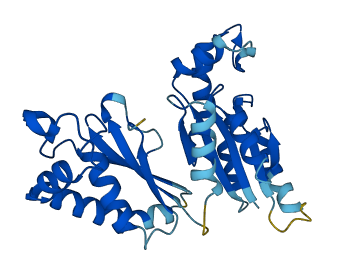
1 structures for Q8KLV8
| Entry ID | Method | Resolution | Chain | Position | Source |
|---|---|---|---|---|---|
| AF-Q8KLV8-F1 | Predicted | AlphaFoldDB |
No variants for Q8KLV8
| Variant ID(s) | Position | Change | Description | Diseaes Association | Provenance |
|---|---|---|---|---|---|
| No variants for Q8KLV8 | |||||
2 associated diseases with Q8KLV8
[MIM: 158590]: Neuronopathy, distal hereditary motor, 2A (HMN2A)
A neuromuscular disorder. Distal hereditary motor neuronopathies constitute a heterogeneous group of neuromuscular disorders caused by selective degeneration of motor neurons in the anterior horn of the spinal cord, without sensory deficit in the posterior horn. The overall clinical picture consists of a classical distal muscular atrophy syndrome in the legs without clinical sensory loss. The disease starts with weakness and wasting of distal muscles of the anterior tibial and peroneal compartments of the legs. Later on, weakness and atrophy may expand to the proximal muscles of the lower limbs and/or to the distal upper limbs. {ECO:0000269|PubMed:15122253, ECO:0000269|PubMed:28144995}. Note=The disease is caused by variants affecting the gene represented in this entry.
[MIM: 608673]: Charcot-Marie-Tooth disease 2L (CMT2L)
An axonal form of Charcot-Marie-Tooth disease, a disorder of the peripheral nervous system, characterized by progressive weakness and atrophy, initially of the peroneal muscles and later of the distal muscles of the arms. Charcot-Marie-Tooth disease is classified in two main groups on the basis of electrophysiologic properties and histopathology
Without disease ID
- A neuromuscular disorder. Distal hereditary motor neuronopathies constitute a heterogeneous group of neuromuscular disorders caused by selective degeneration of motor neurons in the anterior horn of the spinal cord, without sensory deficit in the posterior horn. The overall clinical picture consists of a classical distal muscular atrophy syndrome in the legs without clinical sensory loss. The disease starts with weakness and wasting of distal muscles of the anterior tibial and peroneal compartments of the legs. Later on, weakness and atrophy may expand to the proximal muscles of the lower limbs and/or to the distal upper limbs. {ECO:0000269|PubMed:15122253, ECO:0000269|PubMed:28144995}. Note=The disease is caused by variants affecting the gene represented in this entry.
- An axonal form of Charcot-Marie-Tooth disease, a disorder of the peripheral nervous system, characterized by progressive weakness and atrophy, initially of the peroneal muscles and later of the distal muscles of the arms. Charcot-Marie-Tooth disease is classified in two main groups on the basis of electrophysiologic properties and histopathology
3 regional properties for Q8KLV8
| Type | Name | Position | InterPro Accession |
|---|---|---|---|
| conserved_site | 14-3-3 protein, conserved site | 45 - 55 | IPR023409-1 |
| conserved_site | 14-3-3 protein, conserved site | 217 - 236 | IPR023409-2 |
| domain | 14-3-3 domain | 7 - 248 | IPR023410 |
No GO annotations of cellular component
| Name | Definition |
|---|---|
| No GO annotations for cellular component |
2 GO annotations of molecular function
| Name | Definition |
|---|---|
| ATP binding | Binding to ATP, adenosine 5'-triphosphate, a universally important coenzyme and enzyme regulator. |
| GTP binding | Binding to GTP, guanosine triphosphate. |
No GO annotations of biological process
| Name | Definition |
|---|---|
| No GO annotations for biological process |
No homologous proteins in AiPD
| UniProt AC | Gene Name | Protein Name | Species | Evidence Code |
|---|---|---|---|---|
| No homologous proteins | ||||
| 10 | 20 | 30 | 40 | 50 | 60 |
| MRLIIVSGRS | GSGKSTALNV | LEDNGFYCID | NLPAGLLPEL | AERALLHTEL | LHPQVAVSID |
| 70 | 80 | 90 | 100 | 110 | 120 |
| ARNLPSQLKR | FPELLEEVRA | RHIQCDVLYL | DADDETLLKR | FSETRRRHPL | TNESRSLAEA |
| 130 | 140 | 150 | 160 | 170 | 180 |
| IRDEELLLAA | IIDHADLKID | TTHLNLYQLR | DMLKLRLLNK | PEPGTAFLIE | SFGFKRGMPV |
| 190 | 200 | 210 | 220 | 230 | 240 |
| DADLVFDVRC | LPNPYWKAEL | RDFSGLDQPV | IDYLAAQPDV | EEMFQDIHAY | LNKWLPRFAA |
| 250 | 260 | 270 | 280 | ||
| SNRAYVTIAI | GCTGGHHRSV | YLAERLGLAL | KEPLKNLQVR | HRDLA |