Q8K3Z0
Gene name |
Nod2 (Card15) |
Protein name |
Nucleotide-binding oligomerization domain-containing protein 2 |
Names |
Caspase recruitment domain-containing protein 15 |
Species |
Homo sapiens (Human) |
KEGG Pathway |
|
EC number |
2.3.2.27: Aminoacyltransferases |
Protein Class |
TNF RECEPTOR ASSOCIATED FACTOR (PTHR10131) |
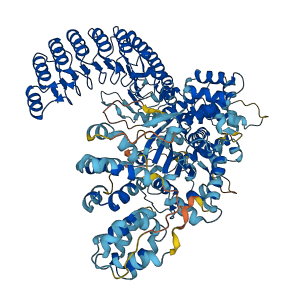
Descriptions
The Tumor Necrosis Factor (TNF) Receptor Associated Factor (TRAF) class of intracellular signal transducers is responsible for mediating many of the activation events initiated by TNF receptor (TNFR) and Toll-like/Interleukin-1, 17 and 18 receptor (TIR) families. These receptors can, both directly and indirectly, activate TRAF6 via specific binding of proteins containing TRAF Interacting Motif (TIM) peptides to a groove on the carboxyl-terminal MATH domain.
TRAF6 is autoinhibited by an intramolecular interaction between the RING-Zinc (RZ) region and MATH domain. The interaction renders TRAF6 inactive and structurally closed, as well as incapable of auto-ubiquitination. RING-Zinc fingers region and the MATH domain are targets for ubiquitination. TRAF autoubiquitination in trans is a means of sustaining an open conformation active in downstream signaling.
Autoinhibitory domains (AIDs)
Target domain |
6-185 (CARD domains) |
Relief mechanism |
Partner binding |
Assay |
Deletion assay |
Accessory elements
No accessory elements
Autoinhibited structure

Activated structure
1 structures for Q8K3Z0
| Entry ID | Method | Resolution | Chain | Position | Source |
|---|---|---|---|---|---|
| AF-Q8K3Z0-F1 | Predicted | AlphaFoldDB |
33 variants for Q8K3Z0
| Variant ID(s) | Position | Change | Description | Diseaes Association | Provenance |
|---|---|---|---|---|---|
| rs247390411 | 26 | I>V | No | Ensembl | |
| rs47572763 | 87 | V>M | No | Ensembl | |
| rs48081862 | 100 | Y>H | No | Ensembl | |
| rs49803184 | 108 | L>V | No | Ensembl | |
| rs261954374 | 139 | G>R | No | Ensembl | |
| rs242023857 | 183 | V>I | No | Ensembl | |
| rs227587892 | 189 | P>L | No | Ensembl | |
| rs233317350 | 204 | S>P | No | Ensembl | |
| rs13479904 | 212 | T>A | No | Ensembl | |
| rs32621110 | 240 | Q>R | No | Ensembl | |
| rs243406545 | 242 | E>D | No | Ensembl | |
| rs218613030 | 322 | P>L | No | Ensembl | |
| rs234099517 | 324 | S>C | No | Ensembl | |
| rs51317776 | 422 | L>F | No | Ensembl | |
| rs49412699 | 422 | L>W | No | Ensembl | |
| rs108246188 | 485 | G>V | No | Ensembl | |
| rs224527675 | 513 | L>F | No | Ensembl | |
| rs218016175 | 514 | G>S | No | Ensembl | |
| rs236785847 | 572 | V>G | No | Ensembl | |
| rs264196416 | 578 | P>S | No | Ensembl | |
| rs242328134 | 603 | V>A | No | Ensembl | |
| rs48436459 | 675 | V>I | No | Ensembl | |
| rs250615209 | 767 | Q>K | No | Ensembl | |
| rs215511090 | 813 | R>C | No | Ensembl | |
| rs49033188 | 925 | E>Q | No | Ensembl | |
| rs228826090 | 985 | Q>K | No | Ensembl | |
| 212 | T>A | strain: NMRI [UniProt] | No | ||
| 240 | Q>R | strain: NMRI [UniProt] | No | ||
| 422 | L>C | strain: NMRI; requires 2 nucleotide substitutions [UniProt] | No | ||
| 485 | G>V | strain: NMRI [UniProt] | No | ||
| 603 | V>A | strain: NMRI [UniProt] | No | ||
| 675 | V>I | strain: NMRI [UniProt] | No | ||
| 925 | E>Q | strain: NMRI [UniProt] | No |
No associated diseases with Q8K3Z0
No regional properties for Q8K3Z0
| Type | Name | Position | InterPro Accession |
|---|---|---|---|
| No domain, repeats, and functional sites for Q8K3Z0 | |||
Functions
| Description | ||
|---|---|---|
| EC Number | 2.3.2.27 | Aminoacyltransferases |
| Subcellular Localization |
|
|
| PANTHER Family | PTHR10131 | TNF RECEPTOR ASSOCIATED FACTOR |
| PANTHER Subfamily | PTHR10131:SF131 | TNF RECEPTOR-ASSOCIATED FACTOR 6 |
| PANTHER Protein Class | scaffold/adaptor protein | |
| PANTHER Pathway Category |
CCKR signaling map TRAF6 p38 MAPK pathway TRAF6 Toll receptor signaling pathway TRAF6 |
|
11 GO annotations of cellular component
| Name | Definition |
|---|---|
| anchored component of plasma membrane | The component of the plasma membrane consisting of the gene products that are tethered to the membrane only by a covalently attached anchor, such as a lipid group, that is embedded in the membrane. Gene products with peptide sequences that are embedded in the membrane are excluded from this grouping. |
| basolateral plasma membrane | The region of the plasma membrane that includes the basal end and sides of the cell. Often used in reference to animal polarized epithelial membranes, where the basal membrane is the part attached to the extracellular matrix, or in plant cells, where the basal membrane is defined with respect to the zygotic axis. |
| cell surface | The external part of the cell wall and/or plasma membrane. |
| cytoplasm | The contents of a cell excluding the plasma membrane and nucleus, but including other subcellular structures. |
| cytoskeleton | A cellular structure that forms the internal framework of eukaryotic and prokaryotic cells. The cytoskeleton includes intermediate filaments, microfilaments, microtubules, the microtrabecular lattice, and other structures characterized by a polymeric filamentous nature and long-range order within the cell. The various elements of the cytoskeleton not only serve in the maintenance of cellular shape but also have roles in other cellular functions, including cellular movement, cell division, endocytosis, and movement of organelles. |
| cytosol | The part of the cytoplasm that does not contain organelles but which does contain other particulate matter, such as protein complexes. |
| Golgi apparatus | A membrane-bound cytoplasmic organelle of the endomembrane system that further processes the core oligosaccharides (e.g. N-glycans) added to proteins in the endoplasmic reticulum and packages them into membrane-bound vesicles. The Golgi apparatus operates at the intersection of the secretory, lysosomal, and endocytic pathways. |
| phagocytic vesicle | A membrane-bounded intracellular vesicle that arises from the ingestion of particulate material by phagocytosis. |
| plasma membrane | The membrane surrounding a cell that separates the cell from its external environment. It consists of a phospholipid bilayer and associated proteins. |
| protein-containing complex | A stable assembly of two or more macromolecules, i.e. proteins, nucleic acids, carbohydrates or lipids, in which at least one component is a protein and the constituent parts function together. |
| vesicle | Any small, fluid-filled, spherical organelle enclosed by membrane. |
11 GO annotations of molecular function
| Name | Definition |
|---|---|
| actin binding | Binding to monomeric or multimeric forms of actin, including actin filaments. |
| ATP binding | Binding to ATP, adenosine 5'-triphosphate, a universally important coenzyme and enzyme regulator. |
| CARD domain binding | Binding to a CARD (N-terminal caspase recruitment) domain, a protein-protein interaction domain that belongs to the death domain-fold superfamily. These protein molecule families are similar in structure with each consisting of six or seven anti-parallel alpha-helices that form highly specific homophilic interactions between signaling partners. CARD exists in the N-terminal prodomains of several caspases and in apoptosis-regulatory proteins and mediates the assembly of CARD-containing proteins that participate in activation or suppression of CARD carrying members of the caspase family. |
| enzyme binding | Binding to an enzyme, a protein with catalytic activity. |
| Hsp70 protein binding | Binding to a Hsp70 protein, heat shock proteins around 70kDa in size. |
| Hsp90 protein binding | Binding to Hsp90 proteins, any of a group of heat shock proteins around 90kDa in size. |
| muramyl dipeptide binding | Interacting selectively and non-covalently, in a non-covalent manner, with muramyl dipeptide; muramyl dipeptide is derived from peptidoglycan. |
| pattern recognition receptor activity | Combining with a pathogen-associated molecular pattern (PAMP), a structure conserved among microbial species to initiate an innate immune response. |
| peptidoglycan binding | Interacting selectively and non-covalently, in a non-covalent manner, with peptidoglycan, any of a class of glycoconjugates found in bacterial cell walls. |
| protein kinase binding | Binding to a protein kinase, any enzyme that catalyzes the transfer of a phosphate group, usually from ATP, to a protein substrate. |
| protein-containing complex binding | Binding to a macromolecular complex. |
75 GO annotations of biological process
| Name | Definition |
|---|---|
| activation of immune response | Any process that initiates an immune response. |
| cellular response to lipopolysaccharide | Any process that results in a change in state or activity of a cell (in terms of movement, secretion, enzyme production, gene expression, etc.) as a result of a lipopolysaccharide stimulus; lipopolysaccharide is a major component of the cell wall of gram-negative bacteria. |
| cellular response to muramyl dipeptide | Any process that results in a change in state or activity of a cell (in terms of movement, secretion, enzyme production, gene expression, etc.) as a result of a muramyl dipeptide stimulus. Muramyl dipeptide is derived from peptidoglycan. |
| cellular response to organic cyclic compound | Any process that results in a change in state or activity of a cell (in terms of movement, secretion, enzyme production, gene expression, etc.) as a result of an organic cyclic compound stimulus. |
| cellular response to peptidoglycan | Any process that results in a change in state or activity of a cell (in terms of movement, secretion, enzyme production, gene expression, etc.) as a result of a peptidoglycan stimulus. Peptidoglycan is a bacterial cell wall macromolecule. |
| defense response | Reactions, triggered in response to the presence of a foreign body or the occurrence of an injury, which result in restriction of damage to the organism attacked or prevention/recovery from the infection caused by the attack. |
| defense response to bacterium | Reactions triggered in response to the presence of a bacterium that act to protect the cell or organism. |
| defense response to Gram-positive bacterium | Reactions triggered in response to the presence of a Gram-positive bacterium that act to protect the cell or organism. |
| detection of bacterium | The series of events in which a stimulus from a bacterium is received and converted into a molecular signal. |
| detection of biotic stimulus | The series of events in which a biotic stimulus, one caused or produced by a living organism, is received and converted into a molecular signal. |
| detection of muramyl dipeptide | The series of events in which a muramyl dipeptide stimulus is received by a cell and converted into a molecular signal. Muramyl dipeptide is derived from peptidoglycan. |
| inflammatory response | The immediate defensive reaction (by vertebrate tissue) to infection or injury caused by chemical or physical agents. The process is characterized by local vasodilation, extravasation of plasma into intercellular spaces and accumulation of white blood cells and macrophages. |
| innate immune response | Innate immune responses are defense responses mediated by germline encoded components that directly recognize components of potential pathogens. |
| innate immune response in mucosa | Any process of the innate immune response that takes place in the mucosal tissues. |
| intracellular signal transduction | The process in which a signal is passed on to downstream components within the cell, which become activated themselves to further propagate the signal and finally trigger a change in the function or state of the cell. |
| maintenance of gastrointestinal epithelium | Protection of epithelial surfaces of the gastrointestinal tract from proteolytic and caustic digestive agents. |
| negative regulation of inflammatory response to antigenic stimulus | Any process that stops, prevents, or reduces the frequency, rate, or extent of an inflammatory response to an antigenic stimulus. |
| negative regulation of interferon-gamma production | Any process that stops, prevents, or reduces the frequency, rate, or extent of interferon-gamma production. Interferon-gamma is also known as type II interferon. |
| negative regulation of interleukin-12 production | Any process that stops, prevents, or reduces the frequency, rate, or extent of interleukin-12 production. |
| negative regulation of interleukin-18 production | Any process that stops, prevents, or reduces the frequency, rate, or extent of interleukin-18 production. |
| negative regulation of interleukin-2 production | Any process that stops, prevents, or reduces the frequency, rate, or extent of interleukin-2 production. |
| negative regulation of macrophage apoptotic process | Any process that stops, prevents, or reduces the frequency, rate or extent of macrophage apoptotic process. |
| negative regulation of NF-kappaB transcription factor activity | Any process that stops, prevents, or reduces the frequency, rate or extent of the activity of the transcription factor NF-kappaB. |
| negative regulation of T cell mediated immunity | Any process that stops, prevents, or reduces the frequency, rate, or extent of T cell mediated immunity. |
| negative regulation of toll-like receptor 2 signaling pathway | Any process that stops, prevents, or reduces the frequency, rate, or extent of toll-like receptor 2 signaling pathway. |
| negative regulation of tumor necrosis factor production | Any process that stops, prevents, or reduces the frequency, rate, or extent of tumor necrosis factor production. |
| nucleotide-binding oligomerization domain containing 2 signaling pathway | The series of molecular signals initiated by the binding of a ligand (such as a bacterial peptidoglycan) to a cytoplasmic nucleotide-binding oligomerization domain containing 2 (NOD2) protein receptor, and ending with regulation of a downstream cellular process. |
| pattern recognition receptor signaling pathway | The series of molecular signals initiated by a ligand binding to a pattern recognition receptor (PRR), and ending with the regulation of a downstream cellular process, e.g. transcription. PRRs bind pathogen-associated molecular pattern (PAMPs), structures conserved among microbial species, or damage-associated molecular pattern (DAMPs), endogenous molecules released from damaged cells. |
| positive regulation of antibacterial peptide biosynthetic process | Any process that activates or increases the frequency, rate, or extent of antibacterial peptide biosynthesis. |
| positive regulation of B cell activation | Any process that activates or increases the frequency, rate or extent of B cell activation. |
| positive regulation of biosynthetic process of antibacterial peptides active against Gram-positive bacteria | Any process that activates or increases the frequency, rate, or extent of biosynthesis of antibacterial peptides active against Gram-positive bacteria. |
| positive regulation of cytokine production involved in immune response | Any process that activates or increases the frequency, rate, or extent of cytokine production that contributes to an immune response. |
| positive regulation of cytokine production involved in inflammatory response | Any process that activates or increases the frequency, rate or extent of cytokine production involved in inflammatory response. |
| positive regulation of dendritic cell antigen processing and presentation | Any process that activates or increases the frequency, rate, or extent of dendritic cell antigen processing and presentation. |
| positive regulation of dendritic cell cytokine production | Any process that activates or increases the frequency, rate, or extent of dendritic cell cytokine production. |
| positive regulation of epithelial cell proliferation | Any process that activates or increases the rate or extent of epithelial cell proliferation. |
| positive regulation of ERK1 and ERK2 cascade | Any process that activates or increases the frequency, rate or extent of signal transduction mediated by the ERK1 and ERK2 cascade. |
| positive regulation of humoral immune response mediated by circulating immunoglobulin | Any process that activates or increases the frequency, rate, or extent of a humoral immune response mediated by circulating immunoglobulin. |
| positive regulation of I-kappaB kinase/NF-kappaB signaling | Any process that activates or increases the frequency, rate or extent of I-kappaB kinase/NF-kappaB signaling. |
| positive regulation of innate immune response | Any process that activates or increases the frequency, rate or extent of the innate immune response, the organism's first line of defense against infection. |
| positive regulation of interleukin-1 beta production | Any process that activates or increases the frequency, rate, or extent of interleukin-1 beta production. |
| positive regulation of interleukin-10 production | Any process that activates or increases the frequency, rate, or extent of interleukin-10 production. |
| positive regulation of interleukin-12 production | Any process that activates or increases the frequency, rate, or extent of interleukin-12 production. |
| positive regulation of interleukin-17 production | Any process that activates or increases the frequency, rate, or extent of production of any member of the interleukin-17 family of cytokines. |
| positive regulation of interleukin-6 production | Any process that activates or increases the frequency, rate, or extent of interleukin-6 production. |
| positive regulation of interleukin-8 production | Any process that activates or increases the frequency, rate, or extent of interleukin-8 production. |
| positive regulation of JNK cascade | Any process that activates or increases the frequency, rate or extent of signal transduction mediated by the JNK cascade. |
| positive regulation of MAP kinase activity | Any process that activates or increases the frequency, rate or extent of MAP kinase activity. |
| positive regulation of MAPK cascade | Any process that activates or increases the frequency, rate or extent of signal transduction mediated by the MAPK cascade. |
| positive regulation of monocyte chemotactic protein-1 production | Any process that activates or increases the frequency, rate, or extent of production of monocyte chemotactic protein-1. |
| positive regulation of NF-kappaB transcription factor activity | Any process that activates or increases the frequency, rate or extent of activity of the transcription factor NF-kappaB. |
| positive regulation of NIK/NF-kappaB signaling | Any process that activates or increases the frequency, rate or extent of NIK/NF-kappaB signaling. |
| positive regulation of nitric-oxide synthase biosynthetic process | Any process that activates or increases the frequency, rate or extent of the chemical reactions and pathways resulting in the formation of a nitric oxide synthase enzyme. |
| positive regulation of Notch signaling pathway | Any process that activates or increases the frequency, rate or extent of the Notch signaling pathway. |
| positive regulation of oxidoreductase activity | Any process that activates or increases the frequency, rate or extent of oxidoreductase activity, the catalysis of an oxidation-reduction (redox) reaction, a reversible chemical reaction in which the oxidation state of an atom or atoms within a molecule is altered. |
| positive regulation of peptidyl-tyrosine phosphorylation | Any process that activates or increases the frequency, rate or extent of the phosphorylation of peptidyl-tyrosine. |
| positive regulation of phagocytosis | Any process that activates or increases the frequency, rate or extent of phagocytosis. |
| positive regulation of phosphatidylinositol 3-kinase activity | Any process that activates or increases the frequency, rate or extent of phosphatidylinositol 3-kinase activity. |
| positive regulation of prostaglandin-E synthase activity | Any process that activates or increases the frequency, rate or extent of prostaglandin-E synthase activity. |
| positive regulation of prostaglandin-endoperoxide synthase activity | Any process that increases the rate, frequency or extent of prostaglandin-endoperoxide synthase activity. Prostaglandin-endoperoxide synthase activity is the catalysis of the reaction: arachidonate + donor-H2 + 2 O2 = prostaglandin H2 + acceptor + H2O. |
| positive regulation of protein K63-linked ubiquitination | Any process that activates or increases the frequency, rate or extent of protein K63-linked ubiquitination. |
| positive regulation of protein ubiquitination | Any process that activates or increases the frequency, rate or extent of the addition of ubiquitin groups to a protein. |
| positive regulation of stress-activated MAPK cascade | Any process that activates or increases the frequency, rate or extent of signal transduction mediated by the stress-activated MAPK cascade. |
| positive regulation of transcription by RNA polymerase II | Any process that activates or increases the frequency, rate or extent of transcription from an RNA polymerase II promoter. |
| positive regulation of tumor necrosis factor production | Any process that activates or increases the frequency, rate or extent of tumor necrosis factor production. |
| positive regulation of type 2 immune response | Any process that activates or increases the frequency, rate, or extent of a type 2 immune response. |
| positive regulation of xenophagy | Any process that activates or increases the frequency, rate or extent of xenophagy. |
| regulation of inflammatory response | Any process that modulates the frequency, rate or extent of the inflammatory response, the immediate defensive reaction (by vertebrate tissue) to infection or injury caused by chemical or physical agents. |
| regulation of neutrophil chemotaxis | Any process that modulates the frequency, rate, or extent of neutrophil chemotaxis. Neutrophil chemotaxis is the directed movement of a neutrophil cell, the most numerous polymorphonuclear leukocyte found in the blood, in response to an external stimulus, usually an infection or wounding. |
| response to exogenous dsRNA | Any process that results in a change in state or activity of a cell or an organism (in terms of movement, secretion, enzyme production, gene expression, etc.) as a result of an exogenous double-stranded RNA stimulus. |
| response to lipopolysaccharide | Any process that results in a change in state or activity of an organism (in terms of movement, secretion, enzyme production, gene expression, etc.) as a result of a lipopolysaccharide stimulus; lipopolysaccharide is a major component of the cell wall of gram-negative bacteria. |
| response to muramyl dipeptide | Any process that results in a change in state or activity of an organism (in terms of movement, secretion, enzyme production, gene expression, etc.) as a result of a muramyl dipeptide stimulus. Muramyl dipeptide is derived from peptidoglycan. |
| response to nutrient | Any process that results in a change in state or activity of a cell or an organism (in terms of movement, secretion, enzyme production, gene expression, etc.) as a result of a nutrient stimulus. |
| response to peptidoglycan | Any process that results in a change in state or activity of an organism (in terms of movement, secretion, enzyme production, gene expression, etc.) as a result of a peptidoglycan stimulus. Peptidoglycan is a bacterial cell wall macromolecule. |
| signal transduction | The cellular process in which a signal is conveyed to trigger a change in the activity or state of a cell. Signal transduction begins with reception of a signal (e.g. a ligand binding to a receptor or receptor activation by a stimulus such as light), or for signal transduction in the absence of ligand, signal-withdrawal or the activity of a constitutively active receptor. Signal transduction ends with regulation of a downstream cellular process, e.g. regulation of transcription or regulation of a metabolic process. Signal transduction covers signaling from receptors located on the surface of the cell and signaling via molecules located within the cell. For signaling between cells, signal transduction is restricted to events at and within the receiving cell. |
3 homologous proteins in AiPD
| UniProt AC | Gene Name | Protein Name | Species | Evidence Code |
|---|---|---|---|---|
| Q6E804 | NOD2 | Nucleotide-binding oligomerization domain-containing protein 2 | Bos taurus (Bovine) | SS |
| Q53B87 | NOD2 | Nucleotide-binding oligomerization domain-containing protein 2 | Pan troglodytes (Chimpanzee) | SS |
| Q9HC29 | NOD2 | Nucleotide-binding oligomerization domain-containing protein 2 | Homo sapiens (Human) | EV |
| 10 | 20 | 30 | 40 | 50 | 60 |
| MSLLNCENSC | GSSQSESDCC | VAMASSCSAV | TKDDSVGGTA | STGNLSSSFM | EEIQGYDVEF |
| 70 | 80 | 90 | 100 | 110 | 120 |
| DPPLESKYEC | PICLMALREA | VQTPCGHRFC | KACIIKSIRD | AGHKCPVDNE | ILLENQLFPD |
| 130 | 140 | 150 | 160 | 170 | 180 |
| NFAKREILSL | MVKCPNEGCL | HKMELRHLED | HQAHCEFALM | DCPQCQRPFQ | KFHINIHILK |
| 190 | 200 | 210 | 220 | 230 | 240 |
| DCPRRQVSCD | NCAASMAFED | KEIHDQNCPL | ANVICEYCNT | ILIREQMPNH | YDLDCPTAPI |
| 250 | 260 | 270 | 280 | 290 | 300 |
| PCTFSTFGCH | EKMQRNHLAR | HLQENTQSHM | RMLAQAVHSL | SVIPDSGYIS | EVRNFQETIH |
| 310 | 320 | 330 | 340 | 350 | 360 |
| QLEGRLVRQD | HQIRELTAKM | ETQSMYVSEL | KRTIRTLEDK | VAEIEAQQCN | GIYIWKIGNF |
| 370 | 380 | 390 | 400 | 410 | 420 |
| GMHLKCQEEE | KPVVIHSPGF | YTGKPGYKLC | MRLHLQLPTA | QRCANYISLF | VHTMQGEYDS |
| 430 | 440 | 450 | 460 | 470 | 480 |
| HLPWPFQGTI | RLTILDQSEA | PVRQNHEEIM | DAKPELLAFQ | RPTIPRNPKG | FGYVTFMHLE |
| 490 | 500 | 510 | 520 | ||
| ALRQRTFIKD | DTLLVRCEVS | TRFDMGSLRR | EGFQPRSTDA | GV |