Q8K3K8
Gene name |
Optn |
Protein name |
Optineurin |
Names |
|
Species |
Mus musculus (Mouse) |
KEGG Pathway |
mmu:71648 |
EC number |
|
Protein Class |
|
Descriptions
The autoinhibited protein was predicted that may have potential autoinhibitory elements via cis-regPred.
Autoinhibitory domains (AIDs)
Target domain |
|
Relief mechanism |
|
Assay |
cis-regPred |
Accessory elements
No accessory elements
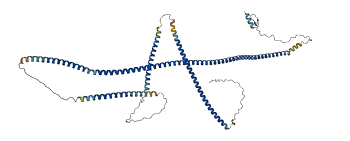
Autoinhibited structure

Activated structure
2 structures for Q8K3K8
| Entry ID | Method | Resolution | Chain | Position | Source |
|---|---|---|---|---|---|
| 5WQ4 | X-ray | 300 A | C/D/E/F | 417-513 | PDB |
| AF-Q8K3K8-F1 | Predicted | AlphaFoldDB |
38 variants for Q8K3K8
| Variant ID(s) | Position | Change | Description | Diseaes Association | Provenance |
|---|---|---|---|---|---|
| rs3388525593 | 17 | C>Y | No | EVA | |
| rs3388522352 | 39 | E>D | No | EVA | |
| rs3388523948 | 69 | F>S | No | EVA | |
| rs3388528276 | 77 | E>K | No | EVA | |
| rs244099759 | 126 | T>P | No | EVA | |
| rs3388529254 | 144 | T>A | No | EVA | |
| rs3388525541 | 145 | Q>R | No | EVA | |
| rs259433184 | 161 | R>Q | No | EVA | |
| rs3388522347 | 198 | T>* | No | EVA | |
| rs239379335 | 198 | T>A | No | EVA | |
| rs3388528697 | 198 | T>S | No | EVA | |
| rs3391235489 | 215 | D>* | No | EVA | |
| rs222986841 | 216 | P>S | No | EVA | |
| rs250080338 | 226 | A>V | No | EVA | |
| rs3388523931 | 228 | S>E* | No | EVA | |
| rs3388521863 | 229 | C>* | No | EVA | |
| rs3388526196 | 230 | A>V | No | EVA | |
| rs3413096966 | 265 | I>L | No | EVA | |
| rs3388526172 | 267 | D>E | No | EVA | |
| rs4222941 | 284 | R>G | No | EVA | |
| rs4222942 | 290 | K>E | No | EVA | |
| rs4222943 | 291 | E>D | No | EVA | |
| rs4222944 | 293 | K>N | No | EVA | |
| rs3388521893 | 294 | G>A | No | EVA | |
| rs27096107 | 360 | S>N | No | EVA | |
| rs3388528812 | 393 | Q>* | No | EVA | |
| rs3388527345 | 452 | Q>R | No | EVA | |
| rs27096123 | 453 | T>M | No | EVA | |
| rs3388527243 | 485 | R>SE* | No | EVA | |
| rs3388525567 | 488 | I>F | No | EVA | |
| rs3388525645 | 508 | D>N | No | EVA | |
| rs3388526133 | 531 | D>V | No | EVA | |
| rs3388525647 | 554 | P>T | No | EVA | |
| rs583314255 | 555 | R>H | No | EVA | |
| rs3388528240 | 560 | H>P | No | EVA | |
| rs3391166888 | 567 | E>D | No | EVA | |
| rs3391093983 | 569 | L>R | No | EVA | |
| rs3388524117 | 571 | D>G | No | EVA |
No associated diseases with Q8K3K8
Functions
11 GO annotations of cellular component
| Name | Definition |
|---|---|
| autophagosome | A double-membrane-bounded compartment that engulfs endogenous cellular material as well as invading microorganisms to target them to the lytic vacuole/lysosome for degradation as part of macroautophagy. |
| axon | The long process of a neuron that conducts nerve impulses, usually away from the cell body to the terminals and varicosities, which are sites of storage and release of neurotransmitter. |
| cytoplasm | The contents of a cell excluding the plasma membrane and nucleus, but including other subcellular structures. |
| cytoplasmic vesicle | A vesicle found in the cytoplasm of a cell. |
| cytosol | The part of the cytoplasm that does not contain organelles but which does contain other particulate matter, such as protein complexes. |
| Golgi apparatus | A membrane-bound cytoplasmic organelle of the endomembrane system that further processes the core oligosaccharides (e.g. N-glycans) added to proteins in the endoplasmic reticulum and packages them into membrane-bound vesicles. The Golgi apparatus operates at the intersection of the secretory, lysosomal, and endocytic pathways. |
| neuronal cell body | The portion of a neuron that includes the nucleus, but excludes cell projections such as axons and dendrites. |
| nucleus | A membrane-bounded organelle of eukaryotic cells in which chromosomes are housed and replicated. In most cells, the nucleus contains all of the cell's chromosomes except the organellar chromosomes, and is the site of RNA synthesis and processing. In some species, or in specialized cell types, RNA metabolism or DNA replication may be absent. |
| perinuclear region of cytoplasm | Cytoplasm situated near, or occurring around, the nucleus. |
| recycling endosome | An organelle consisting of a network of tubules that functions in targeting molecules, such as receptors transporters and lipids, to the plasma membrane. |
| trans-Golgi network | The network of interconnected tubular and cisternal structures located within the Golgi apparatus on the side distal to the endoplasmic reticulum, from which secretory vesicles emerge. The trans-Golgi network is important in the later stages of protein secretion where it is thought to play a key role in the sorting and targeting of secreted proteins to the correct destination. |
9 GO annotations of molecular function
| Name | Definition |
|---|---|
| identical protein binding | Binding to an identical protein or proteins. |
| K63-linked polyubiquitin modification-dependent protein binding | Binding to a protein upon poly-ubiquitination formed by linkages between lysine residues at position 63 in the target protein. |
| metal ion binding | Binding to a metal ion. |
| polyubiquitin modification-dependent protein binding | Binding to a protein upon poly-ubiquitination of the target protein. |
| protein C-terminus binding | Binding to a protein C-terminus, the end of a peptide chain at which the 1-carboxyl function of a constituent amino acid is not attached in peptide linkage to another amino-acid residue. |
| protein-macromolecule adaptor activity | The binding activity of a protein that brings together two or more macromolecules in contact, permitting those molecules to function in a coordinated way. The adaptor can bring together two proteins, or a protein and another macromolecule such as a lipid or a nucleic acid. |
| small GTPase binding | Binding to a small monomeric GTPase. |
| TFIIIA-class transcription factor binding | Binding to an RNA polymerase III transcription factor of the TFIIIA class, one of the factors involved in formation of the preinitiation complex (PIC) at RNA polymerase III promoters. |
| ubiquitin binding | Binding to ubiquitin, a protein that when covalently bound to other cellular proteins marks them for proteolytic degradation. |
22 GO annotations of biological process
| Name | Definition |
|---|---|
| autophagy | The cellular catabolic process in which cells digest parts of their own cytoplasm; allows for both recycling of macromolecular constituents under conditions of cellular stress and remodeling the intracellular structure for cell differentiation. |
| cellular response to unfolded protein | Any process that results in a change in state or activity of a cell (in terms of movement, secretion, enzyme production, gene expression, etc.) as a result of an unfolded protein stimulus. |
| defense response to Gram-negative bacterium | Reactions triggered in response to the presence of a Gram-negative bacterium that act to protect the cell or organism. |
| Golgi organization | A process that is carried out at the cellular level which results in the assembly, arrangement of constituent parts, or disassembly of the Golgi apparatus. |
| Golgi ribbon formation | The formation of a continuous ribbon of interconnected Golgi stacks of flat cisternae. |
| Golgi to plasma membrane protein transport | The directed movement of proteins from the Golgi to the plasma membrane in transport vesicles that move from the trans-Golgi network to the plasma membrane. |
| innate immune response | Innate immune responses are defense responses mediated by germline encoded components that directly recognize components of potential pathogens. |
| negative regulation of cell population proliferation | Any process that stops, prevents or reduces the rate or extent of cell proliferation. |
| negative regulation of I-kappaB kinase/NF-kappaB signaling | Any process that stops, prevents, or reduces the frequency, rate or extent of -kappaB kinase/NF-kappaB signaling. |
| negative regulation of neuron apoptotic process | Any process that stops, prevents, or reduces the frequency, rate or extent of cell death by apoptotic process in neurons. |
| negative regulation of receptor recycling | Any process that stops, prevents, or reduces the rate of receptor recycling. |
| parkin-mediated stimulation of mitophagy in response to mitochondrial depolarization | A positive regulation of the macromitophagy pathway that is triggered by mitochondrial depolarization and requires the function of a parkin-family molecule. |
| positive regulation of autophagy | Any process that activates, maintains or increases the rate of autophagy. Autophagy is the process in which cells digest parts of their own cytoplasm. |
| positive regulation of cell population proliferation | Any process that activates or increases the rate or extent of cell proliferation. |
| positive regulation of cytokine production | Any process that activates or increases the frequency, rate or extent of production of a cytokine. |
| positive regulation of gene expression | Any process that increases the frequency, rate or extent of gene expression. Gene expression is the process in which a gene's coding sequence is converted into a mature gene product (protein or RNA). |
| positive regulation of neural precursor cell proliferation | Any process that activates or increases the frequency, rate or extent of neural precursor cell proliferation. |
| positive regulation of neuron apoptotic process | Any process that activates or increases the frequency, rate or extent of cell death of neurons by apoptotic process. |
| positive regulation of xenophagy | Any process that activates or increases the frequency, rate or extent of xenophagy. |
| protein localization | Any process in which a protein is transported to, or maintained in, a specific location. |
| protein localization to Golgi apparatus | A process in which a protein is transported to, or maintained in, a location within the Golgi apparatus. |
| regulation of I-kappaB kinase/NF-kappaB signaling | Any process that modulates I-kappaB kinase/NF-kappaB signaling. |
1 homologous proteins in AiPD
| UniProt AC | Gene Name | Protein Name | Species | Evidence Code |
|---|---|---|---|---|
| Q9Y6K9 | IKBKG | NF-kappa-B essential modulator | Homo sapiens (Human) | PR |
| 10 | 20 | 30 | 40 | 50 | 60 |
| MSHQPLSCLT | EKGDSPCETP | GNGPSNMVHP | SLDTFTPEEL | LQQMKELLVE | NHQLKEAMKL |
| 70 | 80 | 90 | 100 | 110 | 120 |
| NNQAMKGRFE | ELSAWTEKQK | EERLLFEMQS | KEVKERLKAL | THENERLKEE | LGKFKEKSEK |
| 130 | 140 | 150 | 160 | 170 | 180 |
| PLEDLTGGYR | YPRALEEEVE | KLKTQVEQEV | EHLKIQVMRL | RAEKADLLGI | VSELQLKLNS |
| 190 | 200 | 210 | 220 | 230 | 240 |
| GGSSEDSFVE | IRMTEGETEG | AMKEMKNCPT | PTRTDPISLS | NCTEDARSCA | EFEELTVSQL |
| 250 | 260 | 270 | 280 | 290 | 300 |
| LLCLREGNQK | VERLEVALRE | AKERISDFEK | KANGHSSTEK | QTARRADREK | EDKGQESVGS |
| 310 | 320 | 330 | 340 | 350 | 360 |
| EVETLSIQVT | SLFKELQEAH | TKLSEAELMK | KRLQEKCQAL | ERKNSATPSE | LNEKQELVYS |
| 370 | 380 | 390 | 400 | 410 | 420 |
| NKKLELQVES | MRSEIKMEQA | KTEEEKSRLA | TLQATHNKLL | QEHNKALKTI | EELTKQQAEK |
| 430 | 440 | 450 | 460 | 470 | 480 |
| VDKMLLQELS | EKLELAEQAL | ASKQLQMDEM | KQTLAKQEED | LETMAVLRAQ | MEVYCSDFHA |
| 490 | 500 | 510 | 520 | 530 | 540 |
| ERAAREKIHE | EKEQLALQLA | ILLKENNDIE | EGGSRQSLME | MQCRHGARTS | DSDQQTYLFQ |
| 550 | 560 | 570 | 580 | ||
| RGAEDRSWQH | GQQPRSIPIH | SCPKCGEVLP | DIDTLQIHVM | DCII |