Q8K3H7
Gene name |
CALR (CRT) |
Protein name |
Calreticulin |
Names |
CRP55, Calregulin, Endoplasmic reticulum resident protein 60, ERp60, HACBP |
Species |
Cricetulus griseus (Chinese hamster) (Cricetulus barabensis griseus) |
KEGG Pathway |
cge:100689096 |
EC number |
|
Protein Class |
|
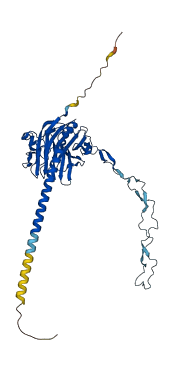
Descriptions
The autoinhibited protein was predicted that may have potential autoinhibitory elements via cis-regPred.
Autoinhibitory domains (AIDs)
Target domain |
|
Relief mechanism |
|
Assay |
cis-regPred |
Accessory elements
No accessory elements
Autoinhibited structure

Activated structure
1 structures for Q8K3H7
| Entry ID | Method | Resolution | Chain | Position | Source |
|---|---|---|---|---|---|
| AF-Q8K3H7-F1 | Predicted | AlphaFoldDB |
No variants for Q8K3H7
| Variant ID(s) | Position | Change | Description | Diseaes Association | Provenance |
|---|---|---|---|---|---|
| No variants for Q8K3H7 | |||||
No associated diseases with Q8K3H7
3 regional properties for Q8K3H7
| Type | Name | Position | InterPro Accession |
|---|---|---|---|
| conserved_site | Calreticulin/calnexin, conserved site | 98 - 113 | IPR018124-1 |
| conserved_site | Calreticulin/calnexin, conserved site | 130 - 138 | IPR018124-2 |
| conserved_site | Calreticulin/calnexin, conserved site | 242 - 254 | IPR018124-3 |
Functions
7 GO annotations of cellular component
| Name | Definition |
|---|---|
| cell surface | The external part of the cell wall and/or plasma membrane. |
| cortical granule | A secretory vesicle that is stored under the cell membrane of an egg. These vesicles fuse with the egg plasma membrane as part of egg activation and are part of the block to polyspermy. |
| cytolytic granule | A specialized secretory lysosome that is present in cells with cytolytic capability such as cytotoxic T lymphocytes and natural killer cells. Cytolytic granules mediate the storage and regulated excretion of lytic molecules for killing of target cells. |
| cytosol | The part of the cytoplasm that does not contain organelles but which does contain other particulate matter, such as protein complexes. |
| extracellular region | The space external to the outermost structure of a cell. For cells without external protective or external encapsulating structures this refers to space outside of the plasma membrane. This term covers the host cell environment outside an intracellular parasite. |
| midbody | A thin cytoplasmic bridge formed between daughter cells at the end of cytokinesis. The midbody forms where the contractile ring constricts, and may persist for some time before finally breaking to complete cytokinesis. |
| sarcoplasmic reticulum lumen | The volume enclosed by the membranes of the sarcoplasmic reticulum. |
3 GO annotations of molecular function
| Name | Definition |
|---|---|
| calcium ion binding | Binding to a calcium ion (Ca2+). |
| carbohydrate binding | Binding to a carbohydrate, which includes monosaccharides, oligosaccharides and polysaccharides as well as substances derived from monosaccharides by reduction of the carbonyl group (alditols), by oxidation of one or more hydroxy groups to afford the corresponding aldehydes, ketones, or carboxylic acids, or by replacement of one or more hydroxy group(s) by a hydrogen atom. Cyclitols are generally not regarded as carbohydrates. |
| unfolded protein binding | Binding to an unfolded protein. |
2 GO annotations of biological process
| Name | Definition |
|---|---|
| protein folding | The process of assisting in the covalent and noncovalent assembly of single chain polypeptides or multisubunit complexes into the correct tertiary structure. |
| protein stabilization | Any process involved in maintaining the structure and integrity of a protein and preventing it from degradation or aggregation. |
No homologous proteins in AiPD
| UniProt AC | Gene Name | Protein Name | Species | Evidence Code |
|---|---|---|---|---|
| No homologous proteins | ||||
| 10 | 20 | 30 | 40 | 50 | 60 |
| MLLSVPLLLG | LLGLAAAEPA | VYFKEQFLDG | DDWTNRWVES | KHKSDFGKFV | LSSGKFYGDQ |
| 70 | 80 | 90 | 100 | 110 | 120 |
| EKDKGLQTSQ | DARFYALSAR | FEPFSNKGQT | LVVQFTVKHE | QNIDCGGGYV | KLFPGSLDQK |
| 130 | 140 | 150 | 160 | 170 | 180 |
| DMHGDSEYNI | MFGPDICGPG | TKKVHVIFNY | KGKNVLINKD | IRCKDDEFTH | LYTLIVRPDN |
| 190 | 200 | 210 | 220 | 230 | 240 |
| TYEVKIDNSQ | VESGSLEDDW | DFLPPKKIKD | PDAAKPEDWD | ERAKIDDPTD | SKPEDWDKPE |
| 250 | 260 | 270 | 280 | 290 | 300 |
| HIPDPDAKKP | EDWDEEMDGE | WEPPVIQNPE | YKGEWKPRQI | DNPDYKGTWI | HPEIDNPEYS |
| 310 | 320 | 330 | 340 | 350 | 360 |
| PDANIYAYDS | FAVLGLDLWQ | VKSGTIFDNF | LITNDEAYAE | EFGNETWGVT | KASEKQMKDK |
| 370 | 380 | 390 | 400 | 410 | |
| QDEEQRLKEE | EEDKKRKEEE | EAEDKEDEDD | RDEDEEDEDE | KEEDEEDTTP | GQTKDEL |