Q8K2Y9
Gene name |
Ccm2 (Osm) |
Protein name |
Cerebral cavernous malformations protein 2 homolog |
Names |
Malcavernin, Osmosensing scaffold for MEKK3 |
Species |
Mus musculus (Mouse) |
KEGG Pathway |
mmu:216527 |
EC number |
|
Protein Class |
|
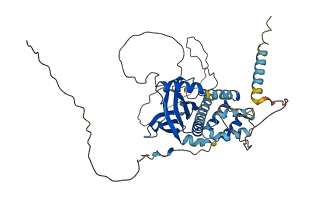
Descriptions
The autoinhibited protein was predicted that may have potential autoinhibitory elements via cis-regPred.
Autoinhibitory domains (AIDs)
Target domain |
|
Relief mechanism |
|
Assay |
cis-regPred |
Accessory elements
No accessory elements
Autoinhibited structure

Activated structure
1 structures for Q8K2Y9
| Entry ID | Method | Resolution | Chain | Position | Source |
|---|---|---|---|---|---|
| AF-Q8K2Y9-F1 | Predicted | AlphaFoldDB |
21 variants for Q8K2Y9
| Variant ID(s) | Position | Change | Description | Diseaes Association | Provenance |
|---|---|---|---|---|---|
| rs3389153209 | 39 | R>G | No | EVA | |
| rs3389140860 | 44 | T>I | No | EVA | |
| rs3401914242 | 77 | P>S | No | EVA | |
| rs3402072967 | 78 | G>V | No | EVA | |
| rs3389130582 | 99 | H>P | No | EVA | |
| rs3389136047 | 119 | N>I | No | EVA | |
| rs3389114331 | 153 | V>A | No | EVA | |
| rs3389141513 | 164 | S>Y | No | EVA | |
| rs3389140865 | 170 | C>Y | No | EVA | |
| rs3389151630 | 171 | A>V | No | EVA | |
| rs3389143525 | 188 | G>R | No | EVA | |
| rs3389130526 | 202 | S>I | No | EVA | |
| rs3389151634 | 235 | D>E | No | EVA | |
| rs3389114375 | 242 | H>Y | No | EVA | |
| rs3401962562 | 255 | V>E | No | EVA | |
| rs3389130544 | 277 | G>A | No | EVA | |
| rs3389138426 | 297 | E>K | No | EVA | |
| rs3389118533 | 315 | L>S | No | EVA | |
| rs3389118477 | 333 | E>D | No | EVA | |
| rs3389107223 | 388 | G>S | No | EVA | |
| rs3389107173 | 400 | A>P | No | EVA |
No associated diseases with Q8K2Y9
3 GO annotations of cellular component
| Name | Definition |
|---|---|
| cytoplasm | The contents of a cell excluding the plasma membrane and nucleus, but including other subcellular structures. |
| mitochondrion | A semiautonomous, self replicating organelle that occurs in varying numbers, shapes, and sizes in the cytoplasm of virtually all eukaryotic cells. It is notably the site of tissue respiration. |
| protein-containing complex | A stable assembly of two or more macromolecules, i.e. proteins, nucleic acids, carbohydrates or lipids, in which at least one component is a protein and the constituent parts function together. |
No GO annotations of molecular function
| Name | Definition |
|---|---|
| No GO annotations for molecular function |
15 GO annotations of biological process
| Name | Definition |
|---|---|
| blood vessel development | The process whose specific outcome is the progression of a blood vessel over time, from its formation to the mature structure. The blood vessel is the vasculature carrying blood. |
| blood vessel endothelial cell differentiation | The process in which a relatively unspecialized cell acquires specialized features of a blood vessel endothelial cell, a thin flattened cell that lines the inside surfaces of blood vessels. |
| cell-cell junction organization | A process that is carried out at the cellular level which results in the assembly, arrangement of constituent parts, or disassembly of a cell-cell junction. A cell-cell junction is a specialized region of connection between two cells. |
| endothelial cell development | The progression of an endothelial cell over time, from its formation to the mature structure. |
| endothelial tube morphogenesis | The process in which the anatomical structures of a tube are generated and organized from an endothelium. Endothelium refers to the layer of cells lining blood vessels, lymphatics, the heart, and serous cavities, and is derived from bone marrow or mesoderm. Corneal endothelium is a special case, derived from neural crest cells. |
| endothelium development | The process whose specific outcome is the progression of an endothelium over time, from its formation to the mature structure. Endothelium refers to the layer of cells lining blood vessels, lymphatics, the heart, and serous cavities, and is derived from bone marrow or mesoderm. Corneal endothelium is a special case, derived from neural crest cells. |
| heart development | The process whose specific outcome is the progression of the heart over time, from its formation to the mature structure. The heart is a hollow, muscular organ, which, by contracting rhythmically, keeps up the circulation of the blood. |
| in utero embryonic development | The process whose specific outcome is the progression of the embryo in the uterus over time, from formation of the zygote in the oviduct, to birth. An example of this process is found in Mus musculus. |
| inner ear development | The process whose specific outcome is the progression of the inner ear over time, from its formation to the mature structure. |
| multicellular organism growth | The increase in size or mass of an entire multicellular organism, as opposed to cell growth. |
| pericardium development | The process whose specific outcome is the progression of the pericardium over time, from its formation to the mature structure. The pericardium is a double-walled sac that contains the heart and the roots of the aorta, vena cava and the pulmonary artery. |
| regulation of angiogenesis | Any process that modulates the frequency, rate or extent of angiogenesis. |
| vasculature development | The process whose specific outcome is the progression of the vasculature over time, from its formation to the mature structure. The vasculature is an interconnected tubular multi-tissue structure that contains fluid that is actively transported around the organism. |
| vasculogenesis | The differentiation of endothelial cells from progenitor cells during blood vessel development, and the de novo formation of blood vessels and tubes. |
| venous blood vessel morphogenesis | The process in which the anatomical structures of venous blood vessels are generated and organized. Veins are blood vessels that transport blood from the body and its organs to the heart. |
No homologous proteins in AiPD
| UniProt AC | Gene Name | Protein Name | Species | Evidence Code |
|---|---|---|---|---|
| No homologous proteins | ||||
| 10 | 20 | 30 | 40 | 50 | 60 |
| MEEEGKKGKK | PGIVSPFKRV | FLKGEKSRDK | KAHEKVTERR | PLHTVVLALP | ERVEPDRLLS |
| 70 | 80 | 90 | 100 | 110 | 120 |
| DYIEKEVKYL | GQLTSIPGYL | NPSSRTEILH | FIDKAKRSHQ | LPGHLTQEHD | AVLSLSAYNV |
| 130 | 140 | 150 | 160 | 170 | 180 |
| KLAWRDGEDI | ILRVPIHDIA | AVSYVRDDAA | HLVVLKTAQD | PGISPSQSLC | AESSRGLSAG |
| 190 | 200 | 210 | 220 | 230 | 240 |
| SLSESAVGPV | EACCLVIMAT | ESKVAAEELC | SLLSQVFQIV | YTESTIDFLD | RAIFDGASTP |
| 250 | 260 | 270 | 280 | 290 | 300 |
| THHLSLHSDD | SSTKVDMKDS | YDADASTFCF | PDSGDVGGLP | PLPFCMQTSP | HSKTVSESEL |
| 310 | 320 | 330 | 340 | 350 | 360 |
| STSATELLQD | YMLTLRTKLS | SQEIQQFAAL | LHEYRNGASI | HEFCISLRQL | YGDSRKFLLL |
| 370 | 380 | 390 | 400 | 410 | 420 |
| GLRPFIPEKD | SQHFENFLET | IGVKDGRGII | TDSFGRHRRA | LSTTSTSTIN | GNRTTGSPDD |
| 430 | 440 | 450 | |||
| RSAPSEGDEW | DRMISDISSD | IEALGCSMDQ | DSA |