Q8K2B0
Gene name |
P3h4 |
Protein name |
Endoplasmic reticulum protein SC65 |
Names |
Leprecan-like protein 4, Prolyl 3-hydroxylase family member 4, Synaptonemal complex protein SC65 |
Species |
Mus musculus (Mouse) |
KEGG Pathway |
mmu:66180 |
EC number |
|
Protein Class |
|
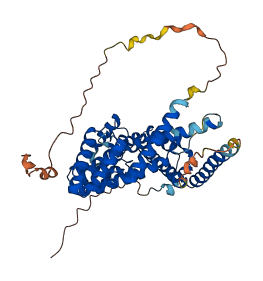
Descriptions
The autoinhibited protein was predicted that may have potential autoinhibitory elements via cis-regPred.
Autoinhibitory domains (AIDs)
Target domain |
|
Relief mechanism |
|
Assay |
cis-regPred |
Accessory elements
No accessory elements
Autoinhibited structure

Activated structure
1 structures for Q8K2B0
| Entry ID | Method | Resolution | Chain | Position | Source |
|---|---|---|---|---|---|
| AF-Q8K2B0-F1 | Predicted | AlphaFoldDB |
18 variants for Q8K2B0
| Variant ID(s) | Position | Change | Description | Diseaes Association | Provenance |
|---|---|---|---|---|---|
| rs3389212578 | 33 | L>M | No | EVA | |
| rs3389200706 | 50 | E>K | No | EVA | |
| rs3389203325 | 58 | Y>N | No | EVA | |
| rs255696810 | 91 | A>T | No | EVA | |
| rs27072799 | 96 | G>S | No | EVA | |
| rs3389215191 | 102 | G>D | No | EVA | |
| rs3389189528 | 128 | T>K | No | EVA | |
| rs236640276 | 189 | N>S | No | EVA | |
| rs3389189455 | 211 | E>* | No | EVA | |
| rs27072803 | 246 | R>W | No | EVA | |
| rs235880336 | 280 | D>E | No | EVA | |
| rs3402691276 | 280 | D>G | No | EVA | |
| rs3389197977 | 294 | V>M | No | EVA | |
| rs3389204222 | 296 | K>N | No | EVA | |
| rs3389215172 | 314 | D>G | No | EVA | |
| rs3389163829 | 390 | E>* | No | EVA | |
| rs3389163845 | 402 | E>K | No | EVA | |
| rs3389200728 | 443 | T>R | No | EVA |
No associated diseases with Q8K2B0
No regional properties for Q8K2B0
| Type | Name | Position | InterPro Accession |
|---|---|---|---|
| No domain, repeats, and functional sites for Q8K2B0 | |||
4 GO annotations of cellular component
| Name | Definition |
|---|---|
| catalytic complex | A protein complex which is capable of catalytic activity. |
| endoplasmic reticulum | The irregular network of unit membranes, visible only by electron microscopy, that occurs in the cytoplasm of many eukaryotic cells. The membranes form a complex meshwork of tubular channels, which are often expanded into slitlike cavities called cisternae. The ER takes two forms, rough (or granular), with ribosomes adhering to the outer surface, and smooth (with no ribosomes attached). |
| intracellular membrane-bounded organelle | Organized structure of distinctive morphology and function, bounded by a single or double lipid bilayer membrane and occurring within the cell. Includes the nucleus, mitochondria, plastids, vacuoles, and vesicles. Excludes the plasma membrane. |
| synaptonemal complex | A proteinaceous scaffold found between homologous chromosomes during meiosis. It consists of 2 lateral elements and a central element, all running parallel to each other. Transverse filaments connect the lateral elements to the central element. |
No GO annotations of molecular function
| Name | Definition |
|---|---|
| No GO annotations for molecular function |
4 GO annotations of biological process
| Name | Definition |
|---|---|
| bone remodeling | The continuous turnover of bone matrix and mineral that involves first, an increase in resorption (osteoclastic activity) and later, reactive bone formation (osteoblastic activity). The process of bone remodeling takes place in the adult skeleton at discrete foci. The process ensures the mechanical integrity of the skeleton throughout life and plays an important role in calcium homeostasis. An imbalance in the regulation of bone resorption and bone formation results in many of the metabolic bone diseases, such as osteoporosis. |
| collagen biosynthetic process | The chemical reactions and pathways resulting in the formation of collagen, any of a group of fibrous proteins of very high tensile strength that form the main component of connective tissue in animals. Collagen is highly enriched in glycine (some regions are 33% glycine) and proline, occurring predominantly as 3-hydroxyproline (about 20%). |
| collagen fibril organization | Any process that determines the size and arrangement of collagen fibrils within an extracellular matrix. |
| peptidyl-lysine hydroxylation | The hydroxylation of peptidyl-lysine to form peptidyl-hydroxylysine. |
| 10 | 20 | 30 | 40 | 50 | 60 |
| MARGAWGLLW | LLLGSAGAQY | EKYSFRGFPP | EDLMPLATAY | GHALEQYEGE | SWRESARYLE |
| 70 | 80 | 90 | 100 | 110 | 120 |
| AALRLHRLLR | DSEAFCHANC | SGPATSQPRP | ASGPDGDHDG | DGEDWARELR | LFGHVLERAA |
| 130 | 140 | 150 | 160 | 170 | 180 |
| CLRRCKKTLP | AFQVPYPPRQ | LLRDFQSRLP | YQYLHYAHFK | ANRLEKAVAA | AYTFLQRNPK |
| 190 | 200 | 210 | 220 | 230 | 240 |
| HELTAKYLNY | YRGMLDIGDE | SLTDLEAQPY | EAVFLRAVKL | YNSGDFRSST | EDMERALAEY |
| 250 | 260 | 270 | 280 | 290 | 300 |
| MTVFARCLAG | CEGAHEQVDF | KDFYPAIADL | FAESLQCKVD | CETNLTPNVG | GFFVDKFVAT |
| 310 | 320 | 330 | 340 | 350 | 360 |
| MYHYLQFAYY | KLNDVRQAAR | SAASYMLFDP | KDSVMQQNLV | YYRFHRARWG | LEDEDFQPRE |
| 370 | 380 | 390 | 400 | 410 | 420 |
| EAMLYHNQTS | ELRELLDFTH | MYLQSDDEME | LEETESLPEP | EEPLSDAEFE | GEGDYEEGLY |
| 430 | 440 | ||||
| ADWWQEPEAK | GDEAEAEPEP | ELT |