Q8K1S1
Gene name |
Lgi4 (Lgil3) |
Protein name |
Leucine-rich repeat LGI family member 4 |
Names |
LGI1-like protein 3, Leucine-rich glioma-inactivated protein 4 |
Species |
Mus musculus (Mouse) |
KEGG Pathway |
mmu:243914 |
EC number |
|
Protein Class |
|
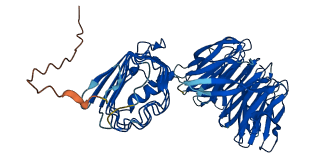
Descriptions
The autoinhibited protein was predicted that may have potential autoinhibitory elements via cis-regPred.
Autoinhibitory domains (AIDs)
Target domain |
|
Relief mechanism |
|
Assay |
cis-regPred |
Accessory elements
No accessory elements
Autoinhibited structure

Activated structure
1 structures for Q8K1S1
| Entry ID | Method | Resolution | Chain | Position | Source |
|---|---|---|---|---|---|
| AF-Q8K1S1-F1 | Predicted | AlphaFoldDB |
30 variants for Q8K1S1
| Variant ID(s) | Position | Change | Description | Diseaes Association | Provenance |
|---|---|---|---|---|---|
| rs230850557 | 30 | H>R | No | EVA | |
| rs3388904578 | 32 | S>P | No | EVA | |
| rs3388893276 | 110 | N>K | No | EVA | |
| rs3388893234 | 160 | F>I | No | EVA | |
| rs3388902731 | 163 | D>V | No | EVA | |
| rs3388879080 | 174 | P>S | No | EVA | |
| rs3388896094 | 187 | G>R | No | EVA | |
| rs3388879111 | 188 | P>S | No | EVA | |
| rs3388891420 | 196 | L>Q | No | EVA | |
| rs32208677 | 208 | A>T | No | EVA | |
| rs255224041 | 244 | R>L | No | EVA | |
| rs3388882499 | 250 | W>* | No | EVA | |
| rs3388897353 | 255 | Q>E | No | EVA | |
| rs3388891329 | 256 | R>S | No | EVA | |
| rs3388896096 | 307 | Q>H | No | EVA | |
| rs3388858506 | 311 | P>S | No | EVA | |
| rs47279719 | 320 | A>V | No | EVA | |
| rs3388858456 | 343 | T>K | No | EVA | |
| rs31650947 | 350 | P>L | No | EVA | |
| rs3388858490 | 357 | S>I | No | EVA | |
| rs3388900079 | 359 | H>Q | No | EVA | |
| rs3388879069 | 377 | H>Y | No | EVA | |
| rs3388891471 | 379 | L>P | No | EVA | |
| rs3388882483 | 392 | W>C | No | EVA | |
| rs3388896049 | 395 | G>S | No | EVA | |
| rs3388904614 | 444 | L>V | No | EVA | |
| rs3388899522 | 455 | V>D | No | EVA | |
| rs3388858504 | 480 | R>H | No | EVA | |
| rs31573735 | 531 | H>Y | No | EVA | |
| rs264798503 | 532 | E>K | No | EVA |
1 associated diseases with Q8K1S1
Without disease ID
13 regional properties for Q8K1S1
| Type | Name | Position | InterPro Accession |
|---|---|---|---|
| domain | Cysteine-rich flanking region, C-terminal | 158 - 207 | IPR000483 |
| repeat | Leucine-rich repeat | 101 - 159 | IPR001611 |
| repeat | Leucine-rich repeat, typical subtype | 75 - 98 | IPR003591-1 |
| repeat | Leucine-rich repeat, typical subtype | 99 - 122 | IPR003591-2 |
| repeat | Leucine-rich repeat, typical subtype | 123 - 146 | IPR003591-3 |
| repeat | Leucine-rich glioma-inactivated, EPTP repeat | 396 - 438 | IPR005492 |
| repeat | EAR | 210 - 252 | IPR009039-1 |
| repeat | EAR | 256 - 298 | IPR009039-2 |
| repeat | EAR | 302 - 349 | IPR009039-3 |
| repeat | EAR | 351 - 394 | IPR009039-4 |
| repeat | EAR | 396 - 439 | IPR009039-5 |
| repeat | EAR | 441 - 483 | IPR009039-6 |
| repeat | EAR | 487 - 532 | IPR009039-7 |
1 GO annotations of cellular component
| Name | Definition |
|---|---|
| extracellular space | That part of a multicellular organism outside the cells proper, usually taken to be outside the plasma membranes, and occupied by fluid. |
No GO annotations of molecular function
| Name | Definition |
|---|---|
| No GO annotations for molecular function |
9 GO annotations of biological process
| Name | Definition |
|---|---|
| adult locomotory behavior | Locomotory behavior in a fully developed and mature organism. |
| glial cell development | The process aimed at the progression of a glial cell over time, from initial commitment of the cell to a specific fate, to the fully functional differentiated cell. |
| glial cell proliferation | The multiplication or reproduction of glial cells by cell division, resulting in the expansion of their population. Glial cells exist throughout the nervous system, and include Schwann cells, astrocytes, and oligodendrocytes among others. |
| gliogenesis | The process that results in the generation of glial cells. This includes the production of glial progenitors and their differentiation into mature glia. |
| myelination | The process in which myelin sheaths are formed and maintained around neurons. Oligodendrocytes in the brain and spinal cord and Schwann cells in the peripheral nervous system wrap axons with compact layers of their plasma membrane. Adjacent myelin segments are separated by a non-myelinated stretch of axon called a node of Ranvier. |
| myelination in peripheral nervous system | The process in which neuronal axons and dendrites become coated with a segmented lipid-rich sheath (myelin) to enable faster and more energetically efficient conduction of electrical impulses. The sheath is formed by the cell membranes of Schwann cells in the peripheral nervous system. Adjacent myelin segments are separated by a non-myelinated stretch of axon called a node of Ranvier. |
| neuron maturation | A developmental process, independent of morphogenetic (shape) change, that is required for a neuron to attain its fully functional state. |
| regulation of myelination | Any process that modulates the frequency, rate or extent of the formation of a myelin sheath around nerve axons. |
| Schwann cell development | The process aimed at the progression of a Schwann cell over time, from initial commitment of the cell to a specific fate, to the fully functional differentiated cell. Schwann cells are found in the peripheral nervous system, where they insulate neurons and axons, and regulate the environment in which neurons function. |
No homologous proteins in AiPD
| UniProt AC | Gene Name | Protein Name | Species | Evidence Code |
|---|---|---|---|---|
| No homologous proteins | ||||
| 10 | 20 | 30 | 40 | 50 | 60 |
| MGGAGILLFL | LAWAGAGVAW | SPPKGKCPPH | CSCSKENTLC | EGSPELPESF | STTLLSLSLV |
| 70 | 80 | 90 | 100 | 110 | 120 |
| RMGVSRLKAG | SFLKMPSLHL | LLFTSNTFSV | IEGDAFIGLS | YLQYLFIEDN | KIGSISKNAL |
| 130 | 140 | 150 | 160 | 170 | 180 |
| RGLRSLTHLS | LANNHLEALP | RFLFRGLETL | THVDLRGNPF | QCDCRVLWLL | QWMPTVNASV |
| 190 | 200 | 210 | 220 | 230 | 240 |
| GTGACAGPPA | VAQIQLNHLD | PKKFKCRATE | LSWLQTVGES | ALSVESFSYQ | GEPHMVLAQP |
| 250 | 260 | 270 | 280 | 290 | 300 |
| FAGRCLILVW | DYSLQRFRPE | EELSAPSVVS | CKPLVLGPRL | FILAARLWGG | SQLWSRSSPD |
| 310 | 320 | 330 | 340 | 350 | 360 |
| LRLTPVQVLA | PQRLLRPNDA | ELLWLDGQPC | FVVADASKAG | STTLLCRDGP | GFYPRQSLHA |
| 370 | 380 | 390 | 400 | 410 | 420 |
| WHRDTDAEAL | ELDGRPHLLL | ASASQRPVLF | HWVGGRFERR | TDIPEAEDVY | ATKHFQAGGD |
| 430 | 440 | 450 | 460 | 470 | 480 |
| VFLCLTRYIG | DSMVMRWDGS | MFRLLQQLPS | RGSHVFQPLL | IARDQLAILG | SDFAFSQVFR |
| 490 | 500 | 510 | 520 | 530 | |
| FESDKGILEP | LQELGPPALV | APRAFAQVTV | AGRRFLFAAC | FKGPTQIYQH | HELDLSA |