Q8K0Y7
Gene name |
Paxx |
Protein name |
Protein PAXX |
Names |
Paralog of XRCC4 and XLF |
Species |
Mus musculus (Mouse) |
KEGG Pathway |
mmu:227622 |
EC number |
|
Protein Class |
|
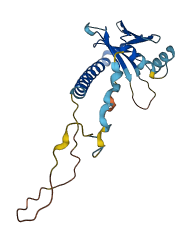
Descriptions
The autoinhibited protein was predicted that may have potential autoinhibitory elements via cis-regPred.
Autoinhibitory domains (AIDs)
Target domain |
|
Relief mechanism |
|
Assay |
cis-regPred |
Accessory elements
No accessory elements
Autoinhibited structure

Activated structure
1 structures for Q8K0Y7
| Entry ID | Method | Resolution | Chain | Position | Source |
|---|---|---|---|---|---|
| AF-Q8K0Y7-F1 | Predicted | AlphaFoldDB |
15 variants for Q8K0Y7
| Variant ID(s) | Position | Change | Description | Diseaes Association | Provenance |
|---|---|---|---|---|---|
| rs28212008 | 3 | P>T | No | EVA | |
| rs3388538054 | 19 | S>F | No | EVA | |
| rs28212009 | 29 | D>E | No | EVA | |
| rs28212010 | 37 | D>N | No | EVA | |
| rs3388534647 | 48 | E>* | No | EVA | |
| rs28212012 | 61 | R>T | No | EVA | |
| rs3388531416 | 92 | Q>L | No | EVA | |
| rs3388531632 | 99 | T>S | No | EVA | |
| rs249857733 | 102 | G>E | No | EVA | |
| rs3388533514 | 120 | A>S | No | EVA | |
| rs28212016 | 136 | N>S | No | EVA | |
| rs3388533461 | 151 | P>L | No | EVA | |
| rs3388537239 | 155 | T>I | No | EVA | |
| rs3388535764 | 167 | D>E | No | EVA | |
| rs3388538041 | 184 | E>K | No | EVA |
No associated diseases with Q8K0Y7
No regional properties for Q8K0Y7
| Type | Name | Position | InterPro Accession |
|---|---|---|---|
| No domain, repeats, and functional sites for Q8K0Y7 | |||
5 GO annotations of cellular component
| Name | Definition |
|---|---|
| Ku70:Ku80 complex | Heterodimeric protein complex composed of a 70 kDa and a 80 kDa subunit, binds DNA through a channel formed by the heterodimer. Functions in DNA double stranded break repair, chromosome maintenance, transcription regulation, V(D)J recombination, and activation of DNA-PK. |
| nonhomologous end joining complex | A protein complex that plays a role in DNA double-strand break repair via nonhomologous end joining. Such complexes typically contain a specialized DNA ligase (e.g. Lig4 in eukaryotes) and one or more proteins that bind to DNA ends. |
| nucleoplasm | That part of the nuclear content other than the chromosomes or the nucleolus. |
| nucleus | A membrane-bounded organelle of eukaryotic cells in which chromosomes are housed and replicated. In most cells, the nucleus contains all of the cell's chromosomes except the organellar chromosomes, and is the site of RNA synthesis and processing. In some species, or in specialized cell types, RNA metabolism or DNA replication may be absent. |
| site of double-strand break | A region of a chromosome at which a DNA double-strand break has occurred. DNA damage signaling and repair proteins accumulate at the lesion to respond to the damage and repair the DNA to form a continuous DNA helix. |
4 GO annotations of molecular function
| Name | Definition |
|---|---|
| DNA polymerase binding | Binding to a DNA polymerase. |
| identical protein binding | Binding to an identical protein or proteins. |
| molecular adaptor activity | The binding activity of a molecule that brings together two or more molecules through a selective, non-covalent, often stoichiometric interaction, permitting those molecules to function in a coordinated way. |
| protein homodimerization activity | Binding to an identical protein to form a homodimer. |
2 GO annotations of biological process
| Name | Definition |
|---|---|
| cellular response to DNA damage stimulus | Any process that results in a change in state or activity of a cell (in terms of movement, secretion, enzyme production, gene expression, etc.) as a result of a stimulus indicating damage to its DNA from environmental insults or errors during metabolism. |
| double-strand break repair via nonhomologous end joining | The repair of a double-strand break in DNA in which the two broken ends are rejoined with little or no sequence complementarity. Information at the DNA ends may be lost due to the modification of broken DNA ends. This term covers instances of separate pathways, called classical (or canonical) and alternative nonhomologous end joining (C-NHEJ and A-NHEJ). These in turn may further branch into sub-pathways, but evidence is still unclear. |
No homologous proteins in AiPD
| UniProt AC | Gene Name | Protein Name | Species | Evidence Code |
|---|---|---|---|---|
| No homologous proteins | ||||
| 10 | 20 | 30 | 40 | 50 | 60 |
| MAPPLLSLPL | CILPPGSGSP | RLVCYCERDS | GGDGDRDDFN | LYVTDAAELW | STCFSPDSLA |
| 70 | 80 | 90 | 100 | 110 | 120 |
| RLKARFGLSG | AEDIHSRFRA | ACQQQAVTVS | LQEDRALITL | SGDTPALAFD | LSKVPSPEAA |
| 130 | 140 | 150 | 160 | 170 | 180 |
| PRLQALTLSL | AEHVCNLERR | LAAAEETITS | PKKNTQPAGT | QFLPELDHQR | GSSGPGVRRR |
| 190 | 200 | ||||
| CPGESLINPG | FKSKKPAAGV | DFDET |