Q8JZX9
Gene name |
Cdc42ep2 (Borg1, Cep2) |
Protein name |
Cdc42 effector protein 2 |
Names |
Binder of Rho GTPases 1 |
Species |
Mus musculus (Mouse) |
KEGG Pathway |
mmu:104252 |
EC number |
|
Protein Class |
|
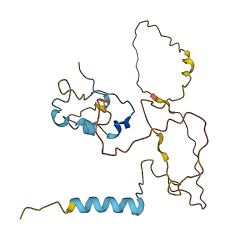
Descriptions
The autoinhibited protein was predicted that may have potential autoinhibitory elements via cis-regPred.
Autoinhibitory domains (AIDs)
Target domain |
|
Relief mechanism |
|
Assay |
cis-regPred |
Accessory elements
No accessory elements
Autoinhibited structure

Activated structure
1 structures for Q8JZX9
| Entry ID | Method | Resolution | Chain | Position | Source |
|---|---|---|---|---|---|
| AF-Q8JZX9-F1 | Predicted | AlphaFoldDB |
11 variants for Q8JZX9
| Variant ID(s) | Position | Change | Description | Diseaes Association | Provenance |
|---|---|---|---|---|---|
| rs3389518897 | 31 | S>I | No | EVA | |
| rs3389486623 | 59 | Q>* | No | EVA | |
| rs3389519924 | 64 | L>F | No | EVA | |
| rs3389512915 | 84 | Q>* | No | EVA | |
| rs3389511996 | 92 | C>Y | No | EVA | |
| rs3389511975 | 121 | L>M | No | EVA | |
| rs3389529066 | 135 | L>F | No | EVA | |
| rs3407824832 | 143 | Q>H | No | EVA | |
| rs3389512006 | 161 | G>D | No | EVA | |
| rs217693899 | 172 | E>D | No | EVA | |
| rs37244441 | 205 | H>Q | No | EVA |
No associated diseases with Q8JZX9
1 regional properties for Q8JZX9
| Type | Name | Position | InterPro Accession |
|---|---|---|---|
| domain | CRIB domain | 29 - 85 | IPR000095 |
8 GO annotations of cellular component
| Name | Definition |
|---|---|
| cytoplasm | The contents of a cell excluding the plasma membrane and nucleus, but including other subcellular structures. |
| cytoskeleton | A cellular structure that forms the internal framework of eukaryotic and prokaryotic cells. The cytoskeleton includes intermediate filaments, microfilaments, microtubules, the microtrabecular lattice, and other structures characterized by a polymeric filamentous nature and long-range order within the cell. The various elements of the cytoskeleton not only serve in the maintenance of cellular shape but also have roles in other cellular functions, including cellular movement, cell division, endocytosis, and movement of organelles. |
| cytosol | The part of the cytoplasm that does not contain organelles but which does contain other particulate matter, such as protein complexes. |
| endomembrane system | A collection of membranous structures involved in transport within the cell. The main components of the endomembrane system are endoplasmic reticulum, Golgi bodies, vesicles, cell membrane and nuclear envelope. Members of the endomembrane system pass materials through each other or though the use of vesicles. |
| membrane | A lipid bilayer along with all the proteins and protein complexes embedded in it an attached to it. |
| microtubule cytoskeleton | The part of the cytoskeleton (the internal framework of a cell) composed of microtubules and associated proteins. |
| phagocytic vesicle | A membrane-bounded intracellular vesicle that arises from the ingestion of particulate material by phagocytosis. |
| plasma membrane | The membrane surrounding a cell that separates the cell from its external environment. It consists of a phospholipid bilayer and associated proteins. |
3 GO annotations of molecular function
| Name | Definition |
|---|---|
| GTPase activator activity | Binds to and increases the activity of a GTPase, an enzyme that catalyzes the hydrolysis of GTP. |
| opioid peptide activity | Naturally occurring peptide that is an opioid (any non-alkaloid having an opiate-like effect that can be reversed by naloxone or other recognized morphine antagonist). These include Leu- and Met-enkephalin, dynorphin and neoendorphin, alpha, beta, gamma and delta endorphins formed from beta-lipotropin, various pronase-resistant peptides such as beta casamorphin, and other peptides whose opiate-like action seems to be indirect. |
| small GTPase binding | Binding to a small monomeric GTPase. |
6 GO annotations of biological process
| Name | Definition |
|---|---|
| actin cytoskeleton organization | A process that is carried out at the cellular level which results in the assembly, arrangement of constituent parts, or disassembly of cytoskeletal structures comprising actin filaments and their associated proteins. |
| cellular response to interferon-gamma | Any process that results in a change in state or activity of a cell (in terms of movement, secretion, enzyme production, gene expression, etc.) as a result of an interferon-gamma stimulus. Interferon gamma is the only member of the type II interferon found so far. |
| positive regulation of actin filament polymerization | Any process that activates or increases the frequency, rate or extent of actin polymerization. |
| positive regulation of pseudopodium assembly | Any process that activates or increases the frequency, rate or extent of the assembly of pseudopodia. |
| regulation of cell shape | Any process that modulates the surface configuration of a cell. |
| Rho protein signal transduction | The series of molecular signals within the cell that are mediated by a member of the Rho family of proteins switching to a GTP-bound active state. |
No homologous proteins in AiPD
| UniProt AC | Gene Name | Protein Name | Species | Evidence Code |
|---|---|---|---|---|
| No homologous proteins | ||||
| 10 | 20 | 30 | 40 | 50 | 60 |
| MSTKVPIYLK | RGSRKGKKEK | LRDLLSSDMI | SPPLGDFRHT | IHIGSGGGDD | MFGDISFLQG |
| 70 | 80 | 90 | 100 | 110 | 120 |
| KFHLLPGTAV | EEAEEDGSFD | LPFQFTRTTT | VCGRELPDGL | SPLLKNAISL | PVIGGPQALT |
| 130 | 140 | 150 | 160 | 170 | 180 |
| LPTAQAPPKP | PRLHLESPQP | SPQPSPQGAG | NVDVWRIPEA | GSPHNGMSPE | PEAEEPFLSH |
| 190 | 200 | 210 | |||
| ASSLLSLHVD | LGPSILDDVL | QIMDHDLGRV | QIPT |