Q8HXX0
Gene name |
PAFAH1B1 |
Protein name |
Platelet-activating factor acetylhydrolase IB subunit alpha |
Names |
Lissencephaly-1 protein, LIS-1, PAF acetylhydrolase 45 kDa subunit, PAF-AH 45 kDa subunit, PAF-AH alpha, PAFAH alpha |
Species |
Macaca fascicularis (Crab-eating macaque) (Cynomolgus monkey) |
KEGG Pathway |
mcf:101866353 |
EC number |
|
Protein Class |
|
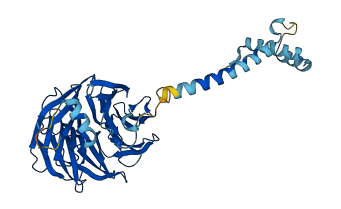
Descriptions
The autoinhibited protein was predicted that may have potential autoinhibitory elements via cis-regPred.
Autoinhibitory domains (AIDs)
Target domain |
|
Relief mechanism |
|
Assay |
cis-regPred |
Accessory elements
No accessory elements
Autoinhibited structure

Activated structure
1 structures for Q8HXX0
| Entry ID | Method | Resolution | Chain | Position | Source |
|---|---|---|---|---|---|
| AF-Q8HXX0-F1 | Predicted | AlphaFoldDB |
No variants for Q8HXX0
| Variant ID(s) | Position | Change | Description | Diseaes Association | Provenance |
|---|---|---|---|---|---|
| No variants for Q8HXX0 | |||||
No associated diseases with Q8HXX0
9 regional properties for Q8HXX0
| Type | Name | Position | InterPro Accession |
|---|---|---|---|
| repeat | WD40 repeat | 97 - 410 | IPR001680 |
| domain | LIS1 homology motif | 7 - 39 | IPR006594 |
| conserved_site | WD40 repeat, conserved site | 165 - 179 | IPR019775-1 |
| conserved_site | WD40 repeat, conserved site | 207 - 221 | IPR019775-2 |
| conserved_site | WD40 repeat, conserved site | 311 - 325 | IPR019775-3 |
| conserved_site | WD40 repeat, conserved site | 395 - 409 | IPR019775-4 |
| repeat | G-protein beta WD-40 repeat | 123 - 137 | IPR020472-1 |
| repeat | G-protein beta WD-40 repeat | 207 - 221 | IPR020472-2 |
| repeat | G-protein beta WD-40 repeat | 311 - 325 | IPR020472-3 |
Functions
7 GO annotations of cellular component
| Name | Definition |
|---|---|
| 1-alkyl-2-acetylglycerophosphocholine esterase complex | An enzyme complex composed of two catalytic alpha subunits, which form a catalytic dimer, and a non-catalytic, regulatory beta subunit; the catalytic dimer may be an alpha1/alpha1 or alpha2/alpha2 homodimer, or an alpha1/alpha2 heterodimer. Modulates the action of platelet-activating factor (PAF). |
| astral microtubule | Any of the spindle microtubules that radiate in all directions from the spindle poles and are thought to contribute to the forces that separate the poles and position them in relation to the rest of the cell. |
| cell cortex | The region of a cell that lies just beneath the plasma membrane and often, but not always, contains a network of actin filaments and associated proteins. |
| centrosome | A structure comprised of a core structure (in most organisms, a pair of centrioles) and peripheral material from which a microtubule-based structure, such as a spindle apparatus, is organized. Centrosomes occur close to the nucleus during interphase in many eukaryotic cells, though in animal cells it changes continually during the cell-division cycle. |
| kinetochore | A multisubunit complex that is located at the centromeric region of DNA and provides an attachment point for the spindle microtubules. |
| microtubule associated complex | Any multimeric complex connected to a microtubule. |
| nuclear membrane | Either of the lipid bilayers that surround the nucleus and form the nuclear envelope; excludes the intermembrane space. |
2 GO annotations of molecular function
| Name | Definition |
|---|---|
| dynein complex binding | Binding to a dynein complex, a protein complex that contains two or three dynein heavy chains and several light chains, and has microtubule motor activity. |
| protein heterodimerization activity | Binding to a nonidentical protein to form a heterodimer. |
12 GO annotations of biological process
| Name | Definition |
|---|---|
| adult locomotory behavior | Locomotory behavior in a fully developed and mature organism. |
| brain morphogenesis | The process in which the anatomical structures of the brain are generated and organized. The brain is one of the two components of the central nervous system and is the center of thought and emotion. It is responsible for the coordination and control of bodily activities and the interpretation of information from the senses (sight, hearing, smell, etc.). |
| cell division | The process resulting in division and partitioning of components of a cell to form more cells; may or may not be accompanied by the physical separation of a cell into distinct, individually membrane-bounded daughter cells. |
| cerebral cortex development | The progression of the cerebral cortex over time from its initial formation until its mature state. The cerebral cortex is the outer layered region of the telencephalon. |
| corpus callosum morphogenesis | The process in which the anatomical structures of the corpus callosum are generated and organized. The corpus callosum is a thick bundle of nerve fibers comprising a commissural plate connecting the two cerebral hemispheres. It consists of contralateral axon projections that provides communications between the right and left cerebral hemispheres. |
| establishment of mitotic spindle orientation | A cell cycle process that sets the alignment of mitotic spindle relative to other cellular structures. |
| lipid catabolic process | The chemical reactions and pathways resulting in the breakdown of lipids, compounds soluble in an organic solvent but not, or sparingly, in an aqueous solvent. |
| microtubule organizing center organization | A process that is carried out at the cellular level which results in the assembly, arrangement of constituent parts, or disassembly of a microtubule organizing center, a structure from which microtubules grow. |
| microtubule sliding | The movement of one microtubule along another microtubule. |
| neuromuscular process controlling balance | Any process that an organism uses to control its balance, the orientation of the organism (or the head of the organism) in relation to the source of gravity. In humans and animals, balance is perceived through visual cues, the labyrinth system of the inner ears and information from skin pressure receptors and muscle and joint receptors. |
| neuron migration | The characteristic movement of an immature neuron from germinal zones to specific positions where they will reside as they mature. |
| reelin-mediated signaling pathway | The series of molecular signals initiated by the binding of reelin (a secreted glycoprotein) to a receptor on the surface of a target cell, and ending with the regulation of a downstream cellular process, e.g. transcription. |
No homologous proteins in AiPD
| UniProt AC | Gene Name | Protein Name | Species | Evidence Code |
|---|---|---|---|---|
| No homologous proteins | ||||
| 10 | 20 | 30 | 40 | 50 | 60 |
| MVLSQRQRDE | LNRAIADYLR | SNGYEEAYSV | FKKEAELDMN | EELDKKYAGL | LEKKWTSVIR |
| 70 | 80 | 90 | 100 | 110 | 120 |
| LQKKVMELES | KLNEAKEEFT | SGGPLGQKRD | PKEWIPRPPE | KYALSGHRSP | VTRVIFHPVF |
| 130 | 140 | 150 | 160 | 170 | 180 |
| SVMVSASEDA | TIKVWDYETG | DFERTLKGHT | DSVQDISFDH | SGKLLTSCSA | DMTIKLWDFQ |
| 190 | 200 | 210 | 220 | 230 | 240 |
| GFECIRTMHG | HDHNVSSVAI | MPNGDHLVSA | SRDKTIKMWE | VQTGYCVKTF | TGHREWVRMV |
| 250 | 260 | 270 | 280 | 290 | 300 |
| RPNQDGTLIA | SCSNDQTVRV | WVVATKECKA | ELREHEHVVE | CISWAPESSY | SSISEATGSE |
| 310 | 320 | 330 | 340 | 350 | 360 |
| TKKSGKPGPF | LLSGSRDKTI | KMWDVSTGMC | LMTLVGHDNW | VRGVLFHSGG | KFILSCADDK |
| 370 | 380 | 390 | 400 | ||
| TLRVWDYKNK | RCMKTLNAHE | HFVTSLDFHK | TAPYVVTGSV | DQTVKVWECR |