Q8HDG8
Gene name |
RARRES2 (TIG2) |
Protein name |
Retinoic acid receptor responder protein 2 |
Names |
Chemerin, RAR-responsive protein TIG2, Tazarotene-induced gene 2 protein |
Species |
Cricetulus griseus (Chinese hamster) (Cricetulus barabensis griseus) |
KEGG Pathway |
cge:100689253 |
EC number |
|
Protein Class |
|
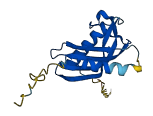
Descriptions
The autoinhibited protein was predicted that may have potential autoinhibitory elements via cis-regPred.
Autoinhibitory domains (AIDs)
Target domain |
|
Relief mechanism |
|
Assay |
cis-regPred |
Accessory elements
No accessory elements
Autoinhibited structure

Activated structure
1 structures for Q8HDG8
| Entry ID | Method | Resolution | Chain | Position | Source |
|---|---|---|---|---|---|
| AF-Q8HDG8-F1 | Predicted | AlphaFoldDB |
No variants for Q8HDG8
| Variant ID(s) | Position | Change | Description | Diseaes Association | Provenance |
|---|---|---|---|---|---|
| No variants for Q8HDG8 | |||||
No associated diseases with Q8HDG8
No regional properties for Q8HDG8
| Type | Name | Position | InterPro Accession |
|---|---|---|---|
| No domain, repeats, and functional sites for Q8HDG8 | |||
1 GO annotations of cellular component
| Name | Definition |
|---|---|
| extracellular region | The space external to the outermost structure of a cell. For cells without external protective or external encapsulating structures this refers to space outside of the plasma membrane. This term covers the host cell environment outside an intracellular parasite. |
1 GO annotations of molecular function
| Name | Definition |
|---|---|
| signaling receptor binding | Binding to one or more specific sites on a receptor molecule, a macromolecule that undergoes combination with a hormone, neurotransmitter, drug or intracellular messenger to initiate a change in cell function. |
8 GO annotations of biological process
| Name | Definition |
|---|---|
| cell differentiation | The process in which relatively unspecialized cells, e.g. embryonic or regenerative cells, acquire specialized structural and/or functional features that characterize the cells, tissues, or organs of the mature organism or some other relatively stable phase of the organism's life history. Differentiation includes the processes involved in commitment of a cell to a specific fate and its subsequent development to the mature state. |
| chemotaxis | The directed movement of a motile cell or organism, or the directed growth of a cell guided by a specific chemical concentration gradient. Movement may be towards a higher concentration (positive chemotaxis) or towards a lower concentration (negative chemotaxis). |
| inflammatory response | The immediate defensive reaction (by vertebrate tissue) to infection or injury caused by chemical or physical agents. The process is characterized by local vasodilation, extravasation of plasma into intercellular spaces and accumulation of white blood cells and macrophages. |
| positive regulation of chemotaxis | Any process that activates or increases the frequency, rate or extent of the directed movement of a motile cell or organism in response to a specific chemical concentration gradient. |
| positive regulation of fat cell differentiation | Any process that activates or increases the frequency, rate or extent of adipocyte differentiation. |
| positive regulation of protein phosphorylation | Any process that activates or increases the frequency, rate or extent of addition of phosphate groups to amino acids within a protein. |
| regulation of insulin receptor signaling pathway | Any process that modulates the frequency, rate or extent of insulin receptor signaling. |
| regulation of lipid catabolic process | Any process that modulates the frequency, rate, or extent of the chemical reactions and pathways resulting in the breakdown of lipids. |
No homologous proteins in AiPD
| UniProt AC | Gene Name | Protein Name | Species | Evidence Code |
|---|---|---|---|---|
| No homologous proteins | ||||
| 10 | 20 | 30 | 40 | 50 | 60 |
| MKYLLISLAL | WLGMVGIHGT | ELELSETQRR | GLQVALEEFH | KHPPVQWAFQ | EIGVDNANDM |
| 70 | 80 | 90 | 100 | 110 | 120 |
| VFSAGTFVRL | EFKLQQTSCF | KKDWKNPECK | IKANGRKRKC | LACIKLDPRG | KVLGRMVHCP |
| 130 | 140 | 150 | 160 | ||
| ILKQGLQQEL | QESQCNRITQ | AGEDPRSHFF | PGQFAFSRAL | KHK |