Q8GEA9
Gene name |
bgaA |
Protein name |
Beta-galactosidase BgaA |
Names |
Beta-gal |
Species |
Thermus sp |
KEGG Pathway |
|
EC number |
3.2.1.23: Glycosidases, ie enzymes hydrolyzing O- and S-glycosyl compounds |
Protein Class |
|
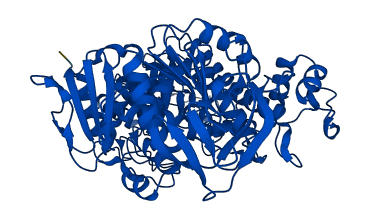
Descriptions
The autoinhibited protein was predicted that may have potential autoinhibitory elements via cis-regPred.
Autoinhibitory domains (AIDs)
Target domain |
|
Relief mechanism |
|
Assay |
cis-regPred |
Accessory elements
No accessory elements
Autoinhibited structure

Activated structure
1 structures for Q8GEA9
| Entry ID | Method | Resolution | Chain | Position | Source |
|---|---|---|---|---|---|
| AF-Q8GEA9-F1 | Predicted | AlphaFoldDB |
No variants for Q8GEA9
| Variant ID(s) | Position | Change | Description | Diseaes Association | Provenance |
|---|---|---|---|---|---|
| No variants for Q8GEA9 | |||||
No associated diseases with Q8GEA9
Functions
| Description | ||
|---|---|---|
| EC Number | 3.2.1.23 | Glycosidases, ie enzymes hydrolyzing O- and S-glycosyl compounds |
| Subcellular Localization |
|
|
| PANTHER Family | ||
| PANTHER Subfamily | ||
| PANTHER Protein Class | ||
| PANTHER Pathway Category | No pathway information available | |
1 GO annotations of cellular component
| Name | Definition |
|---|---|
| beta-galactosidase complex | A protein complex that possesses beta-galactosidase activity, i.e. catalyzes the hydrolysis of terminal non-reducing beta-D-galactose residues in beta-D-galactosides. In E. coli, the complex is a homotetramer; dimeric and hexameric beta-galactosidase complexes have been observed in other species. |
2 GO annotations of molecular function
| Name | Definition |
|---|---|
| beta-galactosidase activity | Catalysis of the hydrolysis of terminal, non-reducing beta-D-galactose residues in beta-D-galactosides. |
| metal ion binding | Binding to a metal ion. |
1 GO annotations of biological process
| Name | Definition |
|---|---|
| galactose metabolic process | The chemical reactions and pathways involving galactose, the aldohexose galacto-hexose. D-galactose is widely distributed in combined form in plants, animals and microorganisms as a constituent of oligo- and polysaccharides; it also occurs in galactolipids and as its glucoside in lactose and melibiose. |
No homologous proteins in AiPD
| UniProt AC | Gene Name | Protein Name | Species | Evidence Code |
|---|---|---|---|---|
| No homologous proteins | ||||
| 10 | 20 | 30 | 40 | 50 | 60 |
| MLGVCYYPEH | WPKARWKEDA | RRMREAGLSY | VRVGEFAWAL | LEPEPGRLEW | GWLDEALATL |
| 70 | 80 | 90 | 100 | 110 | 120 |
| AAEGLKVVLG | TPTATPPKWL | VDRYPEVLPV | DREGRRRRFG | GRRHYCFSSP | AYREEARRIV |
| 130 | 140 | 150 | 160 | 170 | 180 |
| TLLAERYGGL | EAVAGFQTDN | EYGCHGTVRC | YCPRCQEAFR | GWLKARYGTI | EALNEAWGTA |
| 190 | 200 | 210 | 220 | 230 | 240 |
| FWSQRYRNFT | EVELPHLTVA | EPNPSHLLDY | YRFASDQVRA | FNRLQVEILR | AHAPGKFITH |
| 250 | 260 | 270 | 280 | 290 | 300 |
| NFMGFFTDLD | AFALAQDLDF | ASWDSYPLGF | TDLMPLPPEE | KLRYARTGHP | DVAAFHHDLY |
| 310 | 320 | 330 | 340 | 350 | 360 |
| RGVGRGRFWV | MEQQPGPVNW | APHNPSPTPG | MVRLWTWEAL | AHGAEVVSYF | RWRQAPFAQE |
| 370 | 380 | 390 | 400 | 410 | 420 |
| QMHAGLHRPD | SAPDQGFFEA | KQVAEELAAL | ALPPVAQAPV | ALVFDYEAAW | VYEVQPQGAE |
| 430 | 440 | 450 | 460 | 470 | 480 |
| WSYLGLIYLF | YSALRRLGLD | VDVVPPGASL | RGYALTVVPS | LPIVRGEALK | AFQEAEGIVL |
| 490 | 500 | 510 | 520 | 530 | 540 |
| FGPRSGSKTE | TFQIPRELPP | GPLQALLPLK | VVRVESLPPG | LLEVAEGPMG | RFSLGLWREW |
| 550 | 560 | 570 | 580 | 590 | 600 |
| VESPLRPWLA | FADGGGALYR | EGRYLYLAAW | PSPELLGVLL | AGLAQEAGLR | PVFLPEGLRL |
| 610 | 620 | 630 | 640 | ||
| RRRGPWVFAF | NYGPEAVEAP | APEGARFLLG | GKRVGPYDLA | VWEEA |