Q8FL25
Gene name |
gluQ |
Protein name |
Glutamyl-Q tRNA(Asp) synthetase |
Names |
Glu-Q-RSs |
Species |
Escherichia coli O6:H1 (strain CFT073 / ATCC 700928 / UPEC) |
KEGG Pathway |
ecc:c0177 |
EC number |
|
Protein Class |
|
Descriptions
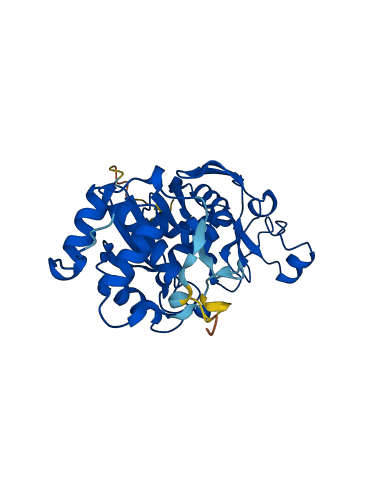
The autoinhibited protein was predicted that may have potential autoinhibitory elements via cis-regPred.
Autoinhibitory domains (AIDs)
Target domain |
|
Relief mechanism |
|
Assay |
cis-regPred |
Accessory elements
No accessory elements
Autoinhibited structure

Activated structure
1 structures for Q8FL25
| Entry ID | Method | Resolution | Chain | Position | Source |
|---|---|---|---|---|---|
| AF-Q8FL25-F1 | Predicted | AlphaFoldDB |
No variants for Q8FL25
| Variant ID(s) | Position | Change | Description | Diseaes Association | Provenance |
|---|---|---|---|---|---|
| No variants for Q8FL25 | |||||
No associated diseases with Q8FL25
4 regional properties for Q8FL25
| Type | Name | Position | InterPro Accession |
|---|---|---|---|
| conserved_site | Aminoacyl-tRNA synthetase, class I, conserved site | 15 - 26 | IPR001412 |
| domain | Glutamyl/glutaminyl-tRNA synthetase, class Ib, catalytic domain | 9 - 318 | IPR020058 |
| domain | Glutamyl-tRNA synthetase | 9 - 325 | IPR033910 |
| domain | Aminoacyl-tRNA synthetase, class I, anticodon-binding | 339 - 476 | IPR045462 |
No GO annotations of cellular component
| Name | Definition |
|---|---|
| No GO annotations for cellular component |
3 GO annotations of molecular function
| Name | Definition |
|---|---|
| aminoacyl-tRNA ligase activity | Catalysis of the formation of aminoacyl-tRNA from ATP, amino acid, and tRNA with the release of diphosphate and AMP. |
| ATP binding | Binding to ATP, adenosine 5'-triphosphate, a universally important coenzyme and enzyme regulator. |
| zinc ion binding | Binding to a zinc ion (Zn). |
2 GO annotations of biological process
| Name | Definition |
|---|---|
| glutamyl-tRNA aminoacylation | The process of coupling glutamate to glutamyl-tRNA, catalyzed by glutamyl-tRNA synthetase. The glutamyl-tRNA synthetase is a class-I synthetase. The activated amino acid is transferred to the 2'-OH group of a glutamic acid-accetping tRNA. The 2'-O-aminoacyl-tRNA will ultimately migrate to the 3' position via transesterification. |
| tRNA modification | The covalent alteration of one or more nucleotides within a tRNA molecule to produce a tRNA molecule with a sequence that differs from that coded genetically. |
No homologous proteins in AiPD
| UniProt AC | Gene Name | Protein Name | Species | Evidence Code |
|---|---|---|---|---|
| No homologous proteins | ||||
| 10 | 20 | 30 | 40 | 50 | 60 |
| MLPPYFLFKE | MTDTHYIGRF | APSPSGELHF | GSLIAALGSY | LQARARQGRW | LVRIEDIDPP |
| 70 | 80 | 90 | 100 | 110 | 120 |
| REVPGAAETI | LRQLEHYGLY | WDGDVLWQSQ | RHHAYREALA | WLHEQGLSYY | CTCTRARIQS |
| 130 | 140 | 150 | 160 | 170 | 180 |
| IGGIYDGHCR | DLHHGPDNAA | VRIRQQHPVT | QFTDLLRGII | HADEKLARED | FIIHRRDGLF |
| 190 | 200 | 210 | 220 | 230 | 240 |
| AYNLAVVVDD | HFQGVSEIVR | GADLIEPTVR | QISLYQLFGW | KVPDYIHLPL | ALNPQGAKLS |
| 250 | 260 | 270 | 280 | 290 | 300 |
| KQNHAPALPK | GDPRPVLIAA | LHFLGQQVET | HWQDFSVEQI | LQSAVKNWTL | TAVPESAIVN |
| STFSNASC |