Q8EYG2
Gene name |
acsA |
Protein name |
Acetyl-coenzyme A synthetase |
Names |
AcCoA synthetase, Acs, Acetate--CoA ligase, Acyl-activating enzyme |
Species |
Leptospira interrogans serogroup Icterohaemorrhagiae serovar Lai (strain 56601) |
KEGG Pathway |
lil:LA_4254 |
EC number |
6.2.1.1: Acid--thiol ligases |
Protein Class |
|
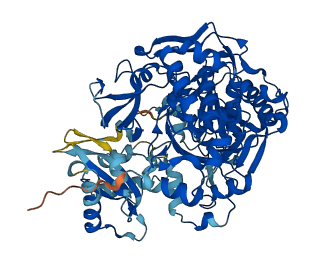
Descriptions
The autoinhibited protein was predicted that may have potential autoinhibitory elements via cis-regPred.
Autoinhibitory domains (AIDs)
Target domain |
|
Relief mechanism |
|
Assay |
cis-regPred |
Accessory elements
No accessory elements
Autoinhibited structure

Activated structure
1 structures for Q8EYG2
| Entry ID | Method | Resolution | Chain | Position | Source |
|---|---|---|---|---|---|
| AF-Q8EYG2-F1 | Predicted | AlphaFoldDB |
No variants for Q8EYG2
| Variant ID(s) | Position | Change | Description | Diseaes Association | Provenance |
|---|---|---|---|---|---|
| No variants for Q8EYG2 | |||||
No associated diseases with Q8EYG2
4 regional properties for Q8EYG2
| Type | Name | Position | InterPro Accession |
|---|---|---|---|
| domain | AMP-dependent synthetase/ligase domain | 96 - 533 | IPR000873 |
| conserved_site | AMP-binding, conserved site | 270 - 281 | IPR020845 |
| domain | AMP-binding enzyme, C-terminal domain | 542 - 620 | IPR025110 |
| domain | Acetyl-coenzyme A synthetase, N-terminal domain | 31 - 86 | IPR032387 |
Functions
| Description | ||
|---|---|---|
| EC Number | 6.2.1.1 | Acid--thiol ligases |
| Subcellular Localization |
|
|
| PANTHER Family | ||
| PANTHER Subfamily | ||
| PANTHER Protein Class | ||
| PANTHER Pathway Category | No pathway information available | |
1 GO annotations of cellular component
| Name | Definition |
|---|---|
| cytosol | The part of the cytoplasm that does not contain organelles but which does contain other particulate matter, such as protein complexes. |
4 GO annotations of molecular function
| Name | Definition |
|---|---|
| acetate-CoA ligase activity | Catalysis of the reaction: ATP + acetate + CoA = AMP + diphosphate + acetyl-CoA. |
| AMP binding | Binding to AMP, adenosine monophosphate. |
| ATP binding | Binding to ATP, adenosine 5'-triphosphate, a universally important coenzyme and enzyme regulator. |
| metal ion binding | Binding to a metal ion. |
2 GO annotations of biological process
| Name | Definition |
|---|---|
| acetyl-CoA biosynthetic process | The chemical reactions and pathways resulting in the formation of acetyl-CoA, a derivative of coenzyme A in which the sulfhydryl group is acetylated. |
| acetyl-CoA biosynthetic process from acetate | The chemical reactions and pathways resulting in the formation of acetyl-CoA from acetate, either directly or via acetylphosphate. |
No homologous proteins in AiPD
| UniProt AC | Gene Name | Protein Name | Species | Evidence Code |
|---|---|---|---|---|
| No homologous proteins | ||||
| 10 | 20 | 30 | 40 | 50 | 60 |
| MPNSEEVMAK | ERVVSPSAEF | KKNANISLKN | YKSLYKESIE | NPNKFWAREA | NRLIWFKKWT |
| 70 | 80 | 90 | 100 | 110 | 120 |
| KVLSHDFKNA | KVEWFKGGKL | NVSYNCLDRH | ISTPLKNKAA | LIWEGDNPTE | SRVLTYYDVY |
| 130 | 140 | 150 | 160 | 170 | 180 |
| REVNRFANIL | KKFGVKKGDR | VLVYLPMIPE | LAITILACTR | IGAIHSVVFG | GFSPEALQSR |
| 190 | 200 | 210 | 220 | 230 | 240 |
| IDDCKPKLVV | TADGGFRGGK | PIELKKNVDL | ALEKSKEKVK | TVIVVRRTGN | ESGLTWKDGQ |
| 250 | 260 | 270 | 280 | 290 | 300 |
| DYWYHFLMND | PELSAYCKPE | EMDAEDPLFI | LYTSGSTGKP | KGVLHTTGGY | LLGANLTFHY |
| 310 | 320 | 330 | 340 | 350 | 360 |
| VFDIKPEDTY | WCTADIGWVT | GHSYLVYGPL | SNGASSVMFE | GVPSYPDAGR | FWDVIDKYGV |
| 370 | 380 | 390 | 400 | 410 | 420 |
| NIFYTAPTAI | RALMREGLNH | IQKRDLSSLR | LLGSVGEPIN | PEAWEWYFKN | IGKGKCPIVD |
| 430 | 440 | 450 | 460 | 470 | 480 |
| TWWQTETGSI | MITALPGAIP | QKPGSATLPF | FGVQPVLVDN | DGKEITDKGE | VSGNLCIKGP |
| 490 | 500 | 510 | 520 | 530 | 540 |
| WPSMMRGVYG | DPKRFFETYF | SQFKGYYFTG | DGARRDKDGY | FWITGRVDDV | INVSGHRIGS |
| 550 | 560 | 570 | 580 | 590 | 600 |
| AEVESALVEN | KSVAEAAVVG | FPHDIKGQGI | YAYVTVKEGV | TTNDVLKKEL | ISTVEKMIGK |
| 610 | 620 | 630 | 640 | 650 | 660 |
| IARPDVIHWA | PGLPKTRSGK | IMRRILRKIV | SGEFEGLGDT | STLADPSVVQ | KLIEDKKKFH |
| S |