Q8DVS2
Gene name |
pepX |
Protein name |
Xaa-Pro dipeptidyl-peptidase |
Names |
X-Pro dipeptidyl-peptidase, X-prolyl-dipeptidyl aminopeptidase, X-PDAP |
Species |
Streptococcus mutans serotype c (strain ATCC 700610 / UA159) |
KEGG Pathway |
smu:SMU_395 |
EC number |
3.4.14.11: Dipeptidyl-peptidases and tripeptidyl-peptidases |
Protein Class |
|
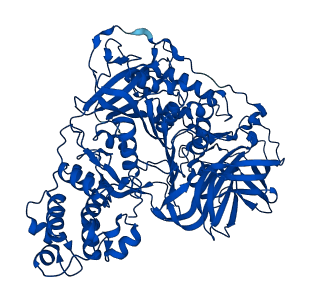
Descriptions
The autoinhibited protein was predicted that may have potential autoinhibitory elements via cis-regPred.
Autoinhibitory domains (AIDs)
Target domain |
|
Relief mechanism |
|
Assay |
cis-regPred |
Accessory elements
No accessory elements
Autoinhibited structure

Activated structure
1 structures for Q8DVS2
| Entry ID | Method | Resolution | Chain | Position | Source |
|---|---|---|---|---|---|
| AF-Q8DVS2-F1 | Predicted | AlphaFoldDB |
No variants for Q8DVS2
| Variant ID(s) | Position | Change | Description | Diseaes Association | Provenance |
|---|---|---|---|---|---|
| No variants for Q8DVS2 | |||||
No associated diseases with Q8DVS2
Functions
| Description | ||
|---|---|---|
| EC Number | 3.4.14.11 | Dipeptidyl-peptidases and tripeptidyl-peptidases |
| Subcellular Localization |
|
|
| PANTHER Family | ||
| PANTHER Subfamily | ||
| PANTHER Protein Class | ||
| PANTHER Pathway Category | No pathway information available | |
1 GO annotations of cellular component
| Name | Definition |
|---|---|
| cytoplasm | The contents of a cell excluding the plasma membrane and nucleus, but including other subcellular structures. |
3 GO annotations of molecular function
| Name | Definition |
|---|---|
| aminopeptidase activity | Catalysis of the hydrolysis of a single N-terminal amino acid residue from a polypeptide chain. |
| dipeptidyl-peptidase activity | Catalysis of the hydrolysis of N-terminal dipeptides from a polypeptide chain. |
| serine-type peptidase activity | Catalysis of the hydrolysis of peptide bonds in a polypeptide chain by a catalytic mechanism that involves a catalytic triad consisting of a serine nucleophile that is activated by a proton relay involving an acidic residue (e.g. aspartate or glutamate) and a basic residue (usually histidine). |
1 GO annotations of biological process
| Name | Definition |
|---|---|
| proteolysis | The hydrolysis of proteins into smaller polypeptides and/or amino acids by cleavage of their peptide bonds. |
No homologous proteins in AiPD
| UniProt AC | Gene Name | Protein Name | Species | Evidence Code |
|---|---|---|---|---|
| No homologous proteins | ||||
| 10 | 20 | 30 | 40 | 50 | 60 |
| MKYNQYSYIG | TSVSQAEKEL | KELGFQISSQ | KTNKANLATF | VSQVYFHNPD | KDDVFKSIIA |
| 70 | 80 | 90 | 100 | 110 | 120 |
| DSQTDLATFL | HSDRELTEEI | FYTIALQLLE | FTPYIDFDEA | KTFIKHSHFP | IIFQPKHFLL |
| 130 | 140 | 150 | 160 | 170 | 180 |
| NFYQLLGTRT | KNGMTLIDKL | VSQGFLPADN | HYRYFNGKSL | ATFDTNALIR | EIVYVEAPLD |
| 190 | 200 | 210 | 220 | 230 | 240 |
| TDKDGQLDLI | KVNIIRPQTK | AKLPVVMTAS | PYHQGTNDKG | ADKKLHQMEG | ELTVKKAATI |
| 250 | 260 | 270 | 280 | 290 | 300 |
| TVTDSHFQAL | QVPSSNLPIS | PAQESFSYID | SYTLNDYFLA | RGFANIYVSG | VGTKDSDGFM |
| 310 | 320 | 330 | 340 | 350 | 360 |
| TSGDYAQIES | FKAVIDWLNG | RTTAYTSHKR | DKRVMADWTN | GLVATTGKSY | LGTMSTGLAT |
| 370 | 380 | 390 | 400 | 410 | 420 |
| TGIKELKVII | AESAISSWYD | YYRENGLVCS | PGGYPGEDID | VLTELTYSRN | LAAGDYLRNN |
| 430 | 440 | 450 | 460 | 470 | 480 |
| AQYQKMLAEQ | VKQIDRTSGD | YNQFWQDRNY | LPHAHKIKAH | VVYTHGLQDW | NVKPNQVYYI |
| 490 | 500 | 510 | 520 | 530 | 540 |
| FNALPEEIQK | HIFLHQGQHV | YMHNWQSIDF | RESMNALLSE | ELLGLQNHFQ | LPTIIWQDNS |
| 550 | 560 | 570 | 580 | 590 | 600 |
| QVQTWKKLNN | FGSHQTRQFS | LGQEKKIIDN | HYPSSDFKLY | SDDYHAFKHD | LFLKKANEIA |
| 610 | 620 | 630 | 640 | 650 | 660 |
| IDLPIQEDML | VNGQIKLNLT | LKSSSNKGLL | SAQVLDYGQK | KRFSDLPTIL | EHNSIDNGQN |
| 670 | 680 | 690 | 700 | 710 | 720 |
| FSREALRELP | FKKAPYRIIT | KGVLNLQNRT | DLLTIEDIFP | NKWMTITFNL | QASLYQLQKG |
| 730 | 740 | 750 | |||
| DSLRIVLYTT | DFEQTVRDNS | NYILVVDLAK | STIEIPIA |