Q8DI83
Gene name |
tlr1707 |
Protein name |
UPF0758 protein tlr1707 |
Names |
|
Species |
Thermosynechococcus vestitus (strain NIES-2133 / IAM M-273 / BP-1) |
KEGG Pathway |
tel:tlr1707 |
EC number |
|
Protein Class |
|
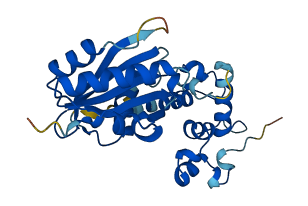
Descriptions
The autoinhibited protein was predicted that may have potential autoinhibitory elements via cis-regPred.
Autoinhibitory domains (AIDs)
Target domain |
|
Relief mechanism |
|
Assay |
cis-regPred |
Accessory elements
No accessory elements
Autoinhibited structure

Activated structure
1 structures for Q8DI83
| Entry ID | Method | Resolution | Chain | Position | Source |
|---|---|---|---|---|---|
| AF-Q8DI83-F1 | Predicted | AlphaFoldDB |
No variants for Q8DI83
| Variant ID(s) | Position | Change | Description | Diseaes Association | Provenance |
|---|---|---|---|---|---|
| No variants for Q8DI83 | |||||
No associated diseases with Q8DI83
3 regional properties for Q8DI83
| Type | Name | Position | InterPro Accession |
|---|---|---|---|
| conserved_site | Chaperonin TCP-1, conserved site | 37 - 49 | IPR002194-1 |
| conserved_site | Chaperonin TCP-1, conserved site | 58 - 74 | IPR002194-2 |
| conserved_site | Chaperonin TCP-1, conserved site | 86 - 94 | IPR002194-3 |
No GO annotations of cellular component
| Name | Definition |
|---|---|
| No GO annotations for cellular component |
3 GO annotations of molecular function
| Name | Definition |
|---|---|
| DNA binding | Any molecular function by which a gene product interacts selectively and non-covalently with DNA (deoxyribonucleic acid). |
| metal ion binding | Binding to a metal ion. |
| metallopeptidase activity | Catalysis of the hydrolysis of peptide bonds by a mechanism in which water acts as a nucleophile, one or two metal ions hold the water molecule in place, and charged amino acid side chains are ligands for the metal ions. |
2 GO annotations of biological process
| Name | Definition |
|---|---|
| DNA repair | The process of restoring DNA after damage. Genomes are subject to damage by chemical and physical agents in the environment (e.g. UV and ionizing radiations, chemical mutagens, fungal and bacterial toxins, etc.) and by free radicals or alkylating agents endogenously generated in metabolism. DNA is also damaged because of errors during its replication. A variety of different DNA repair pathways have been reported that include direct reversal, base excision repair, nucleotide excision repair, photoreactivation, bypass, double-strand break repair pathway, and mismatch repair pathway. |
| proteolysis | The hydrolysis of proteins into smaller polypeptides and/or amino acids by cleavage of their peptide bonds. |
No homologous proteins in AiPD
| UniProt AC | Gene Name | Protein Name | Species | Evidence Code |
|---|---|---|---|---|
| No homologous proteins | ||||
| 10 | 20 | 30 | 40 | 50 | 60 |
| MMSYSLRVAD | LPAGDRPREK | LLSQGARYLS | SAELLAILLG | TGQGAGKLSA | VGLGQFILKQ |
| 70 | 80 | 90 | 100 | 110 | 120 |
| LGERTGDSTD | AVSALRDITP | EELMAIPGVG | PAKATTILAA | VELGKRVFQS | RPGEQTIIDS |
| 130 | 140 | 150 | 160 | 170 | 180 |
| PALAAAVLAA | DLMWQATERF | AVLLLDVRHR | LLGSHVITVG | TATETLAHPR | EIFREAVRRN |
| 190 | 200 | 210 | 220 | 230 | 240 |
| ASRLIIAHNH | PSGNLSPSQA | DLDLTKQILQ | AGQLMEIPVL | DHLILGNGDY | QSLREITPLW |
| QQVPQGDGSA |