Q8CVD0
Gene name |
urdA (SO_4620) |
Protein name |
Urocanate reductase |
Names |
|
Species |
Shewanella oneidensis (strain MR-1) |
KEGG Pathway |
son:SO_4620 |
EC number |
1.3.99.33: With other acceptors |
Protein Class |
|
Descriptions
The autoinhibited protein was predicted that may have potential autoinhibitory elements via cis-regPred.
Autoinhibitory domains (AIDs)
Target domain |
|
Relief mechanism |
|
Assay |
cis-regPred |
Accessory elements
No accessory elements
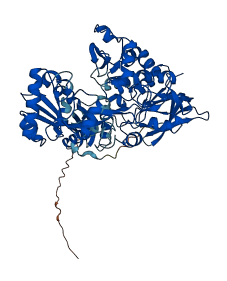
Autoinhibited structure

Activated structure
5 structures for Q8CVD0
| Entry ID | Method | Resolution | Chain | Position | Source |
|---|---|---|---|---|---|
| 6T85 | X-ray | 110 A | A | 130-582 | PDB |
| 6T86 | X-ray | 256 A | A | 130-582 | PDB |
| 6T87 | X-ray | 156 A | A | 130-582 | PDB |
| 6T88 | X-ray | 140 A | A | 130-582 | PDB |
| AF-Q8CVD0-F1 | Predicted | AlphaFoldDB |
No variants for Q8CVD0
| Variant ID(s) | Position | Change | Description | Diseaes Association | Provenance |
|---|---|---|---|---|---|
| No variants for Q8CVD0 | |||||
No associated diseases with Q8CVD0
Functions
| Description | ||
|---|---|---|
| EC Number | 1.3.99.33 | With other acceptors |
| Subcellular Localization |
|
|
| PANTHER Family | ||
| PANTHER Subfamily | ||
| PANTHER Protein Class | ||
| PANTHER Pathway Category | No pathway information available | |
1 GO annotations of cellular component
| Name | Definition |
|---|---|
| plasma membrane | The membrane surrounding a cell that separates the cell from its external environment. It consists of a phospholipid bilayer and associated proteins. |
2 GO annotations of molecular function
| Name | Definition |
|---|---|
| FMN binding | Binding to flavin mono nucleotide. Flavin mono nucleotide (FMN) is the coenzyme or the prosthetic group of various flavoprotein oxidoreductase enzymes. |
| oxidoreductase activity | Catalysis of an oxidation-reduction (redox) reaction, a reversible chemical reaction in which the oxidation state of an atom or atoms within a molecule is altered. One substrate acts as a hydrogen or electron donor and becomes oxidized, while the other acts as hydrogen or electron acceptor and becomes reduced. |
1 GO annotations of biological process
| Name | Definition |
|---|---|
| metabolic process | The chemical reactions and pathways, including anabolism and catabolism, by which living organisms transform chemical substances. Metabolic processes typically transform small molecules, but also include macromolecular processes such as DNA repair and replication, and protein synthesis and degradation. |
No homologous proteins in AiPD
| UniProt AC | Gene Name | Protein Name | Species | Evidence Code |
|---|---|---|---|---|
| No homologous proteins | ||||
| 10 | 20 | 30 | 40 | 50 | 60 |
| MHYKKSIIGI | AVTATAIIAG | CQVTHQIVKS | QGTAQGKHGE | VQVETTFKDG | HIVAIDVLKQ |
| 70 | 80 | 90 | 100 | 110 | 120 |
| KENKVLAGAV | FKDVKQAIID | NNSIEVDGIA | GATVTSKALK | EAVGKSIEAA | GVTLVATASA |
| 130 | 140 | 150 | 160 | 170 | 180 |
| KKSEALTPAE | YTYDVVIIGS | GGAGFSAGLE | AIAAGRSAVI | IEKMPIIGGN | SLISGAEMNV |
| 190 | 200 | 210 | 220 | 230 | 240 |
| AGSWVQKNMG | ITDSKELFIS | DTLKGGDFKG | DPEMVKTMVD | NAVGAAEWLR | DYVKVEFYPD |
| 250 | 260 | 270 | 280 | 290 | 300 |
| QLFQFGGHSV | KRALIPKGHT | GAEVISKFSI | KADEVGLPIH | TNTKAEKLIQ | DQTGRIVGVE |
| 310 | 320 | 330 | 340 | 350 | 360 |
| AAHNGKTITY | HAKRGVVIAT | GGFSSNMEMR | KKYNPELDER | YGSTGHAGGT | GDGIVMAEKI |
| 370 | 380 | 390 | 400 | 410 | 420 |
| HAAAKNMGYI | QSYPICSPTS | GAIALIADSR | FFGAVLINQK | GERFVEELER | RDVISHAILA |
| 430 | 440 | 450 | 460 | 470 | 480 |
| QPGRYTYVLW | NQDIENVAHT | VEMHQGELKE | FTKDGLMYKV | DTLEEAAKVF | NIPEDKLLST |
| 490 | 500 | 510 | 520 | 530 | 540 |
| IKDVNHYAAT | GKDEAFNHRS | GLVDLSKGPY | WILKATPSVH | HTMGGLVVDT | RTRVLDEQGK |
| 550 | 560 | 570 | 580 | ||
| VIPGLFAAGE | VTGLTHGTNR | LGGNAYTDII | VYGRIAGQEA | AK |