Q8CT13
Gene name |
pdhC (SE_0793) |
Protein name |
Dihydrolipoyllysine-residue acetyltransferase component of pyruvate dehydrogenase complex |
Names |
Dihydrolipoamide acetyltransferase component of pyruvate dehydrogenase complex, E2 |
Species |
Staphylococcus epidermidis (strain ATCC 12228 / FDA PCI 1200) |
KEGG Pathway |
sep:SE_0793 |
EC number |
2.3.1.12: Transferring groups other than amino-acyl groups |
Protein Class |
|
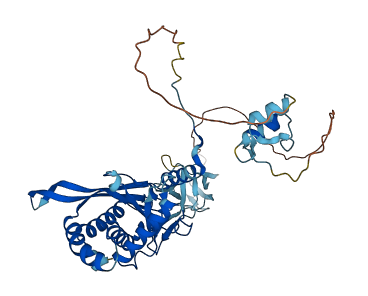
Descriptions
The autoinhibited protein was predicted that may have potential autoinhibitory elements via cis-regPred.
Autoinhibitory domains (AIDs)
Target domain |
|
Relief mechanism |
|
Assay |
cis-regPred |
Accessory elements
No accessory elements
Autoinhibited structure

Activated structure
1 structures for Q8CT13
| Entry ID | Method | Resolution | Chain | Position | Source |
|---|---|---|---|---|---|
| AF-Q8CT13-F1 | Predicted | AlphaFoldDB |
No variants for Q8CT13
| Variant ID(s) | Position | Change | Description | Diseaes Association | Provenance |
|---|---|---|---|---|---|
| No variants for Q8CT13 | |||||
No associated diseases with Q8CT13
6 regional properties for Q8CT13
| Type | Name | Position | InterPro Accession |
|---|---|---|---|
| domain | Biotin/lipoyl attachment | 4 - 78 | IPR000089-1 |
| domain | Biotin/lipoyl attachment | 122 - 196 | IPR000089-2 |
| domain | 2-oxoacid dehydrogenase acyltransferase, catalytic domain | 326 - 552 | IPR001078 |
| binding_site | 2-oxo acid dehydrogenase, lipoyl-binding site | 28 - 57 | IPR003016-1 |
| binding_site | 2-oxo acid dehydrogenase, lipoyl-binding site | 146 - 175 | IPR003016-2 |
| domain | Peripheral subunit-binding domain | 250 - 287 | IPR004167 |
Functions
| Description | ||
|---|---|---|
| EC Number | 2.3.1.12 | Transferring groups other than amino-acyl groups |
| Subcellular Localization |
|
|
| PANTHER Family | ||
| PANTHER Subfamily | ||
| PANTHER Protein Class | ||
| PANTHER Pathway Category | No pathway information available | |
No GO annotations of cellular component
| Name | Definition |
|---|---|
| No GO annotations for cellular component |
1 GO annotations of molecular function
| Name | Definition |
|---|---|
| dihydrolipoyllysine-residue acetyltransferase activity | Catalysis of the reaction: acetyl-CoA + dihydrolipoamide = CoA + S-acetyldihydrolipoamide. |
1 GO annotations of biological process
| Name | Definition |
|---|---|
| glycolytic process | The chemical reactions and pathways resulting in the breakdown of a carbohydrate into pyruvate, with the concomitant production of a small amount of ATP and the reduction of NAD(P) to NAD(P)H. Glycolysis begins with the metabolism of a carbohydrate to generate products that can enter the pathway and ends with the production of pyruvate. Pyruvate may be converted to acetyl-coenzyme A, ethanol, lactate, or other small molecules. |
No homologous proteins in AiPD
| UniProt AC | Gene Name | Protein Name | Species | Evidence Code |
|---|---|---|---|---|
| No homologous proteins | ||||
| 10 | 20 | 30 | 40 | 50 | 60 |
| MAFEFRLPDI | GEGIHEGEIV | KWFIKAGDTI | EEDDVLAEVQ | NDKSVVEIPS | PVSGTVEEVL |
| 70 | 80 | 90 | 100 | 110 | 120 |
| VDEGTVAVVG | DVIVKIDAPD | AEEMQFKGHG | DDEDSKKEEK | EQESPVQEEA | SSTQSQEKTE |
| 130 | 140 | 150 | 160 | 170 | 180 |
| VDESKTVKAM | PSVRKYAREN | GVNIKAVNGS | GKNGRITKED | IDAYLNGGSS | EEGSNTSVAS |
| 190 | 200 | 210 | 220 | 230 | 240 |
| ESTSSDVVNA | SATQALPEGD | FPETTEKIPA | MRKAIAKAMV | NSKHTAPHVT | LMDEIDVQEL |
| 250 | 260 | 270 | 280 | 290 | 300 |
| WDHRKKFKEI | AAEQGTKLTF | LPYVVKALVS | ALKKYPALNT | SFNEEAGEVV | HKHYWNIGIA |
| 310 | 320 | 330 | 340 | 350 | 360 |
| ADTDKGLLVP | VVKHADRKSI | FEISDEINEL | AVKARDGKLT | SEEMKGATCT | ISNIGSAGGQ |
| 370 | 380 | 390 | 400 | 410 | 420 |
| WFTPVINHPE | VAILGIGRIA | QKPIVKDGEI | VAAPVLALSL | SFDHRQIDGA | TGQNAMNHIK |
| 430 | |||||
| RLLNNPELLL | MEG |