Q8BYZ1
Gene name |
Abi3 (Nesh) |
Protein name |
ABI gene family member 3 |
Names |
New molecule including SH3, Nesh |
Species |
Mus musculus (Mouse) |
KEGG Pathway |
mmu:66610 |
EC number |
|
Protein Class |
|
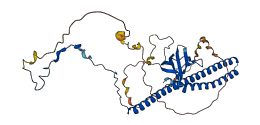
Descriptions
The autoinhibited protein was predicted that may have potential autoinhibitory elements via cis-regPred.
Autoinhibitory domains (AIDs)
Target domain |
|
Relief mechanism |
|
Assay |
cis-regPred |
Accessory elements
No accessory elements
Autoinhibited structure

Activated structure
1 structures for Q8BYZ1
| Entry ID | Method | Resolution | Chain | Position | Source |
|---|---|---|---|---|---|
| AF-Q8BYZ1-F1 | Predicted | AlphaFoldDB |
17 variants for Q8BYZ1
| Variant ID(s) | Position | Change | Description | Diseaes Association | Provenance |
|---|---|---|---|---|---|
| rs3402715568 | 6 | Q>L | No | EVA | |
| rs3402626042 | 8 | Q>* | No | EVA | |
| rs3402652316 | 9 | Q>L | No | EVA | |
| rs3389182465 | 26 | H>Q | No | EVA | |
| rs3389193809 | 27 | S>R | No | EVA | |
| rs3389130979 | 46 | K>R | No | EVA | |
| rs3389203748 | 82 | Q>H | No | EVA | |
| rs3389195343 | 97 | G>D | No | EVA | |
| rs3389195332 | 160 | S>I | No | EVA | |
| rs3401418018 | 218 | G>D | No | EVA | |
| rs3389196967 | 229 | S>P | No | EVA | |
| rs29392269 | 240 | P>L | No | EVA | |
| rs3389198494 | 245 | P>H | No | EVA | |
| rs3389189852 | 246 | V>A | No | EVA | |
| rs3389171400 | 262 | P>T | No | EVA | |
| rs240018814 | 271 | L>P | No | EVA | |
| rs3389171406 | 313 | K>* | No | EVA |
No associated diseases with Q8BYZ1
No regional properties for Q8BYZ1
| Type | Name | Position | InterPro Accession |
|---|---|---|---|
| No domain, repeats, and functional sites for Q8BYZ1 | |||
6 GO annotations of cellular component
| Name | Definition |
|---|---|
| cytoplasm | The contents of a cell excluding the plasma membrane and nucleus, but including other subcellular structures. |
| dendritic shaft | Cylindric portion of the dendrite, directly stemming from the perikaryon, and carrying the dendritic spines. |
| dendritic spine | A small, membranous protrusion from a dendrite that forms a postsynaptic compartment, typically receiving input from a single presynapse. They function as partially isolated biochemical and an electrical compartments. Spine morphology is variable:they can be thin, stubby, mushroom, or branched, with a continuum of intermediate morphologies. They typically terminate in a bulb shape, linked to the dendritic shaft by a restriction. Spine remodeling is though to be involved in synaptic plasticity. |
| lamellipodium | A thin sheetlike process extended by the leading edge of a migrating cell or extending cell process; contains a dense meshwork of actin filaments. |
| postsynaptic density | An electron dense network of proteins within and adjacent to the postsynaptic membrane of an asymmetric, neuron-neuron synapse. Its major components include neurotransmitter receptors and the proteins that spatially and functionally organize them such as anchoring and scaffolding molecules, signaling enzymes and cytoskeletal components. |
| SCAR complex | A pentameric complex that includes orthologues of human PIR121, Nap1, Abi, SCAR, and HSPC300 and regulates actin polymerization and/or depolymerization through small GTPase mediated signal transduction. |
3 GO annotations of molecular function
| Name | Definition |
|---|---|
| actin filament binding | Binding to an actin filament, also known as F-actin, a helical filamentous polymer of globular G-actin subunits. |
| identical protein binding | Binding to an identical protein or proteins. |
| SH3 domain binding | Binding to a SH3 domain (Src homology 3) of a protein, small protein modules containing approximately 50 amino acid residues found in a great variety of intracellular or membrane-associated proteins. |
9 GO annotations of biological process
| Name | Definition |
|---|---|
| defense response to tumor cell | Reactions triggered in response to the presence of a tumor cell that act to protect the cell or organism. |
| negative regulation of lamellipodium assembly | Any process that decreases the rate, frequency or extent of the formation of a lamellipodium, a thin sheetlike extension of the surface of a migrating cell. |
| negative regulation of protein localization to plasma membrane | Any process that stops, prevents or reduces the frequency, rate or extent of protein localization to plasma membrane. |
| positive regulation of cellular senescence | Any process that activates or increases the frequency, rate or extent of cellular senescence. |
| positive regulation of protein tyrosine kinase activity | Any process that increases the rate, frequency, or extent of protein tyrosine kinase activity. |
| regulation of actin cytoskeleton reorganization | Any process that modulates the frequency, rate or extent of actin cytoskeleton reorganization. |
| regulation of cell migration | Any process that modulates the frequency, rate or extent of cell migration. |
| regulation of dendritic spine morphogenesis | Any process that modulates the rate, frequency, or extent of dendritic spine morphogenesis, the process in which the anatomical structures of a dendritic spine are generated and organized. A dendritic spine is a protrusion from a dendrite and a specialized subcellular compartment involved in synaptic transmission. |
| regulation of postsynaptic density assembly | Any process that modulates the frequency, rate or extent of postsynaptic density assembly, the aggregation, arrangement and bonding together of a set of components to form a postsynaptic density. |
1 homologous proteins in AiPD
| UniProt AC | Gene Name | Protein Name | Species | Evidence Code |
|---|---|---|---|---|
| Q9P2A4 | ABI3 | ABI gene family member 3 | Homo sapiens (Human) | PR |
| 10 | 20 | 30 | 40 | 50 | 60 |
| MAELQQLQQL | QEFDIPTGRE | ALRGNHSALL | RVANYCEDNY | LQATDKRKAL | EETMAFTTQA |
| 70 | 80 | 90 | 100 | 110 | 120 |
| LASVAYQVGN | LAGHTLRMLD | LQGAALRQVE | AKMSTLGQMV | NMHMEKVARR | EIGTLATVVR |
| 130 | 140 | 150 | 160 | 170 | 180 |
| LPSNQKVIPP | ESLPSLTPYH | RKPLNFACLD | DIGHGVKDLS | TQLSRTGTLS | RKSIKAPATP |
| 190 | 200 | 210 | 220 | 230 | 240 |
| VSATLGRPPR | IPEPVQLPAV | PDGKLSAASS | ASSLASAGSA | EGASGIPQSK | GQVAPATPPP |
| 250 | 260 | 270 | 280 | 290 | 300 |
| PPVAPVTPPP | PPLSAEVFLP | PPPLEVSQPP | LEAELPLPPP | PALEGDELGL | LPPPPPGFGP |
| 310 | 320 | 330 | 340 | 350 | 360 |
| DEPSWVPASY | LEKVVTLYPY | TRQKDNELSF | SEGTVICVTR | RYSDGWCEGV | SSEGTGFFPG |
| NYVEPSC |