Q8BYC4
Gene name |
Gpr20 |
Protein name |
G-protein coupled receptor 20 |
Names |
|
Species |
Mus musculus (Mouse) |
KEGG Pathway |
mmu:239530 |
EC number |
|
Protein Class |
|
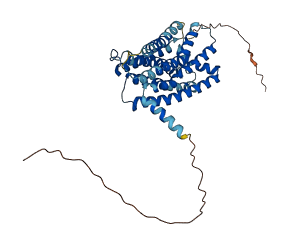
Descriptions
The autoinhibited protein was predicted that may have potential autoinhibitory elements via cis-regPred.
Autoinhibitory domains (AIDs)
Target domain |
|
Relief mechanism |
|
Assay |
cis-regPred |
Accessory elements
No accessory elements
Autoinhibited structure

Activated structure
1 structures for Q8BYC4
| Entry ID | Method | Resolution | Chain | Position | Source |
|---|---|---|---|---|---|
| AF-Q8BYC4-F1 | Predicted | AlphaFoldDB |
16 variants for Q8BYC4
| Variant ID(s) | Position | Change | Description | Diseaes Association | Provenance |
|---|---|---|---|---|---|
| rs3389336682 | 5 | L>W | No | EVA | |
| rs3389359372 | 10 | W>* | No | EVA | |
| rs3389359092 | 13 | A>T | No | EVA | |
| rs3389316566 | 27 | V>L | No | EVA | |
| rs49778102 | 38 | R>W | No | EVA | |
| rs3389372087 | 51 | W>R | No | EVA | |
| rs3389326774 | 113 | G>D | No | EVA | |
| rs258790125 | 115 | R>P | No | EVA | |
| rs3389326789 | 121 | A>V | No | EVA | |
| rs3389355353 | 130 | L>I | No | EVA | |
| rs3389367859 | 135 | S>F | No | EVA | |
| rs3389336736 | 157 | R>H | No | EVA | |
| rs3389375638 | 192 | S>T | No | EVA | |
| rs3389365517 | 343 | I>F | No | EVA | |
| rs3389365594 | 344 | G>A | No | EVA | |
| rs3389346271 | 345 | S>P | No | EVA |
No associated diseases with Q8BYC4
1 regional properties for Q8BYC4
| Type | Name | Position | InterPro Accession |
|---|---|---|---|
| domain | GPCR, rhodopsin-like, 7TM | 68 - 296 | IPR017452 |
4 GO annotations of cellular component
| Name | Definition |
|---|---|
| cytosol | The part of the cytoplasm that does not contain organelles but which does contain other particulate matter, such as protein complexes. |
| integral component of plasma membrane | The component of the plasma membrane consisting of the gene products and protein complexes having at least some part of their peptide sequence embedded in the hydrophobic region of the membrane. |
| plasma membrane | The membrane surrounding a cell that separates the cell from its external environment. It consists of a phospholipid bilayer and associated proteins. |
| receptor complex | Any protein complex that undergoes combination with a hormone, neurotransmitter, drug or intracellular messenger to initiate a change in cell function. |
1 GO annotations of molecular function
| Name | Definition |
|---|---|
| G protein-coupled receptor activity | Combining with an extracellular signal and transmitting the signal across the membrane by activating an associated G-protein; promotes the exchange of GDP for GTP on the alpha subunit of a heterotrimeric G-protein complex. |
2 GO annotations of biological process
| Name | Definition |
|---|---|
| positive regulation of cytosolic calcium ion concentration involved in phospholipase C-activating G protein-coupled signaling pathway | Any process that increases the concentration of calcium ions in the cytosol that occurs as part of a PLC-activating G protein-coupled receptor signaling pathway. G-protein-activated PLC hydrolyses phosphatidylinositol-bisphosphate (PIP2) to release diacylglycerol (DAG) and inositol trisphosphate (IP3). IP3 then binds to calcium release channels in the endoplasmic reticulum (ER) to trigger calcium ion release into the cytosol. |
| positive regulation of Rho protein signal transduction | Any process that activates or increases the frequency, rate or extent of Rho protein signal transduction. |
1 homologous proteins in AiPD
| UniProt AC | Gene Name | Protein Name | Species | Evidence Code |
|---|---|---|---|---|
| Q8BUD0 | Gpr4 | G-protein coupled receptor 4 | Mus musculus (Mouse) | PR |
| 10 | 20 | 30 | 40 | 50 | 60 |
| MPSALSMRPW | DAALPNTTAA | AWTNGSVPEM | PLFHHFARLD | EELQATFPSL | WQALMVVHGT |
| 70 | 80 | 90 | 100 | 110 | 120 |
| IFLAGLVLNG | LALYVFCCRT | RAKTPSVTYT | INLVVTDLLV | GLSLPTRFAV | FYGARGCLRC |
| 130 | 140 | 150 | 160 | 170 | 180 |
| AFPHVLGYFL | NMHCSILFLT | CICVDRYLAI | VQPEGSRRWR | QPACAKAVCI | FVWLAAGVVT |
| 190 | 200 | 210 | 220 | 230 | 240 |
| LSVLGVKSGG | RSCCRVFALT | VLEFLLPLLV | ISVFTGRIMC | ALSRPGLLRQ | GRQRRVRAMQ |
| 250 | 260 | 270 | 280 | 290 | 300 |
| LLLTVLVIFL | VCFTPFHARQ | VAVALWPNVP | KHTSLVAYHV | AVTLSSLNSC | MDPIVYCFIT |
| 310 | 320 | 330 | 340 | 350 | |
| SGFQATVRGL | FYQRGEEFKP | SSMDVVSMHK | STKASAPIHI | LSIGSHTLTQ | PLTNGPEP |