Q8BWR2
Gene name |
Pithd1 (Trp26) |
Protein name |
PITH domain-containing protein 1 |
Names |
|
Species |
Mus musculus (Mouse) |
KEGG Pathway |
mmu:66193 |
EC number |
|
Protein Class |
|
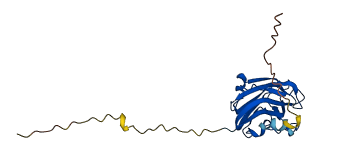
Descriptions
The autoinhibited protein was predicted that may have potential autoinhibitory elements via cis-regPred.
Autoinhibitory domains (AIDs)
Target domain |
|
Relief mechanism |
|
Assay |
cis-regPred |
Accessory elements
No accessory elements
Autoinhibited structure

Activated structure
1 structures for Q8BWR2
| Entry ID | Method | Resolution | Chain | Position | Source |
|---|---|---|---|---|---|
| AF-Q8BWR2-F1 | Predicted | AlphaFoldDB |
5 variants for Q8BWR2
| Variant ID(s) | Position | Change | Description | Diseaes Association | Provenance |
|---|---|---|---|---|---|
| rs3394971171 | 22 | P>H | No | EVA | |
| rs3388716991 | 38 | E>K | No | EVA | |
| rs243892384 | 91 | V>I | No | EVA | |
| rs3394652942 | 113 | Q>* | No | EVA | |
| rs220758479 | 124 | E>D | No | EVA |
No associated diseases with Q8BWR2
1 regional properties for Q8BWR2
| Type | Name | Position | InterPro Accession |
|---|---|---|---|
| domain | PITH domain | 20 - 192 | IPR010400 |
3 GO annotations of cellular component
| Name | Definition |
|---|---|
| cytoplasm | The contents of a cell excluding the plasma membrane and nucleus, but including other subcellular structures. |
| nucleus | A membrane-bounded organelle of eukaryotic cells in which chromosomes are housed and replicated. In most cells, the nucleus contains all of the cell's chromosomes except the organellar chromosomes, and is the site of RNA synthesis and processing. In some species, or in specialized cell types, RNA metabolism or DNA replication may be absent. |
| sperm cytoplasmic droplet | A small amount of cytoplasm surrounded by a cell membrane that is generally retained in spermatozoa after spermiogenesis, when the majority of the cytoplasm is phagocytosed by Sertoli cells to produce what are called residual bodies. Initially, the droplet is located at the neck just behind the head of an elongated spermatid. During epididymal transit, the cytoplasmic droplet migrates caudally to the annulus at the end of the midpiece; the exact position and time varies by species. The cytoplasmic droplet consists of lipids, lipoproteins, RNAs, a variety of hydrolytic enzymes, receptors, ion channels, and Golgi-derived vesicles. The droplet may be involved in regulatory volume loss (RVD) at ejaculation, and in most species, though not in humans, the cytoplasmic droplet is lost at ejaculation. Note that the cytoplasmic droplet is distinct from 'excessive residual cytoplasm' that sometimes remains in epididymal spermatozoa, particularly when spermiogenesis has been disrupted. |
No GO annotations of molecular function
| Name | Definition |
|---|---|
| No GO annotations for molecular function |
6 GO annotations of biological process
| Name | Definition |
|---|---|
| penetration of cumulus oophorus | The infiltration by sperm of the cumulus oophorus to reach the oocyte. The process involves digestive enzymes from a modified lysosome called the acrosome, situated at the head of the sperm. |
| penetration of zona pellucida | The infiltration by sperm of the zona pellucida to reach the oocyte. The process involves digestive enzymes from a modified lysosome called the acrosome, situated at the head of the sperm. |
| positive regulation of DNA-templated transcription | Any process that activates or increases the frequency, rate or extent of cellular DNA-templated transcription. |
| positive regulation of megakaryocyte differentiation | Any process that activates or increases the frequency, rate or extent of megakaryocyte differentiation. |
| regulation of proteasomal protein catabolic process | Any process that modulates the rate, frequency, or extent of the chemical reactions and pathways resulting in the breakdown of a protein or peptide by hydrolysis of its peptide bonds that is mediated by the proteasome. |
| spermatid development | The process whose specific outcome is the progression of a spermatid over time, from its formation to the mature structure. |
1 homologous proteins in AiPD
| UniProt AC | Gene Name | Protein Name | Species | Evidence Code |
|---|---|---|---|---|
| Q9GZP4 | PITHD1 | PITH domain-containing protein 1 | Homo sapiens (Human) | PR |
| 10 | 20 | 30 | 40 | 50 | 60 |
| MSHGHSHGGG | GCRCAAEREE | PPEQRGLAYG | LYLRIDLERL | QCLNESREGS | GRGVFKPWEE |
| 70 | 80 | 90 | 100 | 110 | 120 |
| RTDRSKFVES | DADEELLFNI | PFTGNVKLKG | VIIMGEDDDS | HPSEMRLYKN | IPQMSFDDTE |
| 130 | 140 | 150 | 160 | 170 | 180 |
| REPEQTFSLN | RDITGELEYA | TKISRFSNVY | HLSIHISKNF | GADTTKIFYI | GLRGEWTELR |
| 190 | 200 | 210 | |||
| RHEVTICNYE | ASANPADHRV | HQVTPQTHFI | S |