Q8BRE0
Gene name |
Rd3 |
Protein name |
Protein RD3 |
Names |
Retinal degeneration protein 3 |
Species |
Mus musculus (Mouse) |
KEGG Pathway |
mmu:74023 |
EC number |
|
Protein Class |
|
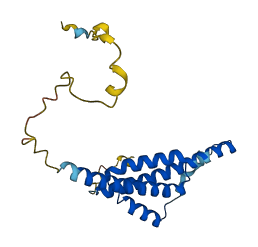
Descriptions
The autoinhibited protein was predicted that may have potential autoinhibitory elements via cis-regPred.
Autoinhibitory domains (AIDs)
Target domain |
|
Relief mechanism |
|
Assay |
cis-regPred |
Accessory elements
No accessory elements
Autoinhibited structure

Activated structure
1 structures for Q8BRE0
| Entry ID | Method | Resolution | Chain | Position | Source |
|---|---|---|---|---|---|
| AF-Q8BRE0-F1 | Predicted | AlphaFoldDB |
10 variants for Q8BRE0
| Variant ID(s) | Position | Change | Description | Diseaes Association | Provenance |
|---|---|---|---|---|---|
| rs1133482505 | 12 | T>I | No | EVA | |
| rs3388522766 | 24 | M>K | No | EVA | |
| rs3391169339 | 42 | R>PGRV* | No | EVA | |
| rs3388525762 | 52 | R>M | No | EVA | |
| rs3388521289 | 134 | E>D | No | EVA | |
| rs3388520763 | 147 | R>C | No | EVA | |
| rs3388521368 | 165 | D>Y | No | EVA | |
| rs3388526935 | 172 | D>H | No | EVA | |
| rs3388520704 | 195 | D>H | No | EVA | |
| rs3388526309 | 196 | D>S | No | EVA |
1 associated diseases with Q8BRE0
Without disease ID
No regional properties for Q8BRE0
| Type | Name | Position | InterPro Accession |
|---|---|---|---|
| No domain, repeats, and functional sites for Q8BRE0 | |||
Functions
8 GO annotations of cellular component
| Name | Definition |
|---|---|
| cone photoreceptor outer segment | The outer segment of a vertebrate cone photoreceptor that contains membrane discs that are contiguous with the ciliary membrane and containing opsin photoreceptor proteins. |
| cytoplasm | The contents of a cell excluding the plasma membrane and nucleus, but including other subcellular structures. |
| endosome | A vacuole to which materials ingested by endocytosis are delivered. |
| nucleus | A membrane-bounded organelle of eukaryotic cells in which chromosomes are housed and replicated. In most cells, the nucleus contains all of the cell's chromosomes except the organellar chromosomes, and is the site of RNA synthesis and processing. In some species, or in specialized cell types, RNA metabolism or DNA replication may be absent. |
| perinuclear region of cytoplasm | Cytoplasm situated near, or occurring around, the nucleus. |
| photoreceptor inner segment | The inner segment of a vertebrate photoreceptor containing mitochondria, ribosomes and membranes where opsin molecules are assembled and passed to be part of the outer segment discs. |
| photoreceptor outer segment | The outer segment of a vertebrate photoreceptor that contains a stack of membrane discs embedded with photoreceptor proteins. |
| rod photoreceptor outer segment | The outer segment of a vertebrate rod photoreceptor that contains sealed membrane discs that are not connected to the ciliary membrane and containing rhodopsin photoreceptor proteins. |
No GO annotations of molecular function
| Name | Definition |
|---|---|
| No GO annotations for molecular function |
5 GO annotations of biological process
| Name | Definition |
|---|---|
| negative regulation of guanylate cyclase activity | Any process that stops, prevents, or reduces the frequency, rate or extent of guanylate cyclase activity. |
| protein transport | The directed movement of proteins into, out of or within a cell, or between cells, by means of some agent such as a transporter or pore. |
| response to stimulus | Any process that results in a change in state or activity of a cell or an organism (in terms of movement, secretion, enzyme production, gene expression, etc.) as a result of a stimulus. The process begins with detection of the stimulus and ends with a change in state or activity or the cell or organism. |
| retina development in camera-type eye | The process whose specific outcome is the progression of the retina over time, from its formation to the mature structure. The retina is the innermost layer or coating at the back of the eyeball, which is sensitive to light and in which the optic nerve terminates. |
| visual perception | The series of events required for an organism to receive a visual stimulus, convert it to a molecular signal, and recognize and characterize the signal. Visual stimuli are detected in the form of photons and are processed to form an image. |
1 homologous proteins in AiPD
| UniProt AC | Gene Name | Protein Name | Species | Evidence Code |
|---|---|---|---|---|
| Q7Z3Z2 | RD3 | Protein RD3 | Homo sapiens (Human) | PR |
| 10 | 20 | 30 | 40 | 50 | 60 |
| MSLIPWLRWN | DTPPRLSART | PAEMVLETLM | MELAGQMREV | ERQQRERRSA | VRKICTGVDY |
| 70 | 80 | 90 | 100 | 110 | 120 |
| SWLANTPRPT | YDISPGERLQ | LEDVCAKIHP | SYCGPAILRF | RQLLAEREPE | VQEVARLFRS |
| 130 | 140 | 150 | 160 | 170 | 180 |
| VLQEALEKMK | QEEEAHKLTR | QWSLRPRGSL | SSFKTRARIA | PFASDIRTIS | EDVERDAPPP |
| 190 | |||||
| PRTWSMPEFR | APQAD |