Q8BQP9
Gene name |
Rgs7bp (D13Bwg1146e, R7bp) |
Protein name |
Regulator of G-protein signaling 7-binding protein |
Names |
R7 family-binding protein |
Species |
Mus musculus (Mouse) |
KEGG Pathway |
mmu:52882 |
EC number |
|
Protein Class |
|
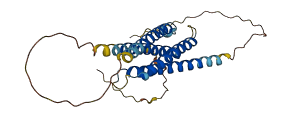
Descriptions
The autoinhibited protein was predicted that may have potential autoinhibitory elements via cis-regPred.
Autoinhibitory domains (AIDs)
Target domain |
|
Relief mechanism |
|
Assay |
cis-regPred |
Accessory elements
No accessory elements
Autoinhibited structure

Activated structure
1 structures for Q8BQP9
| Entry ID | Method | Resolution | Chain | Position | Source |
|---|---|---|---|---|---|
| AF-Q8BQP9-F1 | Predicted | AlphaFoldDB |
4 variants for Q8BQP9
| Variant ID(s) | Position | Change | Description | Diseaes Association | Provenance |
|---|---|---|---|---|---|
| rs3389275764 | 160 | G>* | No | EVA | |
| rs3389297820 | 160 | G>E* | No | EVA | |
| rs3389285312 | 174 | E>V | No | EVA | |
| rs3389275780 | 185 | P>L | No | EVA |
No associated diseases with Q8BQP9
No regional properties for Q8BQP9
| Type | Name | Position | InterPro Accession |
|---|---|---|---|
| No domain, repeats, and functional sites for Q8BQP9 | |||
Functions
13 GO annotations of cellular component
| Name | Definition |
|---|---|
| anchored component of postsynaptic density membrane | The component of the postsynaptic density membrane consisting of the gene products that are tethered to the membrane only by a covalently attached anchor, such as a lipid group that is embedded in the membrane. Gene products with peptide sequences that are embedded in the membrane are excluded from this grouping. |
| anchored component of presynaptic membrane | The component of the presynaptic membrane consisting of the gene products that are tethered to the membrane only by a covalently attached anchor, such as a lipid group that is embedded in the membrane. Gene products with peptide sequences that are embedded in the membrane are excluded from this grouping. |
| axon | The long process of a neuron that conducts nerve impulses, usually away from the cell body to the terminals and varicosities, which are sites of storage and release of neurotransmitter. |
| cytoplasm | The contents of a cell excluding the plasma membrane and nucleus, but including other subcellular structures. |
| dendritic shaft | Cylindric portion of the dendrite, directly stemming from the perikaryon, and carrying the dendritic spines. |
| dendritic spine head | Distal part of the dendritic spine, that carries the post-synaptic density. |
| glutamatergic synapse | A synapse that uses glutamate as a neurotransmitter. |
| neuron projection | A prolongation or process extending from a nerve cell, e.g. an axon or dendrite. |
| nucleus | A membrane-bounded organelle of eukaryotic cells in which chromosomes are housed and replicated. In most cells, the nucleus contains all of the cell's chromosomes except the organellar chromosomes, and is the site of RNA synthesis and processing. In some species, or in specialized cell types, RNA metabolism or DNA replication may be absent. |
| perikaryon | The portion of the cell soma (neuronal cell body) that excludes the nucleus. |
| plasma membrane | The membrane surrounding a cell that separates the cell from its external environment. It consists of a phospholipid bilayer and associated proteins. |
| postsynapse | The part of a synapse that is part of the post-synaptic cell. |
| presynapse | The part of a synapse that is part of the presynaptic cell. |
No GO annotations of molecular function
| Name | Definition |
|---|---|
| No GO annotations for molecular function |
3 GO annotations of biological process
| Name | Definition |
|---|---|
| G protein-coupled receptor signaling pathway | The series of molecular signals initiated by a ligand binding to its receptor, in which the activated receptor promotes the exchange of GDP for GTP on the alpha-subunit of an associated heterotrimeric G-protein complex. The GTP-bound activated alpha-G-protein then dissociates from the beta- and gamma-subunits to further transmit the signal within the cell. The pathway begins with receptor-ligand interaction, and ends with regulation of a downstream cellular process. The pathway can start from the plasma membrane, Golgi or nuclear membrane. |
| negative regulation of signal transduction | Any process that stops, prevents, or reduces the frequency, rate or extent of signal transduction. |
| regulation of postsynaptic membrane potential | Any process that modulates the potential difference across a post-synaptic membrane. |
No homologous proteins in AiPD
| UniProt AC | Gene Name | Protein Name | Species | Evidence Code |
|---|---|---|---|---|
| No homologous proteins | ||||
| 10 | 20 | 30 | 40 | 50 | 60 |
| MSSAPNGRKK | RPSRSTRSSI | FQISKPPLQS | GDWERRGSGS | ESAHKTQRAL | DDCKMLVQEF |
| 70 | 80 | 90 | 100 | 110 | 120 |
| NTQVALYREL | VISIGDVSVS | CPSLRAEMHK | TRTKGCEMAR | QAHQKLAAIS | GPEDGEIHPE |
| 130 | 140 | 150 | 160 | 170 | 180 |
| ICRLYIQLQC | CLEMYTTEML | KSICLLGSLQ | FHRKGKEASG | GAKNLDSKIE | ENAETPALED |
| 190 | 200 | 210 | 220 | 230 | 240 |
| SLSSPLESQQ | QCWQVATDIE | NTERDMREMK | NLLSKLRETM | PLPLKNQDDS | SLLNLTPYPM |
| 250 | |||||
| VRRRKRRFFG | LCCLVSS |