Q8BMN4
Gene name |
Lmln |
Protein name |
Leishmanolysin-like peptidase |
Names |
|
Species |
Mus musculus (Mouse) |
KEGG Pathway |
mmu:239833 |
EC number |
|
Protein Class |
|
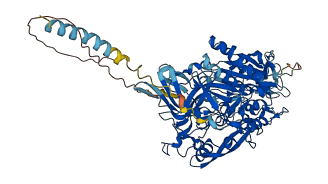
Descriptions
The autoinhibited protein was predicted that may have potential autoinhibitory elements via cis-regPred.
Autoinhibitory domains (AIDs)
Target domain |
|
Relief mechanism |
|
Assay |
cis-regPred |
Accessory elements
No accessory elements
Autoinhibited structure

Activated structure
1 structures for Q8BMN4
| Entry ID | Method | Resolution | Chain | Position | Source |
|---|---|---|---|---|---|
| AF-Q8BMN4-F1 | Predicted | AlphaFoldDB |
24 variants for Q8BMN4
| Variant ID(s) | Position | Change | Description | Diseaes Association | Provenance |
|---|---|---|---|---|---|
| rs214899330 | 8 | G>R | No | EVA | |
| rs263661790 | 18 | G>S | No | EVA | |
| rs3389416544 | 72 | N>K | No | EVA | |
| rs3389411476 | 73 | H>Y | No | EVA | |
| rs3389423712 | 169 | E>K | No | EVA | |
| rs3389416552 | 191 | D>G | No | EVA | |
| rs3389393120 | 229 | K>Q | No | EVA | |
| rs3389412417 | 261 | H>R | No | EVA | |
| rs3389423669 | 273 | L>P | No | EVA | |
| rs3389428901 | 373 | L>I | No | EVA | |
| rs3389428938 | 417 | G>* | No | EVA | |
| rs3389428926 | 462 | R>* | No | EVA | |
| rs260168342 | 490 | P>S | No | EVA | |
| rs3406876082 | 499 | G>R | No | EVA | |
| rs582950717 | 500 | S>A | No | EVA | |
| rs4171218 | 559 | I>V | No | EVA | |
| rs3389411542 | 561 | E>* | No | EVA | |
| rs3389393104 | 565 | R>G | No | EVA | |
| rs3389362438 | 572 | W>L | No | EVA | |
| rs3389419407 | 592 | D>G | No | EVA | |
| rs3389393050 | 608 | I>T | No | EVA | |
| rs238884045 | 640 | A>V | No | EVA | |
| rs3389428895 | 644 | R>Q | No | EVA | |
| rs3389412355 | 659 | V>F | No | EVA |
No associated diseases with Q8BMN4
No regional properties for Q8BMN4
| Type | Name | Position | InterPro Accession |
|---|---|---|---|
| No domain, repeats, and functional sites for Q8BMN4 | |||
Functions
5 GO annotations of cellular component
| Name | Definition |
|---|---|
| cytoplasm | The contents of a cell excluding the plasma membrane and nucleus, but including other subcellular structures. |
| cytosol | The part of the cytoplasm that does not contain organelles but which does contain other particulate matter, such as protein complexes. |
| focal adhesion | A cell-substrate junction that anchors the cell to the extracellular matrix and that forms a point of termination of actin filaments. In insects focal adhesion has also been referred to as hemi-adherens junction (HAJ). |
| lipid droplet | An intracellular non-membrane-bounded organelle comprising a matrix of coalesced lipids surrounded by a phospholipid monolayer. May include associated proteins. |
| membrane | A lipid bilayer along with all the proteins and protein complexes embedded in it an attached to it. |
3 GO annotations of molecular function
| Name | Definition |
|---|---|
| metal ion binding | Binding to a metal ion. |
| metalloendopeptidase activity | Catalysis of the hydrolysis of internal, alpha-peptide bonds in a polypeptide chain by a mechanism in which water acts as a nucleophile, one or two metal ions hold the water molecule in place, and charged amino acid side chains are ligands for the metal ions. |
| peptidase activity | Catalysis of the hydrolysis of a peptide bond. A peptide bond is a covalent bond formed when the carbon atom from the carboxyl group of one amino acid shares electrons with the nitrogen atom from the amino group of a second amino acid. |
4 GO annotations of biological process
| Name | Definition |
|---|---|
| cell adhesion | The attachment of a cell, either to another cell or to an underlying substrate such as the extracellular matrix, via cell adhesion molecules. |
| cell cycle | The progression of biochemical and morphological phases and events that occur in a cell during successive cell replication or nuclear replication events. Canonically, the cell cycle comprises the replication and segregation of genetic material followed by the division of the cell, but in endocycles or syncytial cells nuclear replication or nuclear division may not be followed by cell division. |
| cell division | The process resulting in division and partitioning of components of a cell to form more cells; may or may not be accompanied by the physical separation of a cell into distinct, individually membrane-bounded daughter cells. |
| proteolysis | The hydrolysis of proteins into smaller polypeptides and/or amino acids by cleavage of their peptide bonds. |
1 homologous proteins in AiPD
| UniProt AC | Gene Name | Protein Name | Species | Evidence Code |
|---|---|---|---|---|
| Q96KR4 | LMLN | Leishmanolysin-like peptidase | Homo sapiens (Human) | PR |
| 10 | 20 | 30 | 40 | 50 | 60 |
| MAAAGSGGAG | GPGPGPRGRW | GGCLWVRGVL | LVLGGLPAGA | GAAPVSLGTS | PPCRHHVLSD |
| 70 | 80 | 90 | 100 | 110 | 120 |
| TEVINKVHLK | TNHVTKRDAD | GHLRIKTIYD | QSIEELLPEK | RYLVKNKLFP | QAISYLEKTF |
| 130 | 140 | 150 | 160 | 170 | 180 |
| QVRRPAGRIL | LSRQCATNQY | LRKENDPHRY | CTGECAVHTK | CGPVIVPEEH | LQQCRVCREG |
| 190 | 200 | 210 | 220 | 230 | 240 |
| KWPCGAVGVL | DPEGVRDADF | VLYVGALATE | RCSHENIISY | AAYCQQEAKM | DRPIAGYANL |
| 250 | 260 | 270 | 280 | 290 | 300 |
| CPNMISTQPQ | EFIGMLSTVK | HEIIHALGFS | AGLFAFYHDQ | DGNPLTSRSA | DGLPPFNYSL |
| 310 | 320 | 330 | 340 | 350 | 360 |
| GLYQWSDKVV | RKVERLWNVR | DNKIVRHTVY | LLVTPRVVEE | ARKHFNCPVL | EGMELENQGG |
| 370 | 380 | 390 | 400 | 410 | 420 |
| MGTELNHWEK | RLLENEAMTG | SHTQNRVLSR | ITLALMEDTG | WYKANYSMAE | KLDWGRGLGC |
| 430 | 440 | 450 | 460 | 470 | 480 |
| EFVRKSCKFW | IDQHRQRRQV | PSPYCDTLRS | NPLQLTCRQD | QRAVAVCNLQ | RFPNPLPPEY |
| 490 | 500 | 510 | 520 | 530 | 540 |
| QYFDELTGIP | AEDLPYYGGS | VEIADYCPFS | QEFSWHLSGE | YQRSSDCRIL | ENQPELFKNY |
| 550 | 560 | 570 | 580 | 590 | 600 |
| GAEQYGPHSV | CLLQKSAFIM | EQCERKLSYP | DWGSGCYQVS | CSPQGLKVWV | QDTSYLCSRA |
| 610 | 620 | 630 | 640 | 650 | 660 |
| GQVLPVRIQM | NGWIHNGNLL | CPSCWDFCEQ | CPPETDPPAA | NLTRALPLDL | CSCSSSLVVT |
| 670 | 680 | ||||
| LWLLLGNLFP | LLAGFLLCVW | H |