Q8BK67
Gene name |
Rcc2 (Kiaa1470) |
Protein name |
Protein RCC2 |
Names |
|
Species |
Mus musculus (Mouse) |
KEGG Pathway |
mmu:108911 |
EC number |
|
Protein Class |
|
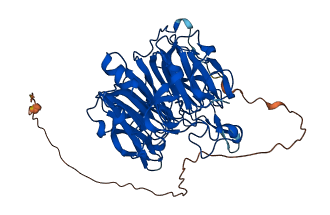
Descriptions
The autoinhibited protein was predicted that may have potential autoinhibitory elements via cis-regPred.
Autoinhibitory domains (AIDs)
Target domain |
|
Relief mechanism |
|
Assay |
cis-regPred |
Accessory elements
No accessory elements
Autoinhibited structure

Activated structure
1 structures for Q8BK67
| Entry ID | Method | Resolution | Chain | Position | Source |
|---|---|---|---|---|---|
| AF-Q8BK67-F1 | Predicted | AlphaFoldDB |
14 variants for Q8BK67
| Variant ID(s) | Position | Change | Description | Diseaes Association | Provenance |
|---|---|---|---|---|---|
| rs3395048573 | 8 | A>T | No | EVA | |
| rs3388727449 | 94 | K>* | No | EVA | |
| rs3388714541 | 103 | Q>R | No | EVA | |
| rs13462328 | 216 | T>S | No | EVA | |
| rs3388718624 | 226 | E>* | No | EVA | |
| rs3388731750 | 251 | G>E | No | EVA | |
| rs3388723952 | 255 | T>I | No | EVA | |
| rs3388719823 | 365 | Q>H | No | EVA | |
| rs3388726943 | 401 | G>D | No | EVA | |
| rs3394451984 | 420 | K>Q | No | EVA | |
| rs3388730842 | 434 | A>T | No | EVA | |
| rs3388726998 | 476 | V>E | No | EVA | |
| rs3388727245 | 513 | P>T | No | EVA | |
| rs3394999214 | 515 | Y>* | No | EVA |
No associated diseases with Q8BK67
Functions
9 GO annotations of cellular component
| Name | Definition |
|---|---|
| chromosome, centromeric core domain | The innermost portion of the centromeric region of a chromosome, encompassing the core region of a chromosome centromere and the proteins that bind to it. |
| early endosome membrane | The lipid bilayer surrounding an early endosome. |
| membrane | A lipid bilayer along with all the proteins and protein complexes embedded in it an attached to it. |
| microtubule | Any of the long, generally straight, hollow tubes of internal diameter 12-15 nm and external diameter 24 nm found in a wide variety of eukaryotic cells; each consists (usually) of 13 protofilaments of polymeric tubulin, staggered in such a manner that the tubulin monomers are arranged in a helical pattern on the microtubular surface, and with the alpha/beta axes of the tubulin subunits parallel to the long axis of the tubule; exist in equilibrium with pool of tubulin monomers and can be rapidly assembled or disassembled in response to physiological stimuli; concerned with force generation, e.g. in the spindle. |
| midbody | A thin cytoplasmic bridge formed between daughter cells at the end of cytokinesis. The midbody forms where the contractile ring constricts, and may persist for some time before finally breaking to complete cytokinesis. |
| mitotic spindle midzone | The area in the center of the anaphase spindle consisting of microtubules, microtubule bundling factors and kinesin motors where the spindle microtubules from opposite poles overlap in an antiparallel manner. |
| nucleolus | A small, dense body one or more of which are present in the nucleus of eukaryotic cells. It is rich in RNA and protein, is not bounded by a limiting membrane, and is not seen during mitosis. Its prime function is the transcription of the nucleolar DNA into 45S ribosomal-precursor RNA, the processing of this RNA into 5.8S, 18S, and 28S components of ribosomal RNA, and the association of these components with 5S RNA and proteins synthesized outside the nucleolus. This association results in the formation of ribonucleoprotein precursors; these pass into the cytoplasm and mature into the 40S and 60S subunits of the ribosome. |
| nucleus | A membrane-bounded organelle of eukaryotic cells in which chromosomes are housed and replicated. In most cells, the nucleus contains all of the cell's chromosomes except the organellar chromosomes, and is the site of RNA synthesis and processing. In some species, or in specialized cell types, RNA metabolism or DNA replication may be absent. |
| plasma membrane | The membrane surrounding a cell that separates the cell from its external environment. It consists of a phospholipid bilayer and associated proteins. |
5 GO annotations of molecular function
| Name | Definition |
|---|---|
| guanyl-nucleotide exchange factor activity | Stimulates the exchange of GDP to GTP on a signaling GTPase, changing its conformation to its active form. Guanine nucleotide exchange factors (GEFs) act by stimulating the release of guanosine diphosphate (GDP) to allow binding of guanosine triphosphate (GTP), which is more abundant in the cell under normal cellular physiological conditions. |
| microtubule binding | Binding to a microtubule, a filament composed of tubulin monomers. |
| protein domain specific binding | Binding to a specific domain of a protein. |
| protein kinase binding | Binding to a protein kinase, any enzyme that catalyzes the transfer of a phosphate group, usually from ATP, to a protein substrate. |
| small GTPase binding | Binding to a small monomeric GTPase. |
15 GO annotations of biological process
| Name | Definition |
|---|---|
| activation of GTPase activity | Any process that initiates the activity of an inactive GTPase through the replacement of GDP by GTP. |
| cell cycle | The progression of biochemical and morphological phases and events that occur in a cell during successive cell replication or nuclear replication events. Canonically, the cell cycle comprises the replication and segregation of genetic material followed by the division of the cell, but in endocycles or syncytial cells nuclear replication or nuclear division may not be followed by cell division. |
| cell division | The process resulting in division and partitioning of components of a cell to form more cells; may or may not be accompanied by the physical separation of a cell into distinct, individually membrane-bounded daughter cells. |
| chromosome passenger complex localization to kinetochore | A cellular protein complex localization that acts on a chromosome passenger complex; as a result, the complex is transported to, or maintained in, a specific location at the kinetochore. A chromosome passenger complex is a protein complex that contains the BIR-domain-containing protein Survivin, Aurora B kinase, INCENP and Borealin, and coordinates various events based on its location to different structures during the course of mitosis. |
| establishment of protein localization | The directed movement of a protein to a specific location. |
| focal adhesion assembly | The aggregation and bonding together of a set of components to form a focal adhesion, a complex of intracellular signaling and structural proteins that provides a structural link between the internal actin cytoskeleton and the ECM, and also function as a locus of signal transduction activity. |
| integrin-mediated signaling pathway | The series of molecular signals initiated by an extracellular ligand binding to an integrin on the surface of a target cell, and ending with the regulation of a downstream cellular process, e.g. transcription. |
| negative regulation of focal adhesion assembly | Any process that stops, prevents, or reduces the frequency, rate or extent of focal adhesion assembly, the establishment and maturation of focal adhesions. |
| negative regulation of GTPase activity | Any process that stops or reduces the rate of GTP hydrolysis by a GTPase. |
| negative regulation of substrate adhesion-dependent cell spreading | Any process that stops, prevents or reduces the frequency, rate or extent of substrate adhesion-dependent cell spreading. |
| positive regulation of attachment of spindle microtubules to kinetochore | Any process that activates or increases the frequency, rate or extent of the attachment of spindle microtubules to the kinetochore. |
| positive regulation of G2/M transition of mitotic cell cycle | Any signalling pathway that activates or increases the activity of a cell cycle cyclin-dependent protein kinase to modulate the switch from G2 phase to M phase of the mitotic cell cycle. |
| regulation of cell migration | Any process that modulates the frequency, rate or extent of cell migration. |
| regulation of fibroblast migration | Any process that modulates the rate, frequency or extent of fibroblast cell migration. Fibroblast cell migration is accomplished by extension and retraction of a pseudopodium. |
| regulation of ruffle assembly | Any process that modulates the frequency, rate or extent of ruffle assembly. |
1 homologous proteins in AiPD
| UniProt AC | Gene Name | Protein Name | Species | Evidence Code |
|---|---|---|---|---|
| Q9P258 | RCC2 | Protein RCC2 | Homo sapiens (Human) | PR |
| 10 | 20 | 30 | 40 | 50 | 60 |
| MPRKKGAAWE | EPSSGNGTAR | AGPRRRGGPA | GRKRERPERC | SSSSGGGSSG | DEDGPELDGA |
| 70 | 80 | 90 | 100 | 110 | 120 |
| PGGGKRTARP | ATAGKAAGAA | AIITEPEHTK | ERVKLEGSKC | KGQLLIFGAT | NWDLIGRKEV |
| 130 | 140 | 150 | 160 | 170 | 180 |
| PKQQAAYRNL | GQNLWGPHRY | GCLSGVRVRT | VVSGSCAAHS | LLITTEGKLW | SWGRNEKGQL |
| 190 | 200 | 210 | 220 | 230 | 240 |
| GHGDTKRVEA | PRLIEALSHE | AIVLAACGRN | HTLALTDTGS | VFAFGENKMG | QLGLGNQTDA |
| 250 | 260 | 270 | 280 | 290 | 300 |
| VPSPAQIMYN | GQPITKMACG | AEFSMLMDCK | GNLYSFGCPE | YGQLGHNSDG | KFIARAQRIE |
| 310 | 320 | 330 | 340 | 350 | 360 |
| YDCELVPRRV | AIFIEKTKDG | QILPVPNVVV | RDVACGANHT | LVLDSQKRVF | SWGFGGYGRL |
| 370 | 380 | 390 | 400 | 410 | 420 |
| GHAEQKDEMV | PRLVKLFDFP | GRGATQIYAG | YTCSFAVSEV | GGLFFWGATN | TSRESTMYPK |
| 430 | 440 | 450 | 460 | 470 | 480 |
| AVQDLCGWRI | RSLACGKSSI | IVAADESTIS | WGPSPTFGEL | GYGDHKPKSS | TAAQEVKTLD |
| 490 | 500 | 510 | |||
| GIFSEQVAMG | YSHSLVIARD | ESEAEKEKLQ | RLPEYTPRTL |