Q8BGW1
Gene name |
Fto |
Protein name |
Alpha-ketoglutarate-dependent dioxygenase FTO |
Names |
Fat mass and obesity-associated protein, Protein fatso, U6 small nuclear RNA (2'-O-methyladenosine-N(6)-)-demethylase FTO, U6 small nuclear RNA N(6)-methyladenosine-demethylase FTO, mRNA (2'-O-methyladenosine-N(6)-)-demethylase FTO, m6A(m)-demethylase FTO, mRNA N(6)-methyladenosine demethylase FTO, tRNA N1-methyl adenine demethylase FTO |
Species |
Mus musculus (Mouse) |
KEGG Pathway |
mmu:26383 |
EC number |
1.14.11.53: With 2-oxoglutarate as one donor, and incorporation of one atom each of oxygen into both donors |
Protein Class |
|
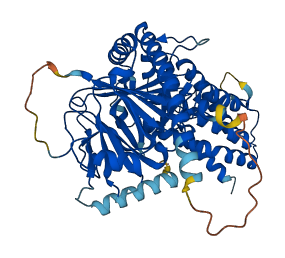
Descriptions
The autoinhibited protein was predicted that may have potential autoinhibitory elements via cis-regPred.
Autoinhibitory domains (AIDs)
Target domain |
|
Relief mechanism |
|
Assay |
cis-regPred |
Accessory elements
No accessory elements
Autoinhibited structure

Activated structure
1 structures for Q8BGW1
| Entry ID | Method | Resolution | Chain | Position | Source |
|---|---|---|---|---|---|
| AF-Q8BGW1-F1 | Predicted | AlphaFoldDB |
24 variants for Q8BGW1
| Variant ID(s) | Position | Change | Description | Diseaes Association | Provenance |
|---|---|---|---|---|---|
| rs3388994380 | 6 | T>I | No | EVA | |
| rs3389001642 | 26 | T>I | No | EVA | |
| rs3389004808 | 38 | F>L | No | EVA | |
| rs3388987987 | 40 | Q>H | No | EVA | |
| rs241846283 | 55 | G>C | No | EVA | |
| rs3399156814 | 113 | L>P | No | EVA | |
| rs3388987914 | 117 | P>S | No | EVA | |
| rs3399496844 | 118 | W>G | No | EVA | |
| rs3388951433 | 125 | V>I | No | EVA | |
| rs3388998828 | 168 | V>L | No | EVA | |
| rs3389003914 | 207 | Q>H | No | EVA | |
| rs3388976710 | 220 | M>R | No | EVA | |
| rs3388976710 | 220 | M>T | No | EVA | |
| rs3388997391 | 243 | S>N | No | EVA | |
| rs3388968980 | 299 | N>H | No | EVA | |
| rs3389001656 | 302 | H>N | No | EVA | |
| rs32686383 | 384 | N>S | No | EVA | |
| rs33176343 | 410 | M>V | No | EVA | |
| rs3389001431 | 435 | I>S | No | EVA | |
| rs33234061 | 463 | V>A | No | EVA | |
| rs3388997422 | 470 | R>L | No | EVA | |
| rs3388998834 | 481 | P>S | No | EVA | |
| rs3388992550 | 484 | F>S | No | EVA | |
| rs3389001692 | 503 | S>K | No | EVA |
No associated diseases with Q8BGW1
Functions
| Description | ||
|---|---|---|
| EC Number | 1.14.11.53 | With 2-oxoglutarate as one donor, and incorporation of one atom each of oxygen into both donors |
| Subcellular Localization |
|
|
| PANTHER Family | ||
| PANTHER Subfamily | ||
| PANTHER Protein Class | ||
| PANTHER Pathway Category | No pathway information available | |
6 GO annotations of cellular component
| Name | Definition |
|---|---|
| cytoplasm | The contents of a cell excluding the plasma membrane and nucleus, but including other subcellular structures. |
| cytosol | The part of the cytoplasm that does not contain organelles but which does contain other particulate matter, such as protein complexes. |
| intracellular membrane-bounded organelle | Organized structure of distinctive morphology and function, bounded by a single or double lipid bilayer membrane and occurring within the cell. Includes the nucleus, mitochondria, plastids, vacuoles, and vesicles. Excludes the plasma membrane. |
| nuclear speck | A discrete extra-nucleolar subnuclear domain, 20-50 in number, in which splicing factors are seen to be localized by immunofluorescence microscopy. |
| nucleus | A membrane-bounded organelle of eukaryotic cells in which chromosomes are housed and replicated. In most cells, the nucleus contains all of the cell's chromosomes except the organellar chromosomes, and is the site of RNA synthesis and processing. In some species, or in specialized cell types, RNA metabolism or DNA replication may be absent. |
| plasma membrane | The membrane surrounding a cell that separates the cell from its external environment. It consists of a phospholipid bilayer and associated proteins. |
6 GO annotations of molecular function
| Name | Definition |
|---|---|
| DNA-N1-methyladenine dioxygenase activity | Catalysis of the oxidative demethylation of N1-methyladenine and N3-methylcytosine in DNA, with concomitant decarboxylation of 2-oxoglutarate and releases oxidized methyl group on N1-methyladenine and N3-methylcytosine as formaldehyde. |
| ferrous iron binding | Binding to a ferrous iron ion, Fe(II). |
| mRNA N6-methyladenosine dioxygenase activity | Catalysis of the oxidative demethylation of N6-methyladenosine RNA, with concomitant decarboxylation of 2-oxoglutarate and releases oxidized methyl group on N6-methyladenosine as formaldehyde. |
| oxidative DNA demethylase activity | Catalysis of the reaction: a methylated nucleobase within DNA + 2-oxoglutarate + O(2) = a nucleobase within DNA + formaldehyde + succinate + CO(2). |
| oxidative RNA demethylase activity | Catalysis of the removal of a methyl group from one or more nucleosides within a RNA molecule involving the oxidation (i.e. electron loss) of one or more atoms. |
| tRNA demethylase activity | Catalysis of the removal of a methyl group from one or more positions within a tRNA molecule. |
14 GO annotations of biological process
| Name | Definition |
|---|---|
| adipose tissue development | The process whose specific outcome is the progression of adipose tissue over time, from its formation to the mature structure. Adipose tissue is specialized tissue that is used to store fat. |
| DNA dealkylation involved in DNA repair | The repair of alkylation damage, e.g. the removal of the alkyl group at the O6-position of guanine by O6-alkylguanine-DNA alkyltransferase (AGT). |
| DNA demethylation | The removal of a methyl group from one or more nucleotides within an DNA molecule. |
| mRNA destabilization | Any process that decreases the stability of an mRNA molecule, making it more vulnerable to degradative processes. Messenger RNA is the intermediate molecule between DNA and protein. It includes UTR and coding sequences. It does not contain introns. |
| oxidative demethylation | The process of removing one or more methyl groups from a molecule, involving the oxidation (i.e. electron loss) of one or more atoms in the substrate. |
| oxidative single-stranded DNA demethylation | Removal of the methyl group from one or more nucleotides within a single-stranded DNA molecule involving the oxidation (i.e. electron loss) of one or more atoms. |
| oxidative single-stranded RNA demethylation | Removal of the methyl group from one or more nucleotides within a single-stranded RNA molecule involving the oxidation (i.e. electron loss) of one or more atoms. |
| regulation of brown fat cell differentiation | Any process that modulates the rate, frequency, or extent of brown fat cell differentiation. Brown fat cell differentiation is the process in which a relatively unspecialized cell acquires specialized features of a brown adipocyte, an animal connective tissue cell involved in adaptive thermogenesis. Brown adipocytes contain multiple small droplets of triglycerides and a high number of mitochondria. |
| regulation of lipid storage | Any process that modulates the rate, frequency or extent of lipid storage. Lipid storage is the accumulation and maintenance in cells or tissues of lipids, compounds soluble in organic solvents but insoluble or sparingly soluble in aqueous solvents. Lipid reserves can be accumulated during early developmental stages for mobilization and utilization at later stages of development. |
| regulation of multicellular organism growth | Any process that modulates the frequency, rate or extent of growth of the body of an organism so that it reaches its usual body size. |
| regulation of respiratory system process | Any process that modulates the frequency, rate or extent of a respiratory system process, an organ system process carried out by any of the organs or tissues of the respiratory system. |
| regulation of white fat cell proliferation | Any process that modulates the frequency, rate or extent of white fat cell proliferation. |
| RNA repair | Any process that results in the repair of damaged RNA. |
| temperature homeostasis | A homeostatic process in which an organism modulates its internal body temperature. |
1 homologous proteins in AiPD
| UniProt AC | Gene Name | Protein Name | Species | Evidence Code |
|---|---|---|---|---|
| Q9C0B1 | FTO | Alpha-ketoglutarate-dependent dioxygenase FTO | Homo sapiens (Human) | PR |
| 10 | 20 | 30 | 40 | 50 | 60 |
| MKRVQTAEER | EREAKKLRLL | EELEDTWLPY | LTPKDDEFYQ | QWQLKYPKLV | FREAGSIPEE |
| 70 | 80 | 90 | 100 | 110 | 120 |
| LHKEVPEAFL | TLHKHGCLFR | DVVRIQGKDV | LTPVSRILIG | DPGCTYKYLN | TRLFTVPWPV |
| 130 | 140 | 150 | 160 | 170 | 180 |
| KGCTVKYTEA | EIAAACQTFL | KLNDYLQVET | IQALEELAVR | EKANEDAVPL | CMAEFPRAGV |
| 190 | 200 | 210 | 220 | 230 | 240 |
| GPSCDDEVDL | KSRAAYNVTL | LNFMDPQKMP | YLKEEPYFGM | GKMAVSWHHD | ENLVDRSAVA |
| 250 | 260 | 270 | 280 | 290 | 300 |
| VYSYSCEGSE | DESEDESSFE | GRDPDTWHVG | FKISWDIETP | GLTIPLHQGD | CYFMLDDLNA |
| 310 | 320 | 330 | 340 | 350 | 360 |
| THQHCVLAGS | QPRFSSTHRV | AECSTGTLDY | ILERCQLALQ | NVLNDSDDGD | VSLKSFDPAV |
| 370 | 380 | 390 | 400 | 410 | 420 |
| LKQGEEIHNE | VEFEWLRQFW | FQGNRYKLCT | DWWCEPMTHL | EGLWKKMESM | TNAVLREVKR |
| 430 | 440 | 450 | 460 | 470 | 480 |
| EGLPVEQRSE | ILSAILVPLT | VRQNLRKEWH | ARCQSRVVRT | LPVQQKPDCR | PYWEKDDPSM |
| 490 | 500 | ||||
| PLPFDLTDVV | SELRGQLLEA | RS |