Q8AXB4
Gene name |
pak3 |
Protein name |
Serine/threonine-protein kinase PAK 3 |
Names |
p21-activated kinase 3, PAK-3 |
Species |
Xenopus laevis (African clawed frog) |
KEGG Pathway |
xla:378493 |
EC number |
|
Protein Class |
|
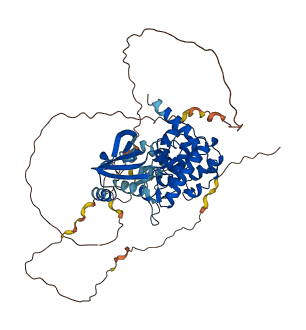
Descriptions
The autoinhibited protein was predicted that may have potential autoinhibitory elements via cis-regPred.
Autoinhibitory domains (AIDs)
Target domain |
|
Relief mechanism |
|
Assay |
cis-regPred |
Accessory elements
424-447 (Activation loop from InterPro)
Target domain |
268-564 (Catalytic domain of the Protein Serine/Threonine Kinase, p21-activated kinase 3) |
Relief mechanism |
|
Assay |
|
Autoinhibited structure

Activated structure
1 structures for Q8AXB4
| Entry ID | Method | Resolution | Chain | Position | Source |
|---|---|---|---|---|---|
| AF-Q8AXB4-F1 | Predicted | AlphaFoldDB |
No variants for Q8AXB4
| Variant ID(s) | Position | Change | Description | Diseaes Association | Provenance |
|---|---|---|---|---|---|
| No variants for Q8AXB4 | |||||
No associated diseases with Q8AXB4
6 regional properties for Q8AXB4
| Type | Name | Position | InterPro Accession |
|---|---|---|---|
| domain | CRIB domain | 69 - 141 | IPR000095 |
| domain | Protein kinase domain | 288 - 539 | IPR000719 |
| active_site | Serine/threonine-protein kinase, active site | 403 - 415 | IPR008271 |
| binding_site | Protein kinase, ATP binding site | 294 - 317 | IPR017441 |
| domain | p21 activated kinase binding domain | 68 - 128 | IPR033923 |
| domain | p21-activated kinase 3, catalytic domain | 268 - 564 | IPR035063 |
1 GO annotations of cellular component
| Name | Definition |
|---|---|
| cytoplasm | The contents of a cell excluding the plasma membrane and nucleus, but including other subcellular structures. |
4 GO annotations of molecular function
| Name | Definition |
|---|---|
| ATP binding | Binding to ATP, adenosine 5'-triphosphate, a universally important coenzyme and enzyme regulator. |
| metal ion binding | Binding to a metal ion. |
| protein serine kinase activity | Catalysis of the reactions: ATP + protein serine = ADP + protein serine phosphate. |
| protein serine/threonine kinase activity | Catalysis of the reactions: ATP + protein serine = ADP + protein serine phosphate, and ATP + protein threonine = ADP + protein threonine phosphate. |
9 GO annotations of biological process
| Name | Definition |
|---|---|
| anterior neural plate formation | The formation of anterior end of the flat, thickened layer of ectodermal cells known as the neural plate. |
| cell cycle | The progression of biochemical and morphological phases and events that occur in a cell during successive cell replication or nuclear replication events. Canonically, the cell cycle comprises the replication and segregation of genetic material followed by the division of the cell, but in endocycles or syncytial cells nuclear replication or nuclear division may not be followed by cell division. |
| cell differentiation | The process in which relatively unspecialized cells, e.g. embryonic or regenerative cells, acquire specialized structural and/or functional features that characterize the cells, tissues, or organs of the mature organism or some other relatively stable phase of the organism's life history. Differentiation includes the processes involved in commitment of a cell to a specific fate and its subsequent development to the mature state. |
| cement gland development | The process whose specific outcome is the progression of the cement gland over time, from its formation to the mature structure. The cement gland is a simple mucus-secreting organ positioned at the anterior of amphibious embryos. The cement gland attaches the newly hatched embryo to a support before the hatchling can swim well or feed. |
| negative regulation of neuroblast proliferation | Any process that stops, prevents, or reduces the frequency, rate or extent of the proliferation of neuroblasts. |
| neural plate formation | The formation of the flat, thickened layer of ectodermal cells known as the neural plate. The underlying dorsal mesoderm signals the ectodermal cells above it to elongate into columnar neural plate cells. The neural plate subsequently develops into the neural tube, which gives rise to the central nervous system. |
| positive regulation of neuron differentiation | Any process that activates or increases the frequency, rate or extent of neuron differentiation. |
| protein phosphorylation | The process of introducing a phosphate group on to a protein. |
| regulation of cell cycle | Any process that modulates the rate or extent of progression through the cell cycle. |
No homologous proteins in AiPD
| UniProt AC | Gene Name | Protein Name | Species | Evidence Code |
|---|---|---|---|---|
| No homologous proteins | ||||
| 10 | 20 | 30 | 40 | 50 | 60 |
| MSDSVDIEEK | PPAPPLRMNS | NNRDSSALNH | CSKPLPMAPE | EKNKKARLRS | IFPGGGDKTN |
| 70 | 80 | 90 | 100 | 110 | 120 |
| KKKEKERPEI | SLPSDFEHTI | HVGFDAVTGE | FTPDLCGSQM | GTGKLPEGIP | EQWARLLQTS |
| 130 | 140 | 150 | 160 | 170 | 180 |
| NITKLEQKKN | PQAVLDVLKF | YDSKETVNNQ | KYMSFTSGDK | SAHGYIAAHS | LNAKTASEPP |
| 190 | 200 | 210 | 220 | 230 | 240 |
| LAPPVSEEED | EEEEEEEDDN | EPPPVIAPRP | EHTKSIYTRS | VIEPVALTAP | AKEASTSPVT |
| 250 | 260 | 270 | 280 | 290 | 300 |
| PQPENSNSST | STLYRNTDRQ | RKKSKMTDEE | ILEKLRSIVS | VGDPKKKYTR | FEKIGQGASG |
| 310 | 320 | 330 | 340 | 350 | 360 |
| TVYTAIDIAT | GQEVAIKQMN | LQQQPKKELI | INEILVMREN | KNPNIVNYLD | SYLVGDELWV |
| 370 | 380 | 390 | 400 | 410 | 420 |
| VMEYLAGGSL | TDVVTETCMD | EGQIAAVCRE | CLQALDFLHS | NQVIHRDIKS | DNILLGMDGS |
| 430 | 440 | 450 | 460 | 470 | 480 |
| VKLTDFGFCA | QITPEQSKRS | TMVGTPYWMA | PEVVTRKAYG | PKVDIWSLGI | MAIEMVEGEP |
| 490 | 500 | 510 | 520 | 530 | 540 |
| PYLNENPLRA | LYLIATNGTP | ELQNPERLSA | IFRDFLNRCL | EMDVDRRGSA | KELLQHPFLK |
| 550 | 560 | ||||
| IAKPLSSLTP | LIIAAKEAIK | NSSR |