Q8A9C3
Gene name |
pyrD (BT_0892) |
Protein name |
Dihydroorotate dehydrogenase B (NAD(+)), catalytic subunit |
Names |
DHOD B, DHODase B, DHOdehase B, Dihydroorotate oxidase B, Orotate reductase (NADH) |
Species |
Bacteroides thetaiotaomicron (strain ATCC 29148 / DSM 2079 / JCM 5827 / CCUG 10774 / NCTC 10582 / VPI-5482 / E50) |
KEGG Pathway |
bth:BT_0892 |
EC number |
1.3.1.14: With NAD(+) or NADP(+) as acceptor |
Protein Class |
|
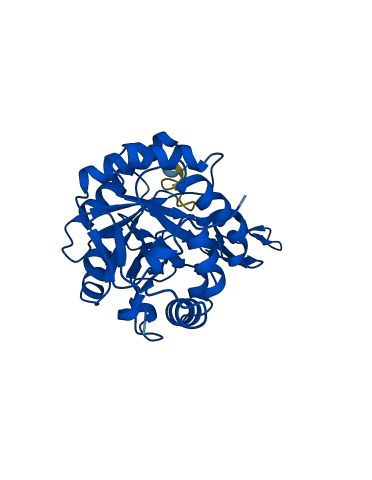
Descriptions
The autoinhibited protein was predicted that may have potential autoinhibitory elements via cis-regPred.
Autoinhibitory domains (AIDs)
Target domain |
|
Relief mechanism |
|
Assay |
cis-regPred |
Accessory elements
No accessory elements
Autoinhibited structure

Activated structure
1 structures for Q8A9C3
| Entry ID | Method | Resolution | Chain | Position | Source |
|---|---|---|---|---|---|
| AF-Q8A9C3-F1 | Predicted | AlphaFoldDB |
No variants for Q8A9C3
| Variant ID(s) | Position | Change | Description | Diseaes Association | Provenance |
|---|---|---|---|---|---|
| No variants for Q8A9C3 | |||||
No associated diseases with Q8A9C3
3 regional properties for Q8A9C3
| Type | Name | Position | InterPro Accession |
|---|---|---|---|
| conserved_site | Dihydroorotate dehydrogenase, conserved site | 40 - 59 | IPR001295-1 |
| conserved_site | Dihydroorotate dehydrogenase, conserved site | 239 - 259 | IPR001295-2 |
| domain | Dihydroorotate dehydrogenase domain | 4 - 299 | IPR005720 |
Functions
| Description | ||
|---|---|---|
| EC Number | 1.3.1.14 | With NAD(+) or NADP(+) as acceptor |
| Subcellular Localization |
|
|
| PANTHER Family | ||
| PANTHER Subfamily | ||
| PANTHER Protein Class | ||
| PANTHER Pathway Category | No pathway information available | |
1 GO annotations of cellular component
| Name | Definition |
|---|---|
| cytoplasm | The contents of a cell excluding the plasma membrane and nucleus, but including other subcellular structures. |
2 GO annotations of molecular function
| Name | Definition |
|---|---|
| dihydroorotate dehydrogenase activity | Catalysis of the reaction: (S)-dihydroorotate + A = AH(2) + orotate. |
| orotate reductase (NADH) activity | Catalysis of the reaction: (S)-dihydroorotate + NAD(+) = H(+) + NADH + orotate. |
2 GO annotations of biological process
| Name | Definition |
|---|---|
| 'de novo' pyrimidine nucleobase biosynthetic process | The chemical reactions and pathways resulting in the formation of pyrimidine nucleobases, 1,3-diazine, organic nitrogenous bases, beginning with the synthesis of a pyrimidine ring from simpler precursors. |
| 'de novo' UMP biosynthetic process | The chemical reactions and pathways resulting in the formation of UMP, uridine monophosphate, starting with the synthesis of (S)-dihydroorotate from bicarbonate; UMP biosynthesis may either occur via reduction by quinone, NAD(+) or oxygen. |
No homologous proteins in AiPD
| UniProt AC | Gene Name | Protein Name | Species | Evidence Code |
|---|---|---|---|---|
| No homologous proteins | ||||
| 10 | 20 | 30 | 40 | 50 | 60 |
| MADLSVNIGE | LQMKNPVMTA | SGTFGYGEEF | SDFIDIARIG | GIIVKGTTLH | KREGNPYPRM |
| 70 | 80 | 90 | 100 | 110 | 120 |
| AETPSGMLNA | VGLQNKGVDY | FVEQIYPRIK | DIQTNMIVNV | SGSAIEDYVK | TAEIINELDK |
| 130 | 140 | 150 | 160 | 170 | 180 |
| IPAIELNISC | PNVKQGGMAF | GVSAKGASEV | VKAVRAAYKK | TLIVKLSPNV | TDITEIARAA |
| 190 | 200 | 210 | 220 | 230 | 240 |
| EESGADSVSL | INTLLGMAID | AERKRPILST | VTGGMSGAAV | KPIALRMVWQ | VAKAVNIPVI |
| 250 | 260 | 270 | 280 | 290 | 300 |
| GLGGIMNWKD | AVEFMLAGAS | AIQIGTANFI | DPAVTIKVED | GINNYLERHG | CKSVKEIIGA |
| LEV |