Q8A0F5
Gene name |
nuoB |
Protein name |
NADH-quinone oxidoreductase subunit B |
Names |
NADH dehydrogenase I subunit B, NDH-1 subunit B |
Species |
Bacteroides thetaiotaomicron (strain ATCC 29148 / DSM 2079 / JCM 5827 / CCUG 10774 / NCTC 10582 / VPI-5482 / E50) |
KEGG Pathway |
bth:BT_4066 |
EC number |
|
Protein Class |
|
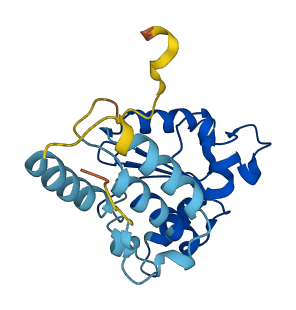
Descriptions
The autoinhibited protein was predicted that may have potential autoinhibitory elements via cis-regPred.
Autoinhibitory domains (AIDs)
Target domain |
|
Relief mechanism |
|
Assay |
cis-regPred |
Accessory elements
No accessory elements
Autoinhibited structure

Activated structure
1 structures for Q8A0F5
| Entry ID | Method | Resolution | Chain | Position | Source |
|---|---|---|---|---|---|
| AF-Q8A0F5-F1 | Predicted | AlphaFoldDB |
No variants for Q8A0F5
| Variant ID(s) | Position | Change | Description | Diseaes Association | Provenance |
|---|---|---|---|---|---|
| No variants for Q8A0F5 | |||||
No associated diseases with Q8A0F5
1 regional properties for Q8A0F5
| Type | Name | Position | InterPro Accession |
|---|---|---|---|
| domain | NADH:ubiquinone oxidoreductase-like, 20kDa subunit | 63 - 173 | IPR006137 |
1 GO annotations of cellular component
| Name | Definition |
|---|---|
| plasma membrane respiratory chain complex I | A subcomplex of the respiratory chain located in the plasma membrane. It contains about 25 different polypeptide subunits, including NADH dehydrogenase (ubiquinone), flavin mononucleotide and several different iron-sulfur clusters containing non-heme iron. The iron undergoes oxidation-reduction between Fe(II) and Fe(III), and catalyzes proton translocation linked to the oxidation of NADH by ubiquinone. Examples of this component are found in bacterial species. |
4 GO annotations of molecular function
| Name | Definition |
|---|---|
| 4 iron, 4 sulfur cluster binding | Binding to a 4 iron, 4 sulfur (4Fe-4S) cluster; this cluster consists of four iron atoms, with the inorganic sulfur atoms found between the irons and acting as bridging ligands. |
| iron ion binding | Binding to an iron (Fe) ion. |
| NADH dehydrogenase (ubiquinone) activity | Catalysis of the reaction: NADH + ubiquinone + 5 H(+)(in) <=> NAD(+) + ubiquinol + 4 H(+)(out). |
| quinone binding | Binding to a quinone, any member of a class of diketones derivable from aromatic compounds by conversion of two CH groups into CO groups with any necessary rearrangement of double bonds. |
2 GO annotations of biological process
| Name | Definition |
|---|---|
| aerobic respiration | The enzymatic release of energy from inorganic and organic compounds (especially carbohydrates and fats) which requires oxygen as the terminal electron acceptor. |
| electron transport coupled proton transport | The transport of protons against an electrochemical gradient, using energy from electron transport. |
No homologous proteins in AiPD
| UniProt AC | Gene Name | Protein Name | Species | Evidence Code |
|---|---|---|---|---|
| No homologous proteins | ||||
| 10 | 20 | 30 | 40 | 50 | 60 |
| MEITKKPKIK | SIPYDEFIDN | ESLEKLVKEL | NTGGANVFLG | VLDDLVNWGR | SNSLWPLTFA |
| 70 | 80 | 90 | 100 | 110 | 120 |
| TSCCGIEFMA | LGAARYDMAR | FGFEVARASP | RQADMIMVCG | TITNKMAPVL | KRLYDQMPDP |
| 130 | 140 | 150 | 160 | 170 | 180 |
| KYVVAVGGCA | VSGGPFKKSY | HVLNGVDKIL | PVDVYIPGCP | PRPEAFYYGM | MQLQRKVKIE |
| 190 | |||||
| KFFGGTNRKE | KKPEFMK |