Q87ST4
Gene name |
surA |
Protein name |
Chaperone SurA |
Names |
Peptidyl-prolyl cis-trans isomerase SurA, PPIase SurA, Rotamase SurA |
Species |
Vibrio parahaemolyticus serotype O3:K6 (strain RIMD 2210633) |
KEGG Pathway |
vpa:VP0338 |
EC number |
5.2.1.8: Cis-trans isomerases |
Protein Class |
|
Descriptions
The autoinhibited protein was predicted that may have potential autoinhibitory elements via cis-regPred.
Autoinhibitory domains (AIDs)
Target domain |
|
Relief mechanism |
|
Assay |
cis-regPred |
Accessory elements
No accessory elements
Autoinhibited structure

Activated structure
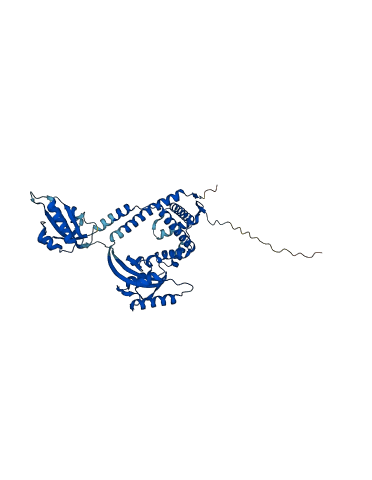
1 structures for Q87ST4
| Entry ID | Method | Resolution | Chain | Position | Source |
|---|---|---|---|---|---|
| AF-Q87ST4-F1 | Predicted | AlphaFoldDB |
No variants for Q87ST4
| Variant ID(s) | Position | Change | Description | Diseaes Association | Provenance |
|---|---|---|---|---|---|
| No variants for Q87ST4 | |||||
No associated diseases with Q87ST4
3 regional properties for Q87ST4
| Type | Name | Position | InterPro Accession |
|---|---|---|---|
| domain | Peptidyl-prolyl cis-trans isomerase, PpiC-type | 170 - 268 | IPR000297-1 |
| domain | Peptidyl-prolyl cis-trans isomerase, PpiC-type | 277 - 377 | IPR000297-2 |
| domain | SurA N-terminal | 24 - 141 | IPR015391 |
Functions
| Description | ||
|---|---|---|
| EC Number | 5.2.1.8 | Cis-trans isomerases |
| Subcellular Localization |
|
|
| PANTHER Family | ||
| PANTHER Subfamily | ||
| PANTHER Protein Class | ||
| PANTHER Pathway Category | No pathway information available | |
1 GO annotations of cellular component
| Name | Definition |
|---|---|
| outer membrane-bounded periplasmic space | The region between the inner (cytoplasmic or plasma) membrane and outer membrane of organisms with two membranes such as Gram negative bacteria. These periplasmic spaces are relatively thick and contain a thin peptidoglycan layer (PGL), also referred to as a thin cell wall. |
3 GO annotations of molecular function
| Name | Definition |
|---|---|
| peptide binding | Binding to a peptide, an organic compound comprising two or more amino acids linked by peptide bonds. |
| peptidyl-prolyl cis-trans isomerase activity | Catalysis of the reaction: peptidyl-proline (omega=180) = peptidyl-proline (omega=0). |
| unfolded protein binding | Binding to an unfolded protein. |
3 GO annotations of biological process
| Name | Definition |
|---|---|
| Gram-negative-bacterium-type cell outer membrane assembly | The assembly of an outer membrane of the type formed in Gram-negative bacteria. This membrane is enriched in polysaccharide and protein, and the outer leaflet of the membrane contains specific lipopolysaccharide structures. |
| protein folding | The process of assisting in the covalent and noncovalent assembly of single chain polypeptides or multisubunit complexes into the correct tertiary structure. |
| protein stabilization | Any process involved in maintaining the structure and integrity of a protein and preventing it from degradation or aggregation. |
No homologous proteins in AiPD
| UniProt AC | Gene Name | Protein Name | Species | Evidence Code |
|---|---|---|---|---|
| No homologous proteins | ||||
| 10 | 20 | 30 | 40 | 50 | 60 |
| MKIWKSILFT | TLLSCGAVAA | PVELDKVAVI | VNDGVILQSD | INTAMKTLQA | NARQSGKSLP |
| 70 | 80 | 90 | 100 | 110 | 120 |
| SASVLKEQVV | EKLIIDTLQG | QEADRIGVRI | DDNRLNQAIA | EIARNNNQSV | EELAASVQAE |
| 130 | 140 | 150 | 160 | 170 | 180 |
| GLSYPEFREQ | IRKEIAASEA | RNALVRRRIN | ILPAEVDSLA | DQLAKETNAT | VQYKIGHIQL |
| 190 | 200 | 210 | 220 | 230 | 240 |
| RFTDGQDKSE | VEAQAKALVK | KLNDGADFTE | MAYTYSKGPK | ALQGGDWGWM | RKEEMPTIFA |
| 250 | 260 | 270 | 280 | 290 | 300 |
| DQIKMQNKGS | IIGPFRSGVG | FHILKIEDVK | GLETVAVTEV | NARHILIKPT | VILSDEGAKK |
| 310 | 320 | 330 | 340 | 350 | 360 |
| QLNEFVRRIK | AGEATFAQLA | SQYSQDPGSA | AQDGELGYQT | PDLYVPEFKH | QVETLPVGSI |
| 370 | 380 | 390 | 400 | 410 | 420 |
| SEPFKTVHGW | HIVEVLDRRQ | VDRTDSAMKN | KAYRILFNRK | FNEEAGAWMQ | ELRASAFVEI |
| VDDNNDN |