Q879S3
Gene name |
yidC |
Protein name |
Membrane protein insertase YidC |
Names |
Foldase YidC, Membrane integrase YidC, Membrane protein YidC |
Species |
Xylella fastidiosa (strain Temecula1 / ATCC 700964) |
KEGG Pathway |
xft:PD_2121 |
EC number |
|
Protein Class |
|
Descriptions
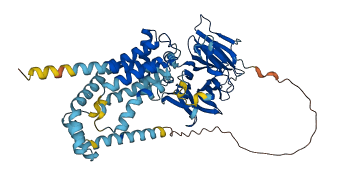
The autoinhibited protein was predicted that may have potential autoinhibitory elements via cis-regPred.
Autoinhibitory domains (AIDs)
Target domain |
|
Relief mechanism |
|
Assay |
cis-regPred |
Accessory elements
No accessory elements
Autoinhibited structure

Activated structure
1 structures for Q879S3
| Entry ID | Method | Resolution | Chain | Position | Source |
|---|---|---|---|---|---|
| AF-Q879S3-F1 | Predicted | AlphaFoldDB |
No variants for Q879S3
| Variant ID(s) | Position | Change | Description | Diseaes Association | Provenance |
|---|---|---|---|---|---|
| No variants for Q879S3 | |||||
4 associated diseases with Q879S3
[MIM: 193700]: Arthrogryposis, distal, 2A (DA2A)
A form of distal arthrogryposis, a disease characterized by congenital joint contractures that mainly involve two or more distal parts of the limbs, in the absence of a primary neurological or muscle disease. DA2A is characterized by contractures of the hands and feet, oropharyngeal abnormalities, scoliosis, and a distinctive face that includes a very small oral orifice, puckered lips, and a H-shaped dimple of the chin. . Note=The disease is caused by variants affecting the gene represented in this entry.
[MIM: 618436]: Arthrogryposis, distal, 2B3 (DA2B3)
A form of distal arthrogryposis, a disease characterized by congenital joint contractures that mainly involve two or more distal parts of the limbs, in the absence of a primary neurological or muscle disease. Distal arthrogryposis type 2 is characterized by contractures of the hands and feet, and a distinctive face characterized by prominent nasolabial folds, small mouth and downslanting palpebral fissures. DA2B3 inheritance is autosomal dominant. . Note=The disease is caused by variants affecting the gene represented in this entry.
[MIM: 178110]: Contractures, pterygia, and spondylocarpotarsal fusion syndrome 1A (CPSFS1A)
An autosomal dominant disease characterized by contractures of proximal and distal joints, pterygia involving the neck, axillae, elbows, and/or knees, as well as variable vertebral, carpal, and tarsal fusions and short stature. Progression of vertebral fusions has been observed, and inter- and intrafamilial variability has been reported. . Note=The disease is caused by variants affecting the gene represented in this entry.
[MIM: 618469]: Contractures, pterygia, and spondylocarpotarsal fusion syndrome 1B (CPSFS1B)
An autosomal recessive disease characterized by contractures affecting proximal and distal joints, vertebral fusions and scoliosis, carpal and tarsal fusions as well as webbing of the skin (pterygium) involving the neck, elbows, fingers, and/or knees. Other features include facial dysmorphism, short neck, and absent finger flexion creases. Inter- and intrafamilial variability has been observed. . Note=The disease is caused by variants affecting the gene represented in this entry.
Without disease ID
- A form of distal arthrogryposis, a disease characterized by congenital joint contractures that mainly involve two or more distal parts of the limbs, in the absence of a primary neurological or muscle disease. DA2A is characterized by contractures of the hands and feet, oropharyngeal abnormalities, scoliosis, and a distinctive face that includes a very small oral orifice, puckered lips, and a H-shaped dimple of the chin. . Note=The disease is caused by variants affecting the gene represented in this entry.
- A form of distal arthrogryposis, a disease characterized by congenital joint contractures that mainly involve two or more distal parts of the limbs, in the absence of a primary neurological or muscle disease. Distal arthrogryposis type 2 is characterized by contractures of the hands and feet, and a distinctive face characterized by prominent nasolabial folds, small mouth and downslanting palpebral fissures. DA2B3 inheritance is autosomal dominant. . Note=The disease is caused by variants affecting the gene represented in this entry.
- An autosomal dominant disease characterized by contractures of proximal and distal joints, pterygia involving the neck, axillae, elbows, and/or knees, as well as variable vertebral, carpal, and tarsal fusions and short stature. Progression of vertebral fusions has been observed, and inter- and intrafamilial variability has been reported. . Note=The disease is caused by variants affecting the gene represented in this entry.
- An autosomal recessive disease characterized by contractures affecting proximal and distal joints, vertebral fusions and scoliosis, carpal and tarsal fusions as well as webbing of the skin (pterygium) involving the neck, elbows, fingers, and/or knees. Other features include facial dysmorphism, short neck, and absent finger flexion creases. Inter- and intrafamilial variability has been observed. . Note=The disease is caused by variants affecting the gene represented in this entry.
2 GO annotations of cellular component
| Name | Definition |
|---|---|
| integral component of membrane | The component of a membrane consisting of the gene products and protein complexes having at least some part of their peptide sequence embedded in the hydrophobic region of the membrane. |
| plasma membrane | The membrane surrounding a cell that separates the cell from its external environment. It consists of a phospholipid bilayer and associated proteins. |
1 GO annotations of molecular function
| Name | Definition |
|---|---|
| membrane insertase activity | Binds transmembrane domain-containing proteins and mediates their integration into a membrane. |
1 GO annotations of biological process
| Name | Definition |
|---|---|
| protein transport | The directed movement of proteins into, out of or within a cell, or between cells, by means of some agent such as a transporter or pore. |
No homologous proteins in AiPD
| UniProt AC | Gene Name | Protein Name | Species | Evidence Code |
|---|---|---|---|---|
| No homologous proteins | ||||
| 10 | 20 | 30 | 40 | 50 | 60 |
| MNQTRVLLIF | SWLTVATLLW | MDWSKNKNET | LEISASHNLG | VDSNLELEHA | VPQIHAGAVP |
| 70 | 80 | 90 | 100 | 110 | 120 |
| LQKDSQLIAA | APKVPVINVT | TDVLQLKLDG | FSILAADLLR | FPQSKDRGAK | PIKLLTDDPN |
| 130 | 140 | 150 | 160 | 170 | 180 |
| YPYSATTGWV | SQSNSPVPNL | STFLPEQPDV | SYKLANDQNR | LVVPFIWTAA | NGVSIRRTFT |
| 190 | 200 | 210 | 220 | 230 | 240 |
| FERGRYAILI | RDEIRNSGET | PWNAYVFRKL | SRVPIPNILN | RAMTNPDSFS | FNGAVWYSEK |
| 250 | 260 | 270 | 280 | 290 | 300 |
| GGYERRAFKD | YMNDGGLNRE | IGGGWIALLQ | HHFFTAWIPQ | KDQASLYLLA | QNGSRDIAEL |
| 310 | 320 | 330 | 340 | 350 | 360 |
| RGPAFTVAPG | QTTTTEARLW | VGPKLVEQIT | KEHVKGLDRV | VDYSRFQLMA | LIGQGLFWIL |
| 370 | 380 | 390 | 400 | 410 | 420 |
| SHLNSLLHNW | GWAIVGLVVL | LRIAMYPLSA | SQYKSAAKMR | KFQPRLQQLK | ERYGEDRQKF |
| 430 | 440 | 450 | 460 | 470 | 480 |
| QQAMMELYKK | EKINPMGGCF | PILIQMPIFF | ALYWVLVESV | ELRQAPWLGW | IQDLTTRDPY |
| 490 | 500 | 510 | 520 | 530 | 540 |
| FILPLLNIVI | MWATQKLTPT | PAGMDPIAGK | MMQVMPLIFG | VMMAFVPSGL | ALYWVINGGL |
| 550 | 560 | ||||
| NLLIQWWMIR | QHADFSRKRS | RENIK |