Q876J2
Gene name |
SPR1 |
Protein name |
Sporulation-specific glucan 1,3-beta-glucosidase |
Names |
Exo-1,3-beta-glucanase |
Species |
Saccharomyces uvarum (strain ATCC 76518 / CBS 7001 / CLIB 283 / NBRC 10550 / MCYC 623 / NCYC 2669 / NRRL Y-11845) (Yeast) (Saccharomyces bayanus var. uvarum) |
KEGG Pathway |
|
EC number |
3.2.1.58: Glycosidases, ie enzymes hydrolyzing O- and S-glycosyl compounds |
Protein Class |
|
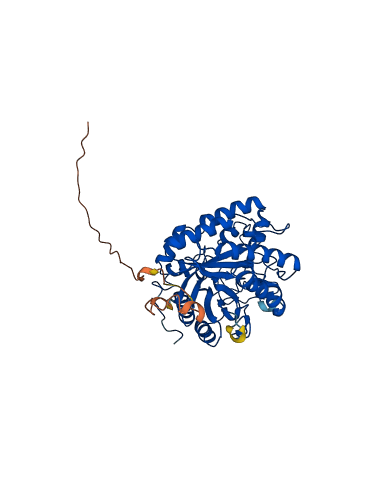
Descriptions
The autoinhibited protein was predicted that may have potential autoinhibitory elements via cis-regPred.
Autoinhibitory domains (AIDs)
Target domain |
|
Relief mechanism |
|
Assay |
cis-regPred |
Accessory elements
No accessory elements
Autoinhibited structure

Activated structure
1 structures for Q876J2
| Entry ID | Method | Resolution | Chain | Position | Source |
|---|---|---|---|---|---|
| AF-Q876J2-F1 | Predicted | AlphaFoldDB |
No variants for Q876J2
| Variant ID(s) | Position | Change | Description | Diseaes Association | Provenance |
|---|---|---|---|---|---|
| No variants for Q876J2 | |||||
No associated diseases with Q876J2
Functions
| Description | ||
|---|---|---|
| EC Number | 3.2.1.58 | Glycosidases, ie enzymes hydrolyzing O- and S-glycosyl compounds |
| Subcellular Localization |
|
|
| PANTHER Family | ||
| PANTHER Subfamily | ||
| PANTHER Protein Class | ||
| PANTHER Pathway Category | No pathway information available | |
1 GO annotations of cellular component
| Name | Definition |
|---|---|
| extracellular region | The space external to the outermost structure of a cell. For cells without external protective or external encapsulating structures this refers to space outside of the plasma membrane. This term covers the host cell environment outside an intracellular parasite. |
1 GO annotations of molecular function
| Name | Definition |
|---|---|
| glucan exo-1,3-beta-glucosidase activity | Catalysis of the successive hydrolysis of beta-D-glucose units from the non-reducing ends of (1->3)-beta-D-glucans, releasing alpha-glucose. |
3 GO annotations of biological process
| Name | Definition |
|---|---|
| carbohydrate metabolic process | The chemical reactions and pathways involving carbohydrates, any of a group of organic compounds based of the general formula Cx(H2O)y. |
| cell wall organization | A process that results in the assembly, arrangement of constituent parts, or disassembly of the cell wall, the rigid or semi-rigid envelope lying outside the cell membrane of plant, fungal and most prokaryotic cells, maintaining their shape and protecting them from osmotic lysis. |
| sporulation resulting in formation of a cellular spore | The process in which a relatively unspecialized cell acquires the specialized features of a cellular spore, a cell form that can be used for dissemination, for survival of adverse conditions because of its heat and dessication resistance, and/or for reproduction. |
No homologous proteins in AiPD
| UniProt AC | Gene Name | Protein Name | Species | Evidence Code |
|---|---|---|---|---|
| No homologous proteins | ||||
| 10 | 20 | 30 | 40 | 50 | 60 |
| MVSFKRLTTL | ALSFTQLVNC | NPVSPKSKDS | LQFIYKEKAN | VYSEANSQSI | REKIRGVNLG |
| 70 | 80 | 90 | 100 | 110 | 120 |
| GWLVLEPYIT | PSIFEAFRTN | PHNDNGIPVD | EYRFCQSLGY | EKAKERLYNH | WSTFYKEEDF |
| 130 | 140 | 150 | 160 | 170 | 180 |
| AKIASQGFNM | VRIPVGYWAF | TTLSHDPYVT | GEQEYFLDKA | VDWARKYGLK | VWIDLHGAAG |
| 190 | 200 | 210 | 220 | 230 | 240 |
| SQNGFDNSGL | RDSYKFLDEE | YLSATMKALT | YILSKYSTDI | YLDTVIGIEL | LNEPLGPVFD |
| 250 | 260 | 270 | 280 | 290 | 300 |
| MERLKNLFLK | PAYDYLRNKI | MSKQIIVMHD | AFQPYNYWDN | FLNGDKEEYG | VILDHHHYQV |
| 310 | 320 | 330 | 340 | 350 | 360 |
| FSPIELARNM | NERIKIACQW | GVGTLSEKHW | SVAGEFSAAL | TDCTKWLNGV | GFGARYDGTW |
| 370 | 380 | 390 | 400 | 410 | 420 |
| AKGNDKSYHI | GSCANNENVG | LWSEERKQNT | RKFIEAQLDA | FEMTGGWIMW | CYKTENSIEW |
| 430 | 440 | ||||
| DVEKLIQHNL | FPQPISDRKH | PNQCH |