Q86L04
Gene name |
trap1 (DDB_G0276947) |
Protein name |
TNF receptor-associated protein 1 homolog, mitochondrial |
Names |
TNFR-associated protein 1 homolog, Trap1 homolog |
Species |
Dictyostelium discoideum (Slime mold) |
KEGG Pathway |
ddi:DDB_G0276947 |
EC number |
|
Protein Class |
|
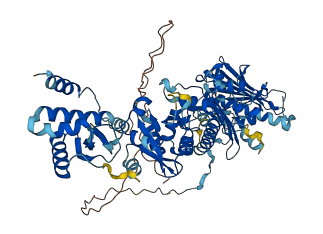
Descriptions
The autoinhibited protein was predicted that may have potential autoinhibitory elements via cis-regPred.
Autoinhibitory domains (AIDs)
Target domain |
|
Relief mechanism |
|
Assay |
cis-regPred |
Accessory elements
No accessory elements
Autoinhibited structure

Activated structure
1 structures for Q86L04
| Entry ID | Method | Resolution | Chain | Position | Source |
|---|---|---|---|---|---|
| AF-Q86L04-F1 | Predicted | AlphaFoldDB |
No variants for Q86L04
| Variant ID(s) | Position | Change | Description | Diseaes Association | Provenance |
|---|---|---|---|---|---|
| No variants for Q86L04 | |||||
No associated diseases with Q86L04
1 regional properties for Q86L04
| Type | Name | Position | InterPro Accession |
|---|---|---|---|
| domain | Heat shock protein Hsp90, N-terminal | 99 - 301 | IPR020575 |
Functions
5 GO annotations of cellular component
| Name | Definition |
|---|---|
| cell cortex | The region of a cell that lies just beneath the plasma membrane and often, but not always, contains a network of actin filaments and associated proteins. |
| cytoskeleton | A cellular structure that forms the internal framework of eukaryotic and prokaryotic cells. The cytoskeleton includes intermediate filaments, microfilaments, microtubules, the microtrabecular lattice, and other structures characterized by a polymeric filamentous nature and long-range order within the cell. The various elements of the cytoskeleton not only serve in the maintenance of cellular shape but also have roles in other cellular functions, including cellular movement, cell division, endocytosis, and movement of organelles. |
| mitochondrial inner membrane | The inner, i.e. lumen-facing, lipid bilayer of the mitochondrial envelope. It is highly folded to form cristae. |
| nucleolus | A small, dense body one or more of which are present in the nucleus of eukaryotic cells. It is rich in RNA and protein, is not bounded by a limiting membrane, and is not seen during mitosis. Its prime function is the transcription of the nucleolar DNA into 45S ribosomal-precursor RNA, the processing of this RNA into 5.8S, 18S, and 28S components of ribosomal RNA, and the association of these components with 5S RNA and proteins synthesized outside the nucleolus. This association results in the formation of ribonucleoprotein precursors; these pass into the cytoplasm and mature into the 40S and 60S subunits of the ribosome. |
| spore wall | The specialized envelope lying outside the cell membrane of a spore. |
5 GO annotations of molecular function
| Name | Definition |
|---|---|
| ATP binding | Binding to ATP, adenosine 5'-triphosphate, a universally important coenzyme and enzyme regulator. |
| ATP hydrolysis activity | Catalysis of the reaction: ATP + H2O = ADP + H+ phosphate. ATP hydrolysis is used in some reactions as an energy source, for example to catalyze a reaction or drive transport against a concentration gradient. |
| ATP-dependent protein folding chaperone | Binding to a protein or a protein-containing complex to assist the protein folding process, driven by ATP hydrolysis. |
| protein kinase binding | Binding to a protein kinase, any enzyme that catalyzes the transfer of a phosphate group, usually from ATP, to a protein substrate. |
| unfolded protein binding | Binding to an unfolded protein. |
4 GO annotations of biological process
| Name | Definition |
|---|---|
| cell differentiation | The process in which relatively unspecialized cells, e.g. embryonic or regenerative cells, acquire specialized structural and/or functional features that characterize the cells, tissues, or organs of the mature organism or some other relatively stable phase of the organism's life history. Differentiation includes the processes involved in commitment of a cell to a specific fate and its subsequent development to the mature state. |
| positive regulation of gene expression | Any process that increases the frequency, rate or extent of gene expression. Gene expression is the process in which a gene's coding sequence is converted into a mature gene product (protein or RNA). |
| protein folding | The process of assisting in the covalent and noncovalent assembly of single chain polypeptides or multisubunit complexes into the correct tertiary structure. |
| sporulation resulting in formation of a cellular spore | The process in which a relatively unspecialized cell acquires the specialized features of a cellular spore, a cell form that can be used for dissemination, for survival of adverse conditions because of its heat and dessication resistance, and/or for reproduction. |
No homologous proteins in AiPD
| UniProt AC | Gene Name | Protein Name | Species | Evidence Code |
|---|---|---|---|---|
| No homologous proteins | ||||
| 10 | 20 | 30 | 40 | 50 | 60 |
| MQRTLSKVIL | NSGKNNLLKS | SNLLNSNLLK | ATTTNIIGIK | TINNNNNVNS | IIGFKSLNKR |
| 70 | 80 | 90 | 100 | 110 | 120 |
| YFTSNTPKVE | EEDDEIAPDE | AIKAEEKIKE | TERVIGLSEK | LSFQTETQKI | LHIVAESLYT |
| 130 | 140 | 150 | 160 | 170 | 180 |
| EKEVFIRELI | SNASDAIEKV | RHTQLTNASM | IEDASIPFEI | KISTDEDNKT | LIIQDSGIGM |
| 190 | 200 | 210 | 220 | 230 | 240 |
| TKDEMIKNLG | KIGYSGSSDF | IKKLGENPDK | ASIIGQFGVG | FYSCFMVGHT | IKIYTKSATP |
| 250 | 260 | 270 | 280 | 290 | 300 |
| GSKGYLWESD | GTGSYSITEA | EGVSRGTKII | IHLKPSSYEY | SKKSIVENII | KKYSNFVGFP |
| 310 | 320 | 330 | 340 | 350 | 360 |
| IALNGTTVNT | IKPLWTLNKN | AISEEEHKEF | YQFLSKSYDT | PSYRVHFSTD | TPLSIRSIFY |
| 370 | 380 | 390 | 400 | 410 | 420 |
| IPSQHMEKYG | MGKMEPGVSL | FSRKVLIQQK | ANGILPEWMR | FVRGVVDSED | IPLNVSREHL |
| 430 | 440 | 450 | 460 | 470 | 480 |
| QDNGLIQRIS | SVLVKRILKH | LNDEAKSDPE | KFNVFMTEFG | GFFKEGIITD | FKWKDEISKL |
| 490 | 500 | 510 | 520 | 530 | 540 |
| LRFESSNGST | ASKTDAVSLE | QYVSRMKPEQ | KNIYFLSVPN | RAVGLSSPYY | EPFQLKDIEV |
| 550 | 560 | 570 | 580 | 590 | 600 |
| IFLYNAVDEF | VLTNVGHFGD | KKIVSVESKE | AEEFLATNQD | KKTETLSQDE | IDKFLSWVST |
| 610 | 620 | 630 | 640 | 650 | 660 |
| VASDKVTQAK | STTRSISSPA | IIIDHESANF | RRMLKMVEPG | KQHETPKQVV | EFNMNHPIIL |
| 670 | 680 | 690 | 700 | 710 | |
| KLVQQTESNP | TIAKLVIDQV | VDNAFVSAGL | IEDNREMIPR | INQLLDSLLT | K |