Q86AS6
Gene name |
hisS (DDB_G0274159) |
Protein name |
Histidine--tRNA ligase, cytoplasmic |
Names |
Histidyl-tRNA synthetase, HisRS |
Species |
Dictyostelium discoideum (Slime mold) |
KEGG Pathway |
ddi:DDB_G0274159 |
EC number |
6.1.1.21: Ligases forming aminoacyl-tRNA and related compounds |
Protein Class |
|
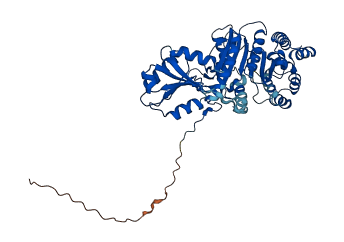
Descriptions
The autoinhibited protein was predicted that may have potential autoinhibitory elements via cis-regPred.
Autoinhibitory domains (AIDs)
Target domain |
|
Relief mechanism |
|
Assay |
cis-regPred |
Accessory elements
No accessory elements
Autoinhibited structure

Activated structure
1 structures for Q86AS6
| Entry ID | Method | Resolution | Chain | Position | Source |
|---|---|---|---|---|---|
| AF-Q86AS6-F1 | Predicted | AlphaFoldDB |
No variants for Q86AS6
| Variant ID(s) | Position | Change | Description | Diseaes Association | Provenance |
|---|---|---|---|---|---|
| No variants for Q86AS6 | |||||
No associated diseases with Q86AS6
4 regional properties for Q86AS6
Functions
| Description | ||
|---|---|---|
| EC Number | 6.1.1.21 | Ligases forming aminoacyl-tRNA and related compounds |
| Subcellular Localization |
|
|
| PANTHER Family | ||
| PANTHER Subfamily | ||
| PANTHER Protein Class | ||
| PANTHER Pathway Category | No pathway information available | |
2 GO annotations of cellular component
| Name | Definition |
|---|---|
| cytosol | The part of the cytoplasm that does not contain organelles but which does contain other particulate matter, such as protein complexes. |
| mitochondrion | A semiautonomous, self replicating organelle that occurs in varying numbers, shapes, and sizes in the cytoplasm of virtually all eukaryotic cells. It is notably the site of tissue respiration. |
2 GO annotations of molecular function
| Name | Definition |
|---|---|
| ATP binding | Binding to ATP, adenosine 5'-triphosphate, a universally important coenzyme and enzyme regulator. |
| histidine-tRNA ligase activity | Catalysis of the reaction: ATP + L-histidine + tRNA(His) = AMP + diphosphate + L-histidyl-tRNA(His). |
2 GO annotations of biological process
| Name | Definition |
|---|---|
| histidyl-tRNA aminoacylation | The process of coupling histidine to histidyl-tRNA, catalyzed by histidyl-tRNA synthetase. The histidyl-tRNA synthetase is a class-II synthetase. The activated amino acid is transferred to the 3''-OH group of a histidine-accetping tRNA. |
| mitochondrial translation | The chemical reactions and pathways resulting in the formation of a protein in a mitochondrion. This is a ribosome-mediated process in which the information in messenger RNA (mRNA) is used to specify the sequence of amino acids in the protein; the mitochondrion has its own ribosomes and transfer RNAs, and uses a genetic code that differs from the nuclear code. |
No homologous proteins in AiPD
| UniProt AC | Gene Name | Protein Name | Species | Evidence Code |
|---|---|---|---|---|
| No homologous proteins | ||||
| 10 | 20 | 30 | 40 | 50 | 60 |
| MSEPVVDNVT | NKVEKMEVKE | KTSAPPKEKK | EKKSNKVQLK | TPKGTQDYNP | RQMTIREQVF |
| 70 | 80 | 90 | 100 | 110 | 120 |
| DGIKQVFKRH | GAVTIETPVF | ELKETLTGKY | GEDSKLIYDL | QDQGGEICSL | RYDLTVPFAR |
| 130 | 140 | 150 | 160 | 170 | 180 |
| YVAMNGVLNI | KRYHIARVYR | RDNPIMTKGR | FREFYQCDFD | IAGTYDLMVP | DAECLVMICE |
| 190 | 200 | 210 | 220 | 230 | 240 |
| ILEQVKVGDF | QIKLNHRKLL | DAIFAICGVP | ADKFRAICSA | VDKLDKSPWE | EVRKEMVEVK |
| 250 | 260 | 270 | 280 | 290 | 300 |
| ALDGAVADKI | EKFVSLKDEP | IKLLQHLRAT | GMCDGNKDAT | EALSQLETLF | GYLECFGVTQ |
| 310 | 320 | 330 | 340 | 350 | 360 |
| HILFDLSLAR | GLDYYTGIIY | EAVLTGQDRV | GSIAAGGRYD | GLVGMYGKKD | VPAVGFSIGI |
| 370 | 380 | 390 | 400 | 410 | 420 |
| ERIFTILEDE | YKKENKKIRE | NATQVFVVQM | EKDLIKERLA | IVSELWKAGI | NAEFSYKVNP |
| 430 | 440 | 450 | 460 | 470 | 480 |
| KLPAQLNTAD | ESNIPLIIII | GKSEVETNSL | SVKTMHDRKQ | VSIERSNFTV | KIKEILSTIP |
| K |