Q869V1
Gene name |
nramp1 (nramp, slc11a1, DDB_G0276973) |
Protein name |
Metal transporter nramp1 homolog |
Names |
Natural resistance-associated membrane protein 1 |
Species |
Dictyostelium discoideum (Slime mold) |
KEGG Pathway |
ddi:DDB_G0276973 |
EC number |
|
Protein Class |
|
Descriptions
The autoinhibited protein was predicted that may have potential autoinhibitory elements via cis-regPred.
Autoinhibitory domains (AIDs)
Target domain |
|
Relief mechanism |
|
Assay |
cis-regPred |
Accessory elements
No accessory elements
Autoinhibited structure

Activated structure
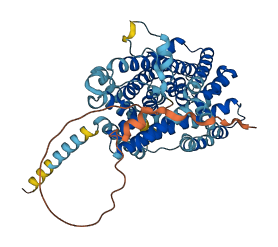
1 structures for Q869V1
| Entry ID | Method | Resolution | Chain | Position | Source |
|---|---|---|---|---|---|
| AF-Q869V1-F1 | Predicted | AlphaFoldDB |
No variants for Q869V1
| Variant ID(s) | Position | Change | Description | Diseaes Association | Provenance |
|---|---|---|---|---|---|
| No variants for Q869V1 | |||||
No associated diseases with Q869V1
5 regional properties for Q869V1
| Type | Name | Position | InterPro Accession |
|---|---|---|---|
| repeat | Pumilio RNA-binding repeat | 114 - 149 | IPR001313-1 |
| repeat | Pumilio RNA-binding repeat | 150 - 187 | IPR001313-2 |
| repeat | Pumilio RNA-binding repeat | 355 - 390 | IPR001313-3 |
| repeat | Pumilio RNA-binding repeat | 538 - 575 | IPR001313-4 |
| repeat | Pumilio RNA-binding repeat | 576 - 613 | IPR001313-5 |
Functions
6 GO annotations of cellular component
| Name | Definition |
|---|---|
| integral component of membrane | The component of a membrane consisting of the gene products and protein complexes having at least some part of their peptide sequence embedded in the hydrophobic region of the membrane. |
| macropinosome | A membrane-bounded, uncoated intracellular vesicle formed by the process of macropinocytosis. |
| membrane | A lipid bilayer along with all the proteins and protein complexes embedded in it an attached to it. |
| phagolysosome | A membrane-bounded intracellular vesicle formed by maturation of an early phagosome following the ingestion of particulate material by phagocytosis; during maturation, phagosomes acquire markers of late endosomes and lysosomes. |
| trans-Golgi network | The network of interconnected tubular and cisternal structures located within the Golgi apparatus on the side distal to the endoplasmic reticulum, from which secretory vesicles emerge. The trans-Golgi network is important in the later stages of protein secretion where it is thought to play a key role in the sorting and targeting of secreted proteins to the correct destination. |
| vesicle membrane | The lipid bilayer surrounding any membrane-bounded vesicle in the cell. |
4 GO annotations of molecular function
| Name | Definition |
|---|---|
| cadmium ion transmembrane transporter activity | Enables the transfer of cadmium (Cd) ions from one side of a membrane to the other. |
| ferrous iron transmembrane transporter activity | Enables the transfer of ferrous iron (Fe(II) or Fe2+) ions from one side of a membrane to the other. |
| iron ion transmembrane transporter activity | Enables the transfer of iron (Fe) ions from one side of a membrane to the other. |
| manganese ion transmembrane transporter activity | Enables the transfer of manganese (Mn) ions from one side of a membrane to the other. |
7 GO annotations of biological process
| Name | Definition |
|---|---|
| cellular iron ion homeostasis | Any process involved in the maintenance of an internal steady state of iron ions at the level of a cell. |
| defense response to bacterium | Reactions triggered in response to the presence of a bacterium that act to protect the cell or organism. |
| iron ion export across plasma membrane | The directed movement of iron ions from inside of a cell, across the plasma membrane and into the extracellular region. |
| iron ion transmembrane transport | A process in which an iron ion is transported from one side of a membrane to the other by means of some agent such as a transporter or pore. |
| manganese ion transport | The directed movement of manganese (Mn) ions into, out of or within a cell, or between cells, by means of some agent such as a transporter or pore. |
| phagocytosis | A vesicle-mediated transport process that results in the engulfment of external particulate material by phagocytes and their delivery to the lysosome. The particles are initially contained within phagocytic vacuoles (phagosomes), which then fuse with primary lysosomes to effect digestion of the particles. |
| response to bacterium | Any process that results in a change in state or activity of a cell or an organism (in terms of movement, secretion, enzyme production, gene expression, etc.) as a result of a stimulus from a bacterium. |
No homologous proteins in AiPD
| UniProt AC | Gene Name | Protein Name | Species | Evidence Code |
|---|---|---|---|---|
| No homologous proteins | ||||
| 10 | 20 | 30 | 40 | 50 | 60 |
| MTPRIESEES | APLVNKNNNN | NNDNNNNNNV | DEENPLIIES | GIPIEDLEQK | NKPYLIKVPN |
| 70 | 80 | 90 | 100 | 110 | 120 |
| IDKPDSKWIN | FKTLWAFTGP | GFLMSIAYLD | PGNLESDIQA | GAMAGYQLLW | VLFWSTVIGF |
| 130 | 140 | 150 | 160 | 170 | 180 |
| WLQMLASRLG | VVTGKHLAEH | CREQYPKTPR | LLLWLMTELA | IIGSDIQEVI | GTAIALQILS |
| 190 | 200 | 210 | 220 | 230 | 240 |
| NGHIPLWAGV | LFTAADTFTF | LFLEKYGIRK | LEAFFCSLIA | IMAISFGVEY | IISKPDQIEV |
| 250 | 260 | 270 | 280 | 290 | 300 |
| VKGVFIPLCS | QNNISQAVGI | LGAVVMPHNI | YLHSALVQSR | EIDRKSETQV | KIANKYNRLE |
| 310 | 320 | 330 | 340 | 350 | 360 |
| SAFALIISFI | INLLLVSVFA | KGFYGETTEI | GLSSAADFLM | DKYGKVAKYI | WAIGLFSAGQ |
| 370 | 380 | 390 | 400 | 410 | 420 |
| CSTMTGTYSG | QFVMEGFLKL | KIAPWKRLLI | TRCTAIVPAM | VVAILSTSHL | DSLDQWLNIL |
| 430 | 440 | 450 | 460 | 470 | 480 |
| QSIQLPFAVV | PVLLFTSSEK | IMGSKFKNHW | LNNQFVRFLS | LLIIAINIYL | IITFSMQISE |
| 490 | 500 | 510 | 520 | 530 | |
| SAWMISIVSI | SFFFYFIFIV | YLSMGQENFN | SMTKKIKNLF | NNNSNQTYNN | INY |