Q866F0
Gene name |
FUT1 |
Protein name |
Galactoside alpha-(1,2)-fucosyltransferase 1 |
Names |
Alpha(1,2)FT 1, Fucosyltransferase 1, GDP-L-fucose:beta-D-galactoside 2-alpha-L-fucosyltransferase 1, Type 1 galactoside alpha-(1,2)-fucosyltransferase FUT1, Type 2 galactoside alpha-(1,2)-fucosyltransferase FUT1 |
Species |
Saimiri boliviensis boliviensis (Bolivian squirrel monkey) |
KEGG Pathway |
|
EC number |
2.4.1.69: Hexosyltransferases |
Protein Class |
|
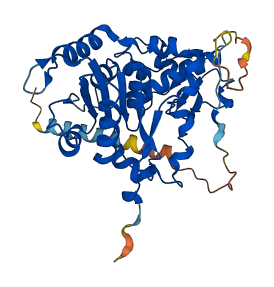
Descriptions
The autoinhibited protein was predicted that may have potential autoinhibitory elements via cis-regPred.
Autoinhibitory domains (AIDs)
Target domain |
|
Relief mechanism |
|
Assay |
cis-regPred |
Accessory elements
No accessory elements
Autoinhibited structure

Activated structure
1 structures for Q866F0
| Entry ID | Method | Resolution | Chain | Position | Source |
|---|---|---|---|---|---|
| AF-Q866F0-F1 | Predicted | AlphaFoldDB |
No variants for Q866F0
| Variant ID(s) | Position | Change | Description | Diseaes Association | Provenance |
|---|---|---|---|---|---|
| No variants for Q866F0 | |||||
No associated diseases with Q866F0
No regional properties for Q866F0
| Type | Name | Position | InterPro Accession |
|---|---|---|---|
| No domain, repeats, and functional sites for Q866F0 | |||
Functions
| Description | ||
|---|---|---|
| EC Number | 2.4.1.69 | Hexosyltransferases |
| Subcellular Localization |
|
|
| PANTHER Family | ||
| PANTHER Subfamily | ||
| PANTHER Protein Class | ||
| PANTHER Pathway Category | No pathway information available | |
2 GO annotations of cellular component
| Name | Definition |
|---|---|
| Golgi cisterna membrane | The lipid bilayer surrounding any of the thin, flattened compartments that form the central portion of the Golgi complex. |
| integral component of membrane | The component of a membrane consisting of the gene products and protein complexes having at least some part of their peptide sequence embedded in the hydrophobic region of the membrane. |
2 GO annotations of molecular function
| Name | Definition |
|---|---|
| alpha-(1,2)-fucosyltransferase activity | Catalysis of the transfer of an L-fucosyl group from GDP-beta-L-fucose to an acceptor molecule to form an alpha-(1->2) linkage. |
| galactoside 2-alpha-L-fucosyltransferase activity | Catalysis of the reaction: GDP-L-fucose + beta-D-galactosyl-R = GDP + alpha-L-fucosyl-(1,2)-beta-D-galactosyl-R. |
11 GO annotations of biological process
| Name | Definition |
|---|---|
| carbohydrate metabolic process | The chemical reactions and pathways involving carbohydrates, any of a group of organic compounds based of the general formula Cx(H2O)y. |
| fucosylation | The covalent attachment of a fucosyl group to an acceptor molecule. |
| lipid metabolic process | The chemical reactions and pathways involving lipids, compounds soluble in an organic solvent but not, or sparingly, in an aqueous solvent. Includes fatty acids; neutral fats, other fatty-acid esters, and soaps; long-chain (fatty) alcohols and waxes; sphingoids and other long-chain bases; glycolipids, phospholipids and sphingolipids; and carotenes, polyprenols, sterols, terpenes and other isoprenoids. |
| olfactory bulb development | The progression of the olfactory bulb over time from its initial formation until its mature state. The olfactory bulb coordinates neuronal signaling involved in the perception of smell. It receives input from the sensory neurons and outputs to the olfactory cortex. |
| positive regulation of cell-matrix adhesion | Any process that activates or increases the rate or extent of cell adhesion to an extracellular matrix. |
| positive regulation of endothelial cell migration | Any process that increases the rate, frequency, or extent of the orderly movement of an endothelial cell into the extracellular matrix to form an endothelium. |
| positive regulation of endothelial cell-matrix adhesion via fibronectin | Any process that activates or increases the frequency, rate or extent of endothelial cell-matrix adhesion via fibronectin. |
| positive regulation of sprouting angiogenesis | Any process that activates or increases the frequency, rate or extent of sprouting angiogenesis. |
| protein glycosylation | A protein modification process that results in the addition of a carbohydrate or carbohydrate derivative unit to a protein amino acid, e.g. the addition of glycan chains to proteins. |
| regulation of cell adhesion | Any process that modulates the frequency, rate or extent of attachment of a cell to another cell or to the extracellular matrix. |
| regulation of endothelial cell proliferation | Any process that modulates the frequency, rate, or extent of endothelial cell proliferation. |
No homologous proteins in AiPD
| UniProt AC | Gene Name | Protein Name | Species | Evidence Code |
|---|---|---|---|---|
| No homologous proteins | ||||
| 10 | 20 | 30 | 40 | 50 | 60 |
| MWPRSHRHLC | LAFLLVCVLS | AISFLIHFHQ | DSIRHGLGLS | VLCPDRRLVT | PAVAIFCLPG |
| 70 | 80 | 90 | 100 | 110 | 120 |
| TPMSPNTSSS | CPQHPASLSG | TWTIYPDGRF | GNQMGQYATL | LALAQLNGRR | AFILPAMHAA |
| 130 | 140 | 150 | 160 | 170 | 180 |
| LAPVFRITLP | VLAPEVDSRT | PWQELRLHDW | MSEEYADLGD | PFLKLSGFPC | SWTFFHHLRE |
| 190 | 200 | 210 | 220 | 230 | 240 |
| QIRSEFTLHD | HLREEAQSVL | RRLRLGRSGA | RPRTFVGVHV | RRGDYLQVMP | QRWKGVVANS |
| 250 | 260 | 270 | 280 | 290 | 300 |
| AYLREAMDWF | RARHEAPVFV | VTSNGMEWCR | ENIDASKGDV | MFAGDGQEAS | PWKDFALLTQ |
| 310 | 320 | 330 | 340 | 350 | 360 |
| CNHTIMTIGT | FGFWAAYLAG | GDTVYLANFT | LPDSEFLKIF | KPEAAFLPEW | VGINADLSPL |
| WPLAEP |