Descriptions
The autoinhibited protein was predicted that may have potential autoinhibitory elements via cis-regPred.
Autoinhibitory domains (AIDs)
Target domain |
|
Relief mechanism |
|
Assay |
cis-regPred |
Accessory elements
No accessory elements
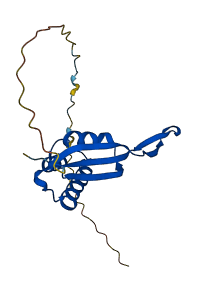
Autoinhibited structure

Activated structure
1 structures for Q84U21
| Entry ID | Method | Resolution | Chain | Position | Source |
|---|---|---|---|---|---|
| AF-Q84U21-F1 | Predicted | AlphaFoldDB |
No variants for Q84U21
| Variant ID(s) | Position | Change | Description | Diseaes Association | Provenance |
|---|---|---|---|---|---|
| No variants for Q84U21 | |||||
No associated diseases with Q84U21
No regional properties for Q84U21
| Type | Name | Position | InterPro Accession |
|---|---|---|---|
| No domain, repeats, and functional sites for Q84U21 | |||
2 GO annotations of cellular component
| Name | Definition |
|---|---|
| chloroplast | A chlorophyll-containing plastid with thylakoids organized into grana and frets, or stroma thylakoids, and embedded in a stroma. |
| large ribosomal subunit | The larger of the two subunits of a ribosome. Two sites on the ribosomal large subunit are involved in translation, namely the aminoacyl site (A site) and peptidyl site (P site). |
2 GO annotations of molecular function
| Name | Definition |
|---|---|
| rRNA binding | Binding to a ribosomal RNA. |
| structural constituent of ribosome | The action of a molecule that contributes to the structural integrity of the ribosome. |
2 GO annotations of biological process
| Name | Definition |
|---|---|
| response to antibiotic | Any process that results in a change in state or activity of a cell or an organism (in terms of movement, secretion, enzyme production, gene expression, etc.) as a result of an antibiotic stimulus. An antibiotic is a chemical substance produced by a microorganism which has the capacity to inhibit the growth of or to kill other microorganisms. |
| translation | The cellular metabolic process in which a protein is formed, using the sequence of a mature mRNA or circRNA molecule to specify the sequence of amino acids in a polypeptide chain. Translation is mediated by the ribosome, and begins with the formation of a ternary complex between aminoacylated initiator methionine tRNA, GTP, and initiation factor 2, which subsequently associates with the small subunit of the ribosome and an mRNA or circRNA. Translation ends with the release of a polypeptide chain from the ribosome. |
No homologous proteins in AiPD
| UniProt AC | Gene Name | Protein Name | Species | Evidence Code |
|---|---|---|---|---|
| No homologous proteins | ||||
| 10 | 20 | 30 | 40 | 50 | 60 |
| MALRACSSSL | VARSAARSVQ | PFRPAAVRPA | RIAPVARKTA | TVVCSAATDA | PAAPVAEAVV |
| 70 | 80 | 90 | 100 | 110 | 120 |
| GEVKSGVAHL | KFQRGSADKI | RRVLDVIRGR | SYEEALVLCE | YMPYRACEKI | IKCLMSAAAN |
| 130 | 140 | 150 | 160 | 170 | |
| AKHNKGALKT | KLVVSECFAD | EGPVLKRARP | RAQGRANLIM | KPTFHMTIRV | EERAQ |