Q83F55
Gene name |
clpB (CBU_0094) |
Protein name |
Chaperone protein ClpB |
Names |
|
Species |
Coxiella burnetii (strain RSA 493 / Nine Mile phase I) |
KEGG Pathway |
cbu:CBU_0094 |
EC number |
|
Protein Class |
|
Descriptions
The autoinhibited protein was predicted that may have potential autoinhibitory elements via cis-regPred.
Autoinhibitory domains (AIDs)
Target domain |
|
Relief mechanism |
|
Assay |
cis-regPred |
Accessory elements
No accessory elements
Autoinhibited structure

Activated structure
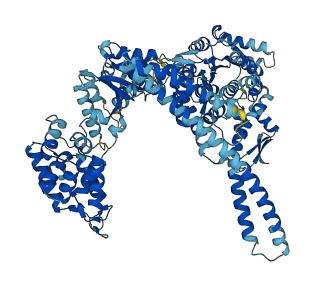
1 structures for Q83F55
| Entry ID | Method | Resolution | Chain | Position | Source |
|---|---|---|---|---|---|
| AF-Q83F55-F1 | Predicted | AlphaFoldDB |
No variants for Q83F55
| Variant ID(s) | Position | Change | Description | Diseaes Association | Provenance |
|---|---|---|---|---|---|
| No variants for Q83F55 | |||||
No associated diseases with Q83F55
1 regional properties for Q83F55
| Type | Name | Position | InterPro Accession |
|---|---|---|---|
| active_site | ClpP, histidine active site | 106 - 119 | IPR033135 |
1 GO annotations of cellular component
| Name | Definition |
|---|---|
| cytoplasm | The contents of a cell excluding the plasma membrane and nucleus, but including other subcellular structures. |
2 GO annotations of molecular function
| Name | Definition |
|---|---|
| ATP binding | Binding to ATP, adenosine 5'-triphosphate, a universally important coenzyme and enzyme regulator. |
| ATP hydrolysis activity | Catalysis of the reaction: ATP + H2O = ADP + H+ phosphate. ATP hydrolysis is used in some reactions as an energy source, for example to catalyze a reaction or drive transport against a concentration gradient. |
2 GO annotations of biological process
| Name | Definition |
|---|---|
| cellular response to heat | Any process that results in a change in state or activity of a cell (in terms of movement, secretion, enzyme production, gene expression, etc.) as a result of a heat stimulus, a temperature stimulus above the optimal temperature for that organism. |
| protein refolding | The process carried out by a cell that restores the biological activity of an unfolded or misfolded protein, using helper proteins such as chaperones. |
No homologous proteins in AiPD
| UniProt AC | Gene Name | Protein Name | Species | Evidence Code |
|---|---|---|---|---|
| No homologous proteins | ||||
| 10 | 20 | 30 | 40 | 50 | 60 |
| MRIDKFTTAF | QTALADAQSL | AVGRDHQFIE | PAHVMKVLLE | QTQGTVAPLL | EQSKVNLSRL |
| 70 | 80 | 90 | 100 | 110 | 120 |
| IDGVNKAIDS | YPQVEGTGGE | VHVSRELSKI | LTLMDKFAQQ | NKDQYISSEW | FIPAALEAKG |
| 130 | 140 | 150 | 160 | 170 | 180 |
| QLRDVLIEAG | ADKKAIEKNI | MNLRKGERVT | EQSAEDQRQA | LAKYTIDLTE | KAETGKLDPV |
| 190 | 200 | 210 | 220 | 230 | 240 |
| IGRDEEIRRT | VQVLQRRTKN | NPVLIGEPGV | GKTAIVEGLA | QRIVNGEVPE | GLKQKRLLAL |
| 250 | 260 | 270 | 280 | 290 | 300 |
| DMGALIAGAK | FRGEFEERLK | AVLKDIAKEE | GRVILFIDEL | HTMVGAGKAE | GAMDAGNMLK |
| 310 | 320 | 330 | 340 | 350 | 360 |
| PALARGELHC | VGATTLDEYR | KYIEKDAALE | RRFQKVLVEE | PSTEDAIAIL | RGLKERYEVH |
| 370 | 380 | 390 | 400 | 410 | 420 |
| HGVEITDPAI | IAAATLSQRY | ITDRNLPDKA | IDLIDEAASQ | IRMEMDSKPV | ELDRLERRLI |
| 430 | 440 | 450 | 460 | 470 | 480 |
| QLKIEREALK | KETDEASKKR | LSDLETEIKN | VEKEYSDLEE | VWKSEKASLH | GTQQIKEELE |
| 490 | 500 | 510 | 520 | 530 | 540 |
| QARIELEAAG | RAGDLARMSE | LQYGIIPELD | KKLKAASQKE | EQFHDHKLLR | SRVTEEEVAE |
| 550 | 560 | 570 | 580 | 590 | 600 |
| VVSKWTHIPV | SKMLEGEREK | LLHMETELHK | RVIGQDEAVN | AVANAIRRSR | AGLSDPNRPV |
| 610 | 620 | 630 | 640 | 650 | 660 |
| GSFLFLGPTG | VGKTELCKAL | AVFLFDTEDA | MVRIDMSEFM | EKHSVARLIG | APPGYVGYEE |
| 670 | 680 | 690 | 700 | 710 | 720 |
| GGYLTEAIRR | RPYSVILLDE | IEKAHNDVFN | VLLQVLDDGR | LTDGQGRTVD | FRNTVIVMTS |
| 730 | 740 | 750 | 760 | 770 | 780 |
| NLGSDLIREF | SGENYDKMKD | AVMEVVAQHF | RPEFINRIDE | AVVFHSLKKE | QIRNIAIIQI |
| 790 | 800 | 810 | 820 | 830 | 840 |
| DRIKKRLKEK | DYQLTISDDA | LDYLSELGYD | PVYGARPLKR | VLQQQLENPL | SQKILEGKFV |
| 850 | |||||
| PGSLINIEKK | GEQLEFKEA |