Q835J5
Gene name |
pepT |
Protein name |
Peptidase T |
Names |
Aminotripeptidase, Tripeptidase, Tripeptide aminopeptidase |
Species |
Enterococcus faecalis (strain ATCC 700802 / V583) |
KEGG Pathway |
efa:EF1382 |
EC number |
3.4.11.4: Aminopeptidases |
Protein Class |
|
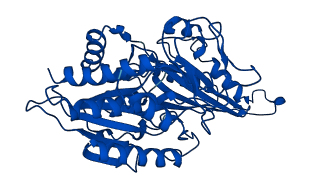
Descriptions
The autoinhibited protein was predicted that may have potential autoinhibitory elements via cis-regPred.
Autoinhibitory domains (AIDs)
Target domain |
|
Relief mechanism |
|
Assay |
cis-regPred |
Accessory elements
No accessory elements
Autoinhibited structure

Activated structure
1 structures for Q835J5
| Entry ID | Method | Resolution | Chain | Position | Source |
|---|---|---|---|---|---|
| AF-Q835J5-F1 | Predicted | AlphaFoldDB |
No variants for Q835J5
| Variant ID(s) | Position | Change | Description | Diseaes Association | Provenance |
|---|---|---|---|---|---|
| No variants for Q835J5 | |||||
No associated diseases with Q835J5
3 regional properties for Q835J5
| Type | Name | Position | InterPro Accession |
|---|---|---|---|
| conserved_site | ArgE/DapE/ACY1/CPG2/YscS, conserved site | 75 - 84 | IPR001261-1 |
| conserved_site | ArgE/DapE/ACY1/CPG2/YscS, conserved site | 141 - 180 | IPR001261-2 |
| domain | Peptidase M20, dimerisation domain | 210 - 308 | IPR011650 |
Functions
| Description | ||
|---|---|---|
| EC Number | 3.4.11.4 | Aminopeptidases |
| Subcellular Localization |
|
|
| PANTHER Family | ||
| PANTHER Subfamily | ||
| PANTHER Protein Class | ||
| PANTHER Pathway Category | No pathway information available | |
1 GO annotations of cellular component
| Name | Definition |
|---|---|
| cytoplasm | The contents of a cell excluding the plasma membrane and nucleus, but including other subcellular structures. |
3 GO annotations of molecular function
| Name | Definition |
|---|---|
| metallopeptidase activity | Catalysis of the hydrolysis of peptide bonds by a mechanism in which water acts as a nucleophile, one or two metal ions hold the water molecule in place, and charged amino acid side chains are ligands for the metal ions. |
| tripeptide aminopeptidase activity | Catalysis of the hydrolysis of a single N-terminal amino acid residue from a tripeptide. |
| zinc ion binding | Binding to a zinc ion (Zn). |
2 GO annotations of biological process
| Name | Definition |
|---|---|
| peptide catabolic process | The chemical reactions and pathways resulting in the breakdown of peptides, compounds of 2 or more (but usually less than 100) amino acids where the alpha carboxyl group of one is bound to the alpha amino group of another. |
| proteolysis | The hydrolysis of proteins into smaller polypeptides and/or amino acids by cleavage of their peptide bonds. |
No homologous proteins in AiPD
| UniProt AC | Gene Name | Protein Name | Species | Evidence Code |
|---|---|---|---|---|
| No homologous proteins | ||||
| 10 | 20 | 30 | 40 | 50 | 60 |
| MYENLLPRFL | RYVKTETRSD | ATSTTTPSTQ | TQVAFAQTLK | KELEELGMSD | VIYNETNGFV |
| 70 | 80 | 90 | 100 | 110 | 120 |
| IATLPSNVEK | DVRSIGFIAH | MDTADFNAVN | VSPQIVENYD | GESTIPLDKE | GKFTLNTKDF |
| 130 | 140 | 150 | 160 | 170 | 180 |
| PNLKNYRGET | LITTDGTTLL | GADDKSGIAE | IMTAMEYLIN | HPEIKHGTIR | VAFGPDEEIG |
| 190 | 200 | 210 | 220 | 230 | 240 |
| VGADKFDVAQ | FNVDFAYTMD | GGPVGELQFE | TFNAAQAEIT | IQGKNVHPGT | AKNTMINALQ |
| 250 | 260 | 270 | 280 | 290 | 300 |
| LGIDFHNALP | ADEVPEKTAG | EEGFYHLAAF | AGTPEEATMT | YIIRDHNREI | FEARKAKIKE |
| 310 | 320 | 330 | 340 | 350 | 360 |
| IQQTLNAPFD | EERIKVDLFD | QYYNMREVIE | KDMSIVEIAK | QAMEELSIQP | IIEPVRGGTD |
| 370 | 380 | 390 | 400 | ||
| GSKISYLGIP | TPNIFAGGEN | MHGRFEFVSL | QAMEKATNVI | IKIAELNAK |