Q81C25
Gene name |
mqo |
Protein name |
Probable malate:quinone oxidoreductase |
Names |
MQO, Malate dehydrogenase [quinone] |
Species |
Bacillus cereus (strain ATCC 14579 / DSM 31 / CCUG 7414 / JCM 2152 / NBRC 15305 / NCIMB 9373 / NCTC 2599 / NRRL B-3711) |
KEGG Pathway |
bce:BC2959 |
EC number |
1.1.5.4: With a quinone or similar compound as acceptor |
Protein Class |
|
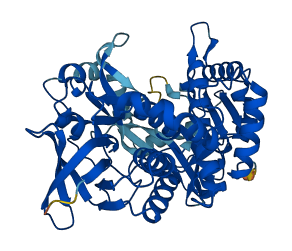
Descriptions
The autoinhibited protein was predicted that may have potential autoinhibitory elements via cis-regPred.
Autoinhibitory domains (AIDs)
Target domain |
|
Relief mechanism |
|
Assay |
cis-regPred |
Accessory elements
No accessory elements
Autoinhibited structure

Activated structure
1 structures for Q81C25
| Entry ID | Method | Resolution | Chain | Position | Source |
|---|---|---|---|---|---|
| AF-Q81C25-F1 | Predicted | AlphaFoldDB |
No variants for Q81C25
| Variant ID(s) | Position | Change | Description | Diseaes Association | Provenance |
|---|---|---|---|---|---|
| No variants for Q81C25 | |||||
No associated diseases with Q81C25
2 regional properties for Q81C25
| Type | Name | Position | InterPro Accession |
|---|---|---|---|
| conserved_site | Phospho-N-acetylmuramoyl-pentapeptide transferase, conserved site | 68 - 80 | IPR018480-1 |
| conserved_site | Phospho-N-acetylmuramoyl-pentapeptide transferase, conserved site | 189 - 200 | IPR018480-2 |
Functions
| Description | ||
|---|---|---|
| EC Number | 1.1.5.4 | With a quinone or similar compound as acceptor |
| Subcellular Localization |
|
|
| PANTHER Family | ||
| PANTHER Subfamily | ||
| PANTHER Protein Class | ||
| PANTHER Pathway Category | No pathway information available | |
1 GO annotations of cellular component
| Name | Definition |
|---|---|
| cytoplasm | The contents of a cell excluding the plasma membrane and nucleus, but including other subcellular structures. |
3 GO annotations of molecular function
| Name | Definition |
|---|---|
| malate dehydrogenase (menaquinone) activity | Catalysis of the reaction: (S)-malate + a menaquinone = oxaloacetate + a menaquinol. |
| malate dehydrogenase (quinone) activity | Catalysis of the reaction: (S)-malate + a quinone = oxaloacetate + a quinol. |
| oxidoreductase activity | Catalysis of an oxidation-reduction (redox) reaction, a reversible chemical reaction in which the oxidation state of an atom or atoms within a molecule is altered. One substrate acts as a hydrogen or electron donor and becomes oxidized, while the other acts as hydrogen or electron acceptor and becomes reduced. |
1 GO annotations of biological process
| Name | Definition |
|---|---|
| tricarboxylic acid cycle | A nearly universal metabolic pathway in which the acetyl group of acetyl coenzyme A is effectively oxidized to two CO2 and four pairs of electrons are transferred to coenzymes. The acetyl group combines with oxaloacetate to form citrate, which undergoes successive transformations to isocitrate, 2-oxoglutarate, succinyl-CoA, succinate, fumarate, malate, and oxaloacetate again, thus completing the cycle. In eukaryotes the tricarboxylic acid is confined to the mitochondria. See also glyoxylate cycle. |
No homologous proteins in AiPD
| UniProt AC | Gene Name | Protein Name | Species | Evidence Code |
|---|---|---|---|---|
| No homologous proteins | ||||
| 10 | 20 | 30 | 40 | 50 | 60 |
| MQQKTDVILI | GAGIMSATLG | SLLKELAPEW | EIKVFEKLAS | AGEESSNEWN | NAGTGHSALC |
| 70 | 80 | 90 | 100 | 110 | 120 |
| ELNYTSEKAD | GSIDISKAVK | VNEQFQLSRQ | FWAYLVKSKL | IRNPQDFIMP | LPHMSLVQGK |
| 130 | 140 | 150 | 160 | 170 | 180 |
| KNVEFLKNRF | EALSKNPLFQ | GMEFSDAPET | LKKWLPLIME | GRTSNEPMAA | TKIDSGTDVN |
| 190 | 200 | 210 | 220 | 230 | 240 |
| FGALTRMLFD | YLKTKNVELN | YKHSVENIKR | TKNGLWEVKV | HDMNSGKIEH | HTAKFVFIGG |
| 250 | 260 | 270 | 280 | 290 | 300 |
| GGGSLPLLQK | TGIPESKHIG | GFPVSGLFMV | CKNQKVVEQH | HAKVYGKAKV | GAPPMSVPHL |
| 310 | 320 | 330 | 340 | 350 | 360 |
| DTRYIDNKKA | LLFGPFAGFS | PKFLKTGSNL | DLIGSVKPNN | VLTMLAAGVK | EMGLTKYLIQ |
| 370 | 380 | 390 | 400 | 410 | 420 |
| QVMLSHEKRM | LDFPAFIPNA | KSEDWDIVVA | GQRVQVIKDT | DAGGKGTLQF | GTEVVSAADG |
| 430 | 440 | 450 | 460 | 470 | 480 |
| SIAALLGASP | GASTAVHVML | EVLEKCFPSR | MIEWEEKIKE | MIPSYGISLT | ENPRLFQDLH |
| 490 | |||||
| TSTGRTLGLN | EKETVHN |