Q818H2
Gene name |
cshB |
Protein name |
DEAD-box ATP-dependent RNA helicase CshB |
Names |
|
Species |
Bacillus cereus (strain ATCC 14579 / DSM 31 / CCUG 7414 / JCM 2152 / NBRC 15305 / NCIMB 9373 / NCTC 2599 / NRRL B-3711) |
KEGG Pathway |
bce:BC4283 |
EC number |
3.6.4.13: Acting on ATP; involved in cellular and subcellular movement |
Protein Class |
|
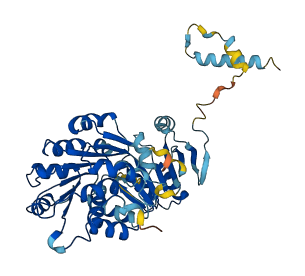
Descriptions
The autoinhibited protein was predicted that may have potential autoinhibitory elements via cis-regPred.
Autoinhibitory domains (AIDs)
Target domain |
|
Relief mechanism |
|
Assay |
cis-regPred |
Accessory elements
No accessory elements
Autoinhibited structure

Activated structure
1 structures for Q818H2
| Entry ID | Method | Resolution | Chain | Position | Source |
|---|---|---|---|---|---|
| AF-Q818H2-F1 | Predicted | AlphaFoldDB |
No variants for Q818H2
| Variant ID(s) | Position | Change | Description | Diseaes Association | Provenance |
|---|---|---|---|---|---|
| No variants for Q818H2 | |||||
No associated diseases with Q818H2
4 regional properties for Q818H2
Functions
| Description | ||
|---|---|---|
| EC Number | 3.6.4.13 | Acting on ATP; involved in cellular and subcellular movement |
| Subcellular Localization |
|
|
| PANTHER Family | ||
| PANTHER Subfamily | ||
| PANTHER Protein Class | ||
| PANTHER Pathway Category | No pathway information available | |
1 GO annotations of cellular component
| Name | Definition |
|---|---|
| cytosol | The part of the cytoplasm that does not contain organelles but which does contain other particulate matter, such as protein complexes. |
5 GO annotations of molecular function
| Name | Definition |
|---|---|
| ATP binding | Binding to ATP, adenosine 5'-triphosphate, a universally important coenzyme and enzyme regulator. |
| ATP hydrolysis activity | Catalysis of the reaction: ATP + H2O = ADP + H+ phosphate. ATP hydrolysis is used in some reactions as an energy source, for example to catalyze a reaction or drive transport against a concentration gradient. |
| RNA binding | Binding to an RNA molecule or a portion thereof. |
| RNA helicase activity | Unwinding of an RNA helix, driven by ATP hydrolysis. |
| RNA strand annealing activity | An activity that facilitates the formation of a complementary double-stranded RNA molecule. |
3 GO annotations of biological process
| Name | Definition |
|---|---|
| response to cold | Any process that results in a change in state or activity of a cell or an organism (in terms of movement, secretion, enzyme production, gene expression, etc.) as a result of a cold stimulus, a temperature stimulus below the optimal temperature for that organism. |
| ribosomal large subunit assembly | The aggregation, arrangement and bonding together of constituent RNAs and proteins to form the large ribosomal subunit. |
| RNA catabolic process | The chemical reactions and pathways resulting in the breakdown of RNA, ribonucleic acid, one of the two main type of nucleic acid, consisting of a long, unbranched macromolecule formed from ribonucleotides joined in 3',5'-phosphodiester linkage. |
No homologous proteins in AiPD
| UniProt AC | Gene Name | Protein Name | Species | Evidence Code |
|---|---|---|---|---|
| No homologous proteins | ||||
| 10 | 20 | 30 | 40 | 50 | 60 |
| MTQQTFTQYD | FKPFLIDAVR | ELRFTEPTGI | QQKIFPVVKK | GVSVIGQSQT | GSGKTHAYLL |
| 70 | 80 | 90 | 100 | 110 | 120 |
| PTLNRINASR | EEVQLVITAP | TRELAQQIYE | EIVKLTKFCA | EDQMITARCL | IGGTDKQRSI |
| 130 | 140 | 150 | 160 | 170 | 180 |
| EKLKKQPHIV | VGTPGRIKDL | VEEQALFVHK | ANTIIVDEAD | LMLDMGFIHD | VDKIAARMPK |
| 190 | 200 | 210 | 220 | 230 | 240 |
| NLQMLVFSAT | IPQKLKPFLK | KYMENPEHIH | INPKQVAAGN | IEHYLVPSKH | RNKIDLVHKM |
| 250 | 260 | 270 | 280 | 290 | 300 |
| LLQFKPYLAV | VFTNTKKMAD | QVADGLMERG | LKVGRIHGDL | SPRDRKKMMK | QIRDLEFQYI |
| 310 | 320 | 330 | 340 | 350 | 360 |
| VATDLAARGI | DIQGISHVIN | YQPPSDLDFF | VHRVARTARA | GHSGIAVTIY | DPANEEALDS |
| 370 | 380 | 390 | 400 | 410 | 420 |
| LEKQRHIEFK | HVDLRGDEWA | DLGERRRRKS | RKKPNDELDV | MATKVIKKPK | KVKPNYKRKL |
| 430 | |||||
| ATERDKVKRK | YSNKKR |