Q811S9
Gene name |
Gnl3 (Ns) |
Protein name |
Guanine nucleotide-binding protein-like 3 |
Names |
Nucleolar GTP-binding protein 3, Nucleostemin |
Species |
Rattus norvegicus (Rat) |
KEGG Pathway |
rno:290556 |
EC number |
|
Protein Class |
|
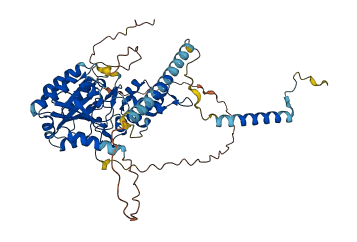
Descriptions
The autoinhibited protein was predicted that may have potential autoinhibitory elements via cis-regPred.
Autoinhibitory domains (AIDs)
Target domain |
|
Relief mechanism |
|
Assay |
cis-regPred |
Accessory elements
No accessory elements
Autoinhibited structure

Activated structure
1 structures for Q811S9
| Entry ID | Method | Resolution | Chain | Position | Source |
|---|---|---|---|---|---|
| AF-Q811S9-F1 | Predicted | AlphaFoldDB |
1 variants for Q811S9
| Variant ID(s) | Position | Change | Description | Diseaes Association | Provenance |
|---|---|---|---|---|---|
| rs8145162 | 487 | E>K | No | EVA |
No associated diseases with Q811S9
6 GO annotations of cellular component
| Name | Definition |
|---|---|
| chromosome | A structure composed of a very long molecule of DNA and associated proteins (e.g. histones) that carries hereditary information. |
| midbody | A thin cytoplasmic bridge formed between daughter cells at the end of cytokinesis. The midbody forms where the contractile ring constricts, and may persist for some time before finally breaking to complete cytokinesis. |
| nuclear body | Extra-nucleolar nuclear domains usually visualized by confocal microscopy and fluorescent antibodies to specific proteins. |
| nucleolus | A small, dense body one or more of which are present in the nucleus of eukaryotic cells. It is rich in RNA and protein, is not bounded by a limiting membrane, and is not seen during mitosis. Its prime function is the transcription of the nucleolar DNA into 45S ribosomal-precursor RNA, the processing of this RNA into 5.8S, 18S, and 28S components of ribosomal RNA, and the association of these components with 5S RNA and proteins synthesized outside the nucleolus. This association results in the formation of ribonucleoprotein precursors; these pass into the cytoplasm and mature into the 40S and 60S subunits of the ribosome. |
| nucleoplasm | That part of the nuclear content other than the chromosomes or the nucleolus. |
| nucleus | A membrane-bounded organelle of eukaryotic cells in which chromosomes are housed and replicated. In most cells, the nucleus contains all of the cell's chromosomes except the organellar chromosomes, and is the site of RNA synthesis and processing. In some species, or in specialized cell types, RNA metabolism or DNA replication may be absent. |
2 GO annotations of molecular function
| Name | Definition |
|---|---|
| GTP binding | Binding to GTP, guanosine triphosphate. |
| mRNA 5'-UTR binding | Binding to an mRNA molecule at its 5' untranslated region. |
8 GO annotations of biological process
| Name | Definition |
|---|---|
| cell population proliferation | The multiplication or reproduction of cells, resulting in the expansion of a cell population. |
| positive regulation of miRNA transcription | Any process that activates or increases the frequency, rate or extent of microRNA (miRNA) gene transcription. |
| positive regulation of protein localization to chromosome, telomeric region | Any process that activates or increases the frequency, rate or extent of protein localization to chromosome, telomeric region. |
| positive regulation of protein sumoylation | Any process that activates or increases the frequency, rate or extent of the addition of SUMO groups to a protein. |
| positive regulation of telomere maintenance | Any process that activates or increases the frequency, rate or extent of a process that affects and monitors the activity of telomeric proteins and the length of telomeric DNA. |
| regulation of cell population proliferation | Any process that modulates the frequency, rate or extent of cell proliferation. |
| stem cell division | The self-renewing division of a stem cell. A stem cell is an undifferentiated cell, in the embryo or adult, that can undergo unlimited division and give rise to one or several different cell types. |
| stem cell population maintenance | The process by which an organism or tissue maintains a population of stem cells of a single type. This can be achieved by a number of mechanisms: stem cell asymmetric division maintains stem cell numbers; stem cell symmetric division increases them; maintenance of a stem cell niche maintains the conditions for commitment to the stem cell fate for some types of stem cell; stem cells may arise de novo from other cell types. |
1 homologous proteins in AiPD
| UniProt AC | Gene Name | Protein Name | Species | Evidence Code |
|---|---|---|---|---|
| Q8CI11 | Gnl3 | Guanine nucleotide-binding protein-like 3 | Mus musculus (Mouse) | PR |
| 10 | 20 | 30 | 40 | 50 | 60 |
| MKRPKLKKAS | KRMTCHKRYK | IQKKVREHHR | KLRKEAKKRG | HKKPKKDPGV | PNSAPFKEAL |
| 70 | 80 | 90 | 100 | 110 | 120 |
| LREAELRKQQ | LEELKQQQKL | DRQKEQERKR | KLEISPDDEQ | SNVETQEESD | EPKIKKAKSG |
| 130 | 140 | 150 | 160 | 170 | 180 |
| KQNPKKLHCQ | ELKKVIEASD | IVLEVLDARD | PLGCRCPQVE | EAVIQSGCKK | LVLVLNKSDL |
| 190 | 200 | 210 | 220 | 230 | 240 |
| VPKENLENWL | TYLNKELPTV | VFKASTNLKN | RKKTFKIKKK | VVPFQSKLCC | GKEALWKLLG |
| 250 | 260 | 270 | 280 | 290 | 300 |
| GFQQSCGKGV | QVGVVGFPNV | GKSSIINSLK | QERICSVGVS | MGLTRSMQIV | PLDKQITIID |
| 310 | 320 | 330 | 340 | 350 | 360 |
| SPCFIISPCN | SPAALALRSP | ASIEVLRPLE | AASAILSQAD | SQQVVLKYTV | PGYKDSLDFF |
| 370 | 380 | 390 | 400 | 410 | 420 |
| TKLAQRRGLH | QKGGSPNVES | AAKLLWSEWT | GASLGYYCHP | PASWNHSPHF | NENITAIMKR |
| 430 | 440 | 450 | 460 | 470 | 480 |
| GFNLEELEKN | NAHSIQVLKG | PHLTNKILFR | SSGLTNGILE | EKDIPEESPK | QTEDQQDGDD |
| 490 | 500 | 510 | 520 | 530 | |
| QEHVTGEKNA | EISDVTPVEE | TREMSPGQST | ASKPSDRSFI | LDKMSEEDDA | YDFTTDYI |