Q80X71
Gene name |
Tmem106b |
Protein name |
Transmembrane protein 106B |
Names |
|
Species |
Mus musculus (Mouse) |
KEGG Pathway |
mmu:71900 |
EC number |
|
Protein Class |
|
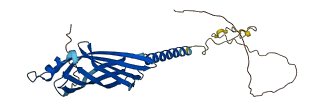
Descriptions
The autoinhibited protein was predicted that may have potential autoinhibitory elements via cis-regPred.
Autoinhibitory domains (AIDs)
Target domain |
|
Relief mechanism |
|
Assay |
cis-regPred |
Accessory elements
No accessory elements
Autoinhibited structure

Activated structure
1 structures for Q80X71
| Entry ID | Method | Resolution | Chain | Position | Source |
|---|---|---|---|---|---|
| AF-Q80X71-F1 | Predicted | AlphaFoldDB |
9 variants for Q80X71
| Variant ID(s) | Position | Change | Description | Diseaes Association | Provenance |
|---|---|---|---|---|---|
| rs3388809456 | 78 | Q>K | No | EVA | |
| rs3388803771 | 98 | Y>* | No | EVA | |
| rs3388797279 | 112 | L>* | No | EVA | |
| rs3388797279 | 112 | L>W | No | EVA | |
| rs3388816849 | 135 | S>T | No | EVA | |
| rs3388819682 | 148 | T>M | No | EVA | |
| rs3388809442 | 191 | L>F | No | EVA | |
| rs3388819650 | 191 | L>P | No | EVA | |
| rs244457720 | 218 | L>V | No | EVA |
No associated diseases with Q80X71
No regional properties for Q80X71
| Type | Name | Position | InterPro Accession |
|---|---|---|---|
| No domain, repeats, and functional sites for Q80X71 | |||
Functions
5 GO annotations of cellular component
| Name | Definition |
|---|---|
| endosome | A vacuole to which materials ingested by endocytosis are delivered. |
| integral component of membrane | The component of a membrane consisting of the gene products and protein complexes having at least some part of their peptide sequence embedded in the hydrophobic region of the membrane. |
| late endosome membrane | The lipid bilayer surrounding a late endosome. |
| lysosomal membrane | The lipid bilayer surrounding the lysosome and separating its contents from the cell cytoplasm. |
| lysosome | A small lytic vacuole that has cell cycle-independent morphology found in most animal cells and that contains a variety of hydrolases, most of which have their maximal activities in the pH range 5-6. The contained enzymes display latency if properly isolated. About 40 different lysosomal hydrolases are known and lysosomes have a great variety of morphologies and functions. |
1 GO annotations of molecular function
| Name | Definition |
|---|---|
| ATPase binding | Binding to an ATPase, any enzyme that catalyzes the hydrolysis of ATP. |
10 GO annotations of biological process
| Name | Definition |
|---|---|
| dendrite morphogenesis | The process in which the anatomical structures of a dendrite are generated and organized. |
| lysosomal lumen acidification | Any process that reduces the pH of the lysosomal lumen, measured by the concentration of the hydrogen ion. |
| lysosomal protein catabolic process | Any cellular protein catabolic process that takes place in a lysosome. |
| lysosomal transport | The directed movement of substances into, out of or within a lysosome. |
| lysosome localization | Any process in which a lysosome is transported to, and/or maintained in, a specific location. |
| lysosome organization | A process that is carried out at the cellular level which results in the assembly, arrangement of constituent parts, or disassembly of a lysosome. A lysosome is a cytoplasmic, membrane-bounded organelle that is found in most animal cells and that contains a variety of hydrolases. |
| neuron cellular homeostasis | The cellular homeostatic process that preserves a neuron in a stable, differentiated functional and structural state. |
| positive regulation of dendrite development | Any process that activates or increases the frequency, rate or extent of dendrite development. |
| positive regulation of hydrolase activity | Any process that activates or increases the frequency, rate or extent of hydrolase activity, the catalysis of the hydrolysis of various bonds. |
| regulation of lysosome organization | Any process that modulates the frequency, rate or extent of lysosome organization. |
1 homologous proteins in AiPD
| UniProt AC | Gene Name | Protein Name | Species | Evidence Code |
|---|---|---|---|---|
| Q9NUM4 | TMEM106B | Transmembrane protein 106B | Homo sapiens (Human) | PR |
| 10 | 20 | 30 | 40 | 50 | 60 |
| MGKSLSHLPL | HSNKEDGYDG | VTSTDNMRNG | LVSSEVHNED | GRNGDVSQFP | YVEFTGRDSV |
| 70 | 80 | 90 | 100 | 110 | 120 |
| TCPTCQGTGR | IPRGQENQLV | ALIPYSDQRL | RPRRTKLYVM | ASVFVCLLLS | GLAVFFLFPR |
| 130 | 140 | 150 | 160 | 170 | 180 |
| SIEVKYIGVK | SAYVSYDAEK | RTIYLNITNT | LNITNNNYYS | VEVENITAQV | QFSKTVIGKA |
| 190 | 200 | 210 | 220 | 230 | 240 |
| RLNNITNIGP | LDMKQIDYTV | PTVIAEEMSY | MYDFCTLLSI | KVHNIVLMMQ | VTVTTAYFGH |
| 250 | 260 | 270 | |||
| SEQISQERYQ | YVDCGRNTTY | QLAQSEYLNV | LQPQQ |