Q80VJ2
Gene name |
Sra1 |
Protein name |
Steroid receptor RNA activator 1 |
Names |
Steroid receptor RNA activator protein, SRAP |
Species |
Mus musculus (Mouse) |
KEGG Pathway |
mmu:24068 |
EC number |
|
Protein Class |
|
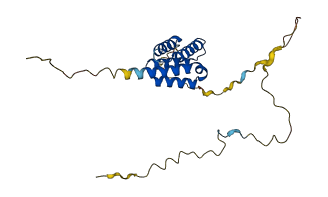
Descriptions
The autoinhibited protein was predicted that may have potential autoinhibitory elements via cis-regPred.
Autoinhibitory domains (AIDs)
Target domain |
|
Relief mechanism |
|
Assay |
cis-regPred |
Accessory elements
No accessory elements
Autoinhibited structure

Activated structure
2 structures for Q80VJ2
| Entry ID | Method | Resolution | Chain | Position | Source |
|---|---|---|---|---|---|
| 2YRU | NMR | - | A | 90-194 | PDB |
| AF-Q80VJ2-F1 | Predicted | AlphaFoldDB |
No variants for Q80VJ2
| Variant ID(s) | Position | Change | Description | Diseaes Association | Provenance |
|---|---|---|---|---|---|
| No variants for Q80VJ2 | |||||
No associated diseases with Q80VJ2
1 regional properties for Q80VJ2
| Type | Name | Position | InterPro Accession |
|---|---|---|---|
| domain | SRA1/Sec31 | 61 - 202 | IPR009917 |
12 GO annotations of cellular component
| Name | Definition |
|---|---|
| cell leading edge | The area of a motile cell closest to the direction of movement. |
| cytoplasm | The contents of a cell excluding the plasma membrane and nucleus, but including other subcellular structures. |
| cytosol | The part of the cytoplasm that does not contain organelles but which does contain other particulate matter, such as protein complexes. |
| intercellular bridge | A direct connection between the cytoplasm of two cells that is formed following the completion of cleavage furrow ingression during cell division. They are usually present only briefly prior to completion of cytokinesis. However, in some cases, such as the bridges between germ cells during their development, they become stabilised. |
| microtubule cytoskeleton | The part of the cytoskeleton (the internal framework of a cell) composed of microtubules and associated proteins. |
| nucleoplasm | That part of the nuclear content other than the chromosomes or the nucleolus. |
| nucleus | A membrane-bounded organelle of eukaryotic cells in which chromosomes are housed and replicated. In most cells, the nucleus contains all of the cell's chromosomes except the organellar chromosomes, and is the site of RNA synthesis and processing. In some species, or in specialized cell types, RNA metabolism or DNA replication may be absent. |
| plasma membrane | The membrane surrounding a cell that separates the cell from its external environment. It consists of a phospholipid bilayer and associated proteins. |
| ribonucleoprotein complex | A macromolecular complex that contains both RNA and protein molecules. |
| SCAR complex | A pentameric complex that includes orthologues of human PIR121, Nap1, Abi, SCAR, and HSPC300 and regulates actin polymerization and/or depolymerization through small GTPase mediated signal transduction. |
| steroid hormone aporeceptor complex | A protein complex consisting of a steroid receptor associated with nonreceptor proteins, minimally a dimer of Hsp90 and a monomer of hsp56/FKBP59; forms in the absence of bound ligand. |
| transcription regulator complex | A protein complex that is capable of associating with DNA by direct binding, or via other DNA-binding proteins or complexes, and regulating transcription. |
6 GO annotations of molecular function
| Name | Definition |
|---|---|
| DNA binding | Any molecular function by which a gene product interacts selectively and non-covalently with DNA (deoxyribonucleic acid). |
| nuclear receptor binding | Binding to a nuclear receptor protein. Nuclear receptor proteins are DNA-binding transcription factors which are regulated by binding to a ligand. |
| nuclear receptor coactivator activity | A transcription coactivator activity that activates or increases the transcription of specific gene sets via binding to a DNA-bound nuclear receptor, either on its own or as part of a complex. Coactivators often act by altering chromatin structure and modifications. For example, one class of transcription coregulators modifies chromatin structure through covalent modification of histones. A second class remodels the conformation of chromatin in an ATP-dependent fashion. A third class modulates interactions of DNA-bound DNA-binding transcription factors with other transcription coregulators. A fourth class of coactivator activity is the bridging of a DNA-binding transcription factor to the general (basal) transcription machinery. The Mediator complex, which bridges sequence-specific DNA binding transcription factors and RNA polymerase, is also a transcription coactivator. |
| steroid receptor RNA activator RNA binding | Binding to a steroid receptor RNA activator RNA (SRA). SRA enhances steroid hormone receptor transcriptional activity as an RNA transcript by an indirect mechanism that does not involve SRA-steroid receptor binding. |
| transcription coactivator activity | A transcription coregulator activity that activates or increases the transcription of specific gene sets via binding to a DNA-bound DNA-binding transcription factor, either on its own or as part of a complex. Coactivators often act by altering chromatin structure and modifications. For example, one class of transcription coactivators modifies chromatin structure through covalent modification of histones. A second class remodels the conformation of chromatin in an ATP-dependent fashion. A third class modulates interactions of DNA-bound DNA-binding transcription factors with other transcription coregulators. A fourth class of coactivator activity is the bridging of a DNA-binding transcription factor to the general (basal) transcription machinery. The Mediator complex, which bridges sequence-specific DNA binding transcription factors and RNA polymerase, is also a transcription coactivator. |
| transcription coregulator activity | A transcription regulator activity that modulates the transcription of specific gene sets via binding to a DNA-bound DNA-binding transcription factor, either on its own or as part of a complex. Coregulators often act by altering chromatin structure and modifications. For example, one class of transcription coregulators modifies chromatin structure through covalent modification of histones. A second class remodels the conformation of chromatin in an ATP-dependent fashion. A third class modulates interactions of DNA-bound DNA-binding transcription factors with other transcription coregulators. |
8 GO annotations of biological process
| Name | Definition |
|---|---|
| apoptotic process | A programmed cell death process which begins when a cell receives an internal (e.g. DNA damage) or external signal (e.g. an extracellular death ligand), and proceeds through a series of biochemical events (signaling pathway phase) which trigger an execution phase. The execution phase is the last step of an apoptotic process, and is typically characterized by rounding-up of the cell, retraction of pseudopodes, reduction of cellular volume (pyknosis), chromatin condensation, nuclear fragmentation (karyorrhexis), plasma membrane blebbing and fragmentation of the cell into apoptotic bodies. When the execution phase is completed, the cell has died. |
| cell differentiation | The process in which relatively unspecialized cells, e.g. embryonic or regenerative cells, acquire specialized structural and/or functional features that characterize the cells, tissues, or organs of the mature organism or some other relatively stable phase of the organism's life history. Differentiation includes the processes involved in commitment of a cell to a specific fate and its subsequent development to the mature state. |
| cellular response to estrogen stimulus | Any process that results in a change in state or activity of a cell (in terms of movement, secretion, enzyme production, gene expression, etc.) as a result of stimulus by an estrogen, C18 steroid hormones that can stimulate the development of female sexual characteristics. |
| negative regulation of myoblast differentiation | Any process that stops, prevents, or reduces the frequency, rate or extent of myoblast differentiation. A myoblast is a mononucleate cell type that, by fusion with other myoblasts, gives rise to the myotubes that eventually develop into skeletal muscle fibers. |
| positive regulation of transcription by RNA polymerase II | Any process that activates or increases the frequency, rate or extent of transcription from an RNA polymerase II promoter. |
| regulation of apoptotic process | Any process that modulates the occurrence or rate of cell death by apoptotic process. |
| regulation of mitotic cell cycle | Any process that modulates the rate or extent of progress through the mitotic cell cycle. |
| regulation of transcription by RNA polymerase II | Any process that modulates the frequency, rate or extent of transcription mediated by RNA polymerase II. |
No homologous proteins in AiPD
| UniProt AC | Gene Name | Protein Name | Species | Evidence Code |
|---|---|---|---|---|
| No homologous proteins | ||||
| 10 | 20 | 30 | 40 | 50 | 60 |
| MAELYVKPGN | KERGWNDPPQ | FSYGLQTQTG | GPKRTPLTKR | VAAPQDGSPR | APETSGPPPV |
| 70 | 80 | 90 | 100 | 110 | 120 |
| DHPPPSSKAS | RPPPMGSCPA | TGVEPPSSPV | IESETLIEDV | LRPLEQALED | CHGHTKKQVC |
| 130 | 140 | 150 | 160 | 170 | 180 |
| DDISRRLALL | REQWAGGKLS | IPVKKRMALL | VQELLHHQWD | AADDIHRSLM | VDHVTEVSQW |
| 190 | 200 | 210 | |||
| MVGVKRLIAE | KKSLSSEETK | EEKFTVEPEN | QTIPGFQQPS |