Q7ZYA2
Gene name |
taf8 |
Protein name |
Transcription initiation factor TFIID subunit 8 |
Names |
TBP-associated factor 8 |
Species |
Xenopus laevis (African clawed frog) |
KEGG Pathway |
xla:380201 |
EC number |
|
Protein Class |
|
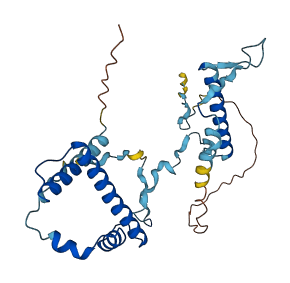
Descriptions
The autoinhibited protein was predicted that may have potential autoinhibitory elements via cis-regPred.
Autoinhibitory domains (AIDs)
Target domain |
|
Relief mechanism |
|
Assay |
cis-regPred |
Accessory elements
No accessory elements
Autoinhibited structure

Activated structure
1 structures for Q7ZYA2
| Entry ID | Method | Resolution | Chain | Position | Source |
|---|---|---|---|---|---|
| AF-Q7ZYA2-F1 | Predicted | AlphaFoldDB |
No variants for Q7ZYA2
| Variant ID(s) | Position | Change | Description | Diseaes Association | Provenance |
|---|---|---|---|---|---|
| No variants for Q7ZYA2 | |||||
No associated diseases with Q7ZYA2
2 GO annotations of cellular component
| Name | Definition |
|---|---|
| cytoplasm | The contents of a cell excluding the plasma membrane and nucleus, but including other subcellular structures. |
| transcription factor TFIID complex | A complex composed of TATA binding protein (TBP) and TBP associated factors (TAFs); the total mass is typically about 800 kDa. Most of the TAFs are conserved across species. In TATA-containing promoters for RNA polymerase II (Pol II), TFIID is believed to recognize at least two distinct elements, the TATA element and a downstream promoter element. TFIID is also involved in recognition of TATA-less Pol II promoters. Binding of TFIID to DNA is necessary but not sufficient for transcription initiation from most RNA polymerase II promoters. |
1 GO annotations of molecular function
| Name | Definition |
|---|---|
| protein heterodimerization activity | Binding to a nonidentical protein to form a heterodimer. |
1 GO annotations of biological process
| Name | Definition |
|---|---|
| cell differentiation | The process in which relatively unspecialized cells, e.g. embryonic or regenerative cells, acquire specialized structural and/or functional features that characterize the cells, tissues, or organs of the mature organism or some other relatively stable phase of the organism's life history. Differentiation includes the processes involved in commitment of a cell to a specific fate and its subsequent development to the mature state. |
No homologous proteins in AiPD
| UniProt AC | Gene Name | Protein Name | Species | Evidence Code |
|---|---|---|---|---|
| No homologous proteins | ||||
| 10 | 20 | 30 | 40 | 50 | 60 |
| MFPTIRSCAR | GTSTPADNYM | LARRRTLQVV | VSSLLTEAGF | DSAEKAAVES | LTEMLQSYLS |
| 70 | 80 | 90 | 100 | 110 | 120 |
| EIGRSAKSYC | EHTARTQPTL | PDIVVTLIEM | GFNVDSLPAY | AKRSQRMVIT | APPVTNNPVV |
| 130 | 140 | 150 | 160 | 170 | 180 |
| PKALSAGDNK | PHPAHIPSHF | PEFPDPHTYI | KTPTYREPVC | DYQVLREKAA | SQRRDVERAL |
| 190 | 200 | 210 | 220 | 230 | 240 |
| TRFMAKTGET | QSLFKDDTST | FPLIAARPLS | IPYLNALLPS | ELELQQVDET | DSSEQDDQTD |
| 250 | 260 | 270 | 280 | 290 | |
| TENLSLHLQG | DEVGMEKENA | SVLQQNSMKG | GEETLIDNPY | LRPVKKPKLR | RKK |