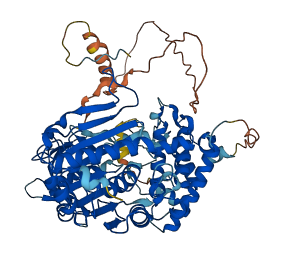
Descriptions
The autoinhibited protein was predicted that may have potential autoinhibitory elements via cis-regPred.
Autoinhibitory domains (AIDs)
Target domain |
|
Relief mechanism |
|
Assay |
cis-regPred |
Accessory elements
No accessory elements
Autoinhibited structure

Activated structure
1 structures for Q7ZY60
| Entry ID | Method | Resolution | Chain | Position | Source |
|---|---|---|---|---|---|
| AF-Q7ZY60-F1 | Predicted | AlphaFoldDB |
No variants for Q7ZY60
| Variant ID(s) | Position | Change | Description | Diseaes Association | Provenance |
|---|---|---|---|---|---|
| No variants for Q7ZY60 | |||||
No associated diseases with Q7ZY60
1 regional properties for Q7ZY60
| Type | Name | Position | InterPro Accession |
|---|---|---|---|
| domain | Septin-type guanine nucleotide-binding (G) domain | 47 - 318 | IPR030379 |
1 GO annotations of cellular component
| Name | Definition |
|---|---|
| SUMO activating enzyme complex | A conserved heterodimeric complex with SUMO activating enzyme activity. |
4 GO annotations of molecular function
| Name | Definition |
|---|---|
| ATP binding | Binding to ATP, adenosine 5'-triphosphate, a universally important coenzyme and enzyme regulator. |
| metal ion binding | Binding to a metal ion. |
| SUMO activating enzyme activity | Catalysis of the activation of the proteolytically processed small ubiquitin-related modifier SUMO, through the formation of an ATP-dependent high-energy thiolester bond. |
| transferase activity | Catalysis of the transfer of a group, e.g. a methyl group, glycosyl group, acyl group, phosphorus-containing, or other groups, from one compound (generally regarded as the donor) to another compound (generally regarded as the acceptor). Transferase is the systematic name for any enzyme of EC class 2. |
1 GO annotations of biological process
| Name | Definition |
|---|---|
| protein sumoylation | The process in which a SUMO protein (small ubiquitin-related modifier) is conjugated to a target protein via an isopeptide bond between the carboxy-terminus of SUMO with an epsilon-amino group of a lysine residue of the target protein. |
No homologous proteins in AiPD
| UniProt AC | Gene Name | Protein Name | Species | Evidence Code |
|---|---|---|---|---|
| No homologous proteins | ||||
| 10 | 20 | 30 | 40 | 50 | 60 |
| MAVIGALPKE | VAEAVSASRL | LVVGAGGIGC | ELLKNLVLTG | FTNLDVIDLD | TIDVSNLNRQ |
| 70 | 80 | 90 | 100 | 110 | 120 |
| FLFQKKHVGR | SKAQVAKESV | LQFCPDASIT | AYHDSIMNPD | YNVEFFKQFT | MAMNALDNNA |
| 130 | 140 | 150 | 160 | 170 | 180 |
| ARNHVNRMCL | AAGIPLIESG | TAGYLGQVSV | IKKGVTECYE | CQPKPTQKTF | PGCTIRNTPS |
| 190 | 200 | 210 | 220 | 230 | 240 |
| EPIHCIVWAK | YLFNQLFGEE | DADQEVAPDI | ADPEAAWDPT | KAAERANASN | VDGDIKRVST |
| 250 | 260 | 270 | 280 | 290 | 300 |
| KQWAKSTGYD | PIKLFNKLFR | DDIKYLLTMD | RLWRKRKPPI | PLEWASLHNK | ENCSEIQNES |
| 310 | 320 | 330 | 340 | 350 | 360 |
| SLLGLKDQKV | LNVASYAQLF | SKSVETLREQ | LREKGDGAEL | VWDKDDVPAM | DFVTAAANLR |
| 370 | 380 | 390 | 400 | 410 | 420 |
| MHIFSMNMKS | KFDVKSMAGN | IIPAIATTNA | VISGLIVLEG | LKILSGNTEQ | CRTVFLNKQP |
| 430 | 440 | 450 | 460 | 470 | 480 |
| NPRKKLLVPC | SLDPPNPSCY | VCAIKPEVTV | KLNVHKVTVQ | MLQDKILKEK | FAMVAPDVQI |
| 490 | 500 | 510 | 520 | 530 | 540 |
| EDGKGTILIS | SEAGETDANN | HRKISEFGIR | NSSQLQADDF | LQDYTLMMNI | LHSDEMEKDV |
| 550 | 560 | 570 | 580 | 590 | 600 |
| DFEVVGDVPE | KGPQKPPEES | VKNITNGSDD | GAQPSTSKAQ | DQDDVLIVDS | DEESPSSSNA |
| 610 | 620 | 630 | 640 | ||
| DVGMESASLK | RKLPDEEAVS | STKRKRIEPP | VEEDDDIIAL | D |