Q7ZXK3
Gene name |
stat3.2 (stat3-a) |
Protein name |
Signal transducer and activator of transcription 3.2 |
Names |
Protein Stat3-A |
Species |
Xenopus laevis (African clawed frog) |
KEGG Pathway |
xla:379264 |
EC number |
|
Protein Class |
|
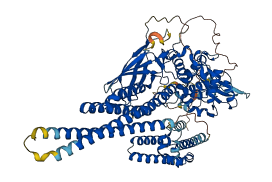
Descriptions
The autoinhibited protein was predicted that may have potential autoinhibitory elements via cis-regPred.
Autoinhibitory domains (AIDs)
Target domain |
|
Relief mechanism |
|
Assay |
cis-regPred |
Accessory elements
No accessory elements
Autoinhibited structure

Activated structure
1 structures for Q7ZXK3
| Entry ID | Method | Resolution | Chain | Position | Source |
|---|---|---|---|---|---|
| AF-Q7ZXK3-F1 | Predicted | AlphaFoldDB |
No variants for Q7ZXK3
| Variant ID(s) | Position | Change | Description | Diseaes Association | Provenance |
|---|---|---|---|---|---|
| No variants for Q7ZXK3 | |||||
No associated diseases with Q7ZXK3
5 regional properties for Q7ZXK3
| Type | Name | Position | InterPro Accession |
|---|---|---|---|
| domain | SH2 domain | 580 - 674 | IPR000980 |
| domain | STAT transcription factor, protein interaction | 2 - 122 | IPR013799 |
| domain | STAT transcription factor, all-alpha domain | 145 - 312 | IPR013800 |
| domain | STAT transcription factor, DNA-binding | 326 - 464 | IPR013801 |
| domain | STAT3, SH2 domain | 554 - 715 | IPR035855 |
Functions
2 GO annotations of cellular component
| Name | Definition |
|---|---|
| cytoplasm | The contents of a cell excluding the plasma membrane and nucleus, but including other subcellular structures. |
| nucleus | A membrane-bounded organelle of eukaryotic cells in which chromosomes are housed and replicated. In most cells, the nucleus contains all of the cell's chromosomes except the organellar chromosomes, and is the site of RNA synthesis and processing. In some species, or in specialized cell types, RNA metabolism or DNA replication may be absent. |
3 GO annotations of molecular function
| Name | Definition |
|---|---|
| DNA-binding transcription factor activity | A transcription regulator activity that modulates transcription of gene sets via selective and non-covalent binding to a specific double-stranded genomic DNA sequence (sometimes referred to as a motif) within a cis-regulatory region. Regulatory regions include promoters (proximal and distal) and enhancers. Genes are transcriptional units, and include bacterial operons. |
| protein kinase binding | Binding to a protein kinase, any enzyme that catalyzes the transfer of a phosphate group, usually from ATP, to a protein substrate. |
| sequence-specific DNA binding | Binding to DNA of a specific nucleotide composition, e.g. GC-rich DNA binding, or with a specific sequence motif or type of DNA e.g. promotor binding or rDNA binding. |
4 GO annotations of biological process
| Name | Definition |
|---|---|
| mesoderm formation | The process that gives rise to the mesoderm. This process pertains to the initial formation of the structure from unspecified parts. |
| neural crest cell differentiation | The process in which a relatively unspecialized cell acquires specialized features of a neural crest cell. |
| positive regulation of DNA-templated transcription | Any process that activates or increases the frequency, rate or extent of cellular DNA-templated transcription. |
| signal transduction | The cellular process in which a signal is conveyed to trigger a change in the activity or state of a cell. Signal transduction begins with reception of a signal (e.g. a ligand binding to a receptor or receptor activation by a stimulus such as light), or for signal transduction in the absence of ligand, signal-withdrawal or the activity of a constitutively active receptor. Signal transduction ends with regulation of a downstream cellular process, e.g. regulation of transcription or regulation of a metabolic process. Signal transduction covers signaling from receptors located on the surface of the cell and signaling via molecules located within the cell. For signaling between cells, signal transduction is restricted to events at and within the receiving cell. |
No homologous proteins in AiPD
| UniProt AC | Gene Name | Protein Name | Species | Evidence Code |
|---|---|---|---|---|
| No homologous proteins | ||||
| 10 | 20 | 30 | 40 | 50 | 60 |
| MAQWNQLQQL | DTRYLEQLHQ | LYSDSFPMEL | RQFLAPWIES | QDWAFAASKE | SHATLVFHNL |
| 70 | 80 | 90 | 100 | 110 | 120 |
| LGEIDQQYSR | FLQESNVLYQ | HNLRRIKQFL | QSTYLEKPME | IARIVARCLW | EEGRLLQTAV |
| 130 | 140 | 150 | 160 | 170 | 180 |
| AAAQQGGPAS | HPNAAVITEK | QQMLEQHLQD | VRKKVQDLEQ | KMKVVENLQD | DFDFNYKTLK |
| 190 | 200 | 210 | 220 | 230 | 240 |
| SQSDLSELNG | NNQSVTRQKM | QQLEQMLTAL | DQLRRTIISD | LASLLSAMEY | VQKNLTDEEL |
| 250 | 260 | 270 | 280 | 290 | 300 |
| ADWKRRQQIA | CIGGPPNICL | DRLENWITSL | AESQLQTRQQ | IRKLEELQQK | VSYKGDPIVQ |
| 310 | 320 | 330 | 340 | 350 | 360 |
| HRPMLEERIV | ELFRNLMKSA | FVVERQPCMP | MHPDRPLVIK | TGVQFTNKVR | LLVKFPELNY |
| 370 | 380 | 390 | 400 | 410 | 420 |
| QLKIKVCIDK | DSGEGAALRG | SRKFNILGTN | TKVMNMEESN | NGSLSAEFKH | LTLREQRCGN |
| 430 | 440 | 450 | 460 | 470 | 480 |
| GGRANCDASL | IVTEELHLIT | FETEVYHQGL | KIDLETHSLP | VVVISNICQM | PNAWASILWY |
| 490 | 500 | 510 | 520 | 530 | 540 |
| NMLTNNPKNV | NFFTKPPIGT | WDQVAEVLSW | QFSSTTKRGL | SIEQLTTLAE | KLLGPGVNYS |
| 550 | 560 | 570 | 580 | 590 | 600 |
| GCQITWAKFC | KENMAGKGFS | FWVWLDNLID | LVKKYMLALW | NEGYIIGFIS | KERERALLSP |
| 610 | 620 | 630 | 640 | 650 | 660 |
| KPPGTFLLRF | SESSKEGGIT | FTWVEKDISG | KTQIQSVEPY | TKQQLNSMSF | AEIIMGYKIM |
| 670 | 680 | 690 | 700 | 710 | 720 |
| DATNILVSPL | VYLYPDIPKE | EAFGKYCRPE | SQEHQEPTDP | GTAPYLRTMF | ICVTPTTCTL |
| 730 | 740 | 750 | 760 | ||
| DLPMSPGTFD | SVMQFPGEGS | ESGNGNQFET | LTFDVDLPSE | CAASPM |