Q7Z5Q1
Gene name |
CPEB2 |
Protein name |
Cytoplasmic polyadenylation element-binding protein 2 |
Names |
CPE-BP2, CPE-binding protein 2, hCPEB-2 |
Species |
Homo sapiens (Human) |
KEGG Pathway |
hsa:132864 |
EC number |
|
Protein Class |
|
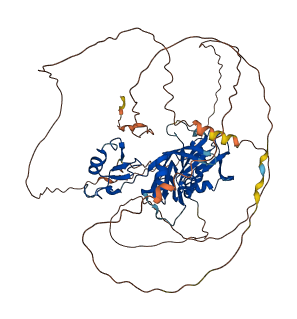
Descriptions
The autoinhibited protein was predicted that may have potential autoinhibitory elements via cis-regPred.
Autoinhibitory domains (AIDs)
Target domain |
|
Relief mechanism |
|
Assay |
cis-regPred |
Accessory elements
No accessory elements
Autoinhibited structure

Activated structure
1 structures for Q7Z5Q1
| Entry ID | Method | Resolution | Chain | Position | Source |
|---|---|---|---|---|---|
| AF-Q7Z5Q1-F1 | Predicted | AlphaFoldDB |
No variants for Q7Z5Q1
| Variant ID(s) | Position | Change | Description | Diseaes Association | Provenance |
|---|---|---|---|---|---|
| No variants for Q7Z5Q1 | |||||
No associated diseases with Q7Z5Q1
3 regional properties for Q7Z5Q1
| Type | Name | Position | InterPro Accession |
|---|---|---|---|
| domain | RNA recognition motif domain | 331 - 420 | IPR000504-1 |
| domain | RNA recognition motif domain | 440 - 518 | IPR000504-2 |
| domain | Cytoplasmic polyadenylation element-binding protein, ZZ domain | 513 - 575 | IPR032296 |
5 GO annotations of cellular component
| Name | Definition |
|---|---|
| cytoplasm | The contents of a cell excluding the plasma membrane and nucleus, but including other subcellular structures. |
| messenger ribonucleoprotein complex | A ribonucleoprotein complex containing both protein and messenger RNA (mRNA) molecules. |
| neuron projection | A prolongation or process extending from a nerve cell, e.g. an axon or dendrite. |
| nucleus | A membrane-bounded organelle of eukaryotic cells in which chromosomes are housed and replicated. In most cells, the nucleus contains all of the cell's chromosomes except the organellar chromosomes, and is the site of RNA synthesis and processing. In some species, or in specialized cell types, RNA metabolism or DNA replication may be absent. |
| synapse | The junction between an axon of one neuron and a dendrite of another neuron, a muscle fiber or a glial cell. As the axon approaches the synapse it enlarges into a specialized structure, the presynaptic terminal bouton, which contains mitochondria and synaptic vesicles. At the tip of the terminal bouton is the presynaptic membrane; facing it, and separated from it by a minute cleft (the synaptic cleft) is a specialized area of membrane on the receiving cell, known as the postsynaptic membrane. In response to the arrival of nerve impulses, the presynaptic terminal bouton secretes molecules of neurotransmitters into the synaptic cleft. These diffuse across the cleft and transmit the signal to the postsynaptic membrane. |
9 GO annotations of molecular function
| Name | Definition |
|---|---|
| GTPase inhibitor activity | Stops, prevents or reduces the activity of any enzyme that catalyzes the hydrolysis of GTP to GDP and orthophosphate. |
| mRNA 3'-UTR AU-rich region binding | Binding to a region containing frequent adenine and uridine bases within the 3' untranslated region of a mRNA molecule or in pre-mRNA intron. The ARE-binding element consensus is UUAUUUAUU. ARE-binding proteins control the stability and/or translation of mRNAs. |
| mRNA 3'-UTR binding | Binding to a 3' untranslated region of an mRNA molecule. |
| mRNA regulatory element binding translation repressor activity | Antagonizes the ribosome-mediated translation of mRNA into a polypeptide via direct binding (through a selective and non-covalent interaction) to nucleic acid. |
| ribosomal large subunit binding | Binding to a large ribosomal subunit. |
| ribosomal small subunit binding | Binding to a small ribosomal subunit. |
| ribosome binding | Binding to a ribosome. |
| RNA binding | Binding to an RNA molecule or a portion thereof. |
| translation factor activity, RNA binding | Functions during translation by binding to RNA during polypeptide synthesis at the ribosome. |
7 GO annotations of biological process
| Name | Definition |
|---|---|
| cellular response to arsenic-containing substance | Any process that results in a change in state or activity of a cell (in terms of movement, secretion, enzyme production, gene expression, etc.) as a result of an arsenic stimulus from compounds containing arsenic, including arsenates, arsenites, and arsenides. |
| cellular response to hypoxia | Any process that results in a change in state or activity of a cell (in terms of movement, secretion, enzyme production, gene expression, etc.) as a result of a stimulus indicating lowered oxygen tension. Hypoxia, defined as a decline in O2 levels below normoxic levels of 20.8 - 20.95%, results in metabolic adaptation at both the cellular and organismal level. |
| cellular response to insulin stimulus | Any process that results in a change in state or activity of a cell (in terms of movement, secretion, enzyme production, gene expression, etc.) as a result of an insulin stimulus. Insulin is a polypeptide hormone produced by the islets of Langerhans of the pancreas in mammals, and by the homologous organs of other organisms. |
| cellular response to oxidative stress | Any process that results in a change in state or activity of a cell (in terms of movement, secretion, enzyme production, gene expression, etc.) as a result of oxidative stress, a state often resulting from exposure to high levels of reactive oxygen species, e.g. superoxide anions, hydrogen peroxide (H2O2), and hydroxyl radicals. |
| negative regulation of cytoplasmic translation | Any process that stops, prevents or reduces the frequency, rate or extent of cytoplasmic translation. |
| negative regulation of cytoplasmic translational elongation | Any process that stops, prevents or reduces the frequency, rate or extent of cytoplasmic translational elongation. |
| negative regulation of GTPase activity | Any process that stops or reduces the rate of GTP hydrolysis by a GTPase. |
1 homologous proteins in AiPD
| UniProt AC | Gene Name | Protein Name | Species | Evidence Code |
|---|---|---|---|---|
| Q812E0 | Cpeb2 | Cytoplasmic polyadenylation element-binding protein 2 | Mus musculus (Mouse) | PR |
| 10 | 20 | 30 | 40 | 50 | 60 |
| MPPPSPDSEN | GFYPGLPSSM | NPAFFPSFSP | VSPHGCTGLS | VPTSGGGGGG | FGGPFSATAV |
| 70 | 80 | 90 | 100 | 110 | 120 |
| PPPPPPAMNI | PQQQPPPPAA | PQQPQSRRSP | VSPQLQQQHQ | AAAAAFLQQR | NSYNHHQPLL |
| 130 | 140 | 150 | 160 | 170 | 180 |
| KQSPWSNHQS | SGWGTGSMSW | GAMHGRDHRR | TGNMGIPGTM | NQISPLKKPF | SGNVIAPPKF |
| 190 | 200 | 210 | 220 | 230 | 240 |
| TRSTPSLTPK | SWIEDNVFRT | DNNSNTLLPL | QVRSSLQLPA | WGSDSLQDSW | CTAAGTSRID |
| 250 | 260 | 270 | 280 | 290 | 300 |
| QDRSRMYDSL | NMHSLENSLI | DIMRAEHDPL | KGRLSYPHPG | TDNLLMLNGR | SSLFPIDDGL |
| 310 | 320 | 330 | 340 | 350 | 360 |
| LDDGHSDQVG | VLNSPTCYSA | HQNGERIERF | SRKVFVGGLP | PDIDEDEITA | SFRRFGPLVV |
| 370 | 380 | 390 | 400 | 410 | 420 |
| DWPHKAESKS | YFPPKGYAFL | LFQEESSVQA | LIDACIEEDG | KLYLCVSSPT | IKDKPVQIRP |
| 430 | 440 | 450 | 460 | 470 | 480 |
| WNLSDSDFVM | DGSQPLDPRK | TIFVGGVPRP | LRAVELAMIM | DRLYGGVCYA | GIDTDPELKY |
| 490 | 500 | 510 | 520 | 530 | 540 |
| PKGAGRVAFS | NQQSYIAAIS | ARFVQLQHGD | IDKRVEVKPY | VLDDQMCDEC | QGARCGGKFA |
| 550 | 560 | 570 | 580 | ||
| PFFCANVTCL | QYYCEFCWAN | IHSRAGREFH | KPLVKEGADR | PRQIHFRWN |