Q7X2C7
Gene name |
bchE |
Protein name |
Anaerobic magnesium-protoporphyrin IX monomethyl ester cyclase |
Names |
MPE cyclase |
Species |
Rubrivivax gelatinosus (Rhodocyclus gelatinosus) (Rhodopseudomonas gelatinosa) |
KEGG Pathway |
|
EC number |
1.21.98.3: With other, known acceptors |
Protein Class |
|
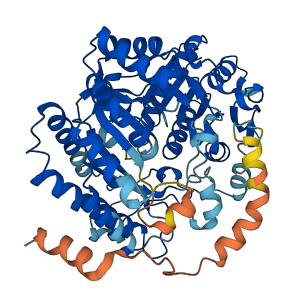
Descriptions
The autoinhibited protein was predicted that may have potential autoinhibitory elements via cis-regPred.
Autoinhibitory domains (AIDs)
Target domain |
|
Relief mechanism |
|
Assay |
cis-regPred |
Accessory elements
No accessory elements
Autoinhibited structure

Activated structure
1 structures for Q7X2C7
| Entry ID | Method | Resolution | Chain | Position | Source |
|---|---|---|---|---|---|
| AF-Q7X2C7-F1 | Predicted | AlphaFoldDB |
No variants for Q7X2C7
| Variant ID(s) | Position | Change | Description | Diseaes Association | Provenance |
|---|---|---|---|---|---|
| No variants for Q7X2C7 | |||||
No associated diseases with Q7X2C7
Functions
| Description | ||
|---|---|---|
| EC Number | 1.21.98.3 | With other, known acceptors |
| Subcellular Localization |
|
|
| PANTHER Family | ||
| PANTHER Subfamily | ||
| PANTHER Protein Class | ||
| PANTHER Pathway Category | No pathway information available | |
No GO annotations of cellular component
| Name | Definition |
|---|---|
| No GO annotations for cellular component |
4 GO annotations of molecular function
| Name | Definition |
|---|---|
| 4 iron, 4 sulfur cluster binding | Binding to a 4 iron, 4 sulfur (4Fe-4S) cluster; this cluster consists of four iron atoms, with the inorganic sulfur atoms found between the irons and acting as bridging ligands. |
| cobalamin binding | Binding to cobalamin (vitamin B12), a water-soluble vitamin characterized by possession of a corrin nucleus containing a cobalt atom. |
| metal ion binding | Binding to a metal ion. |
| oxidoreductase activity | Catalysis of an oxidation-reduction (redox) reaction, a reversible chemical reaction in which the oxidation state of an atom or atoms within a molecule is altered. One substrate acts as a hydrogen or electron donor and becomes oxidized, while the other acts as hydrogen or electron acceptor and becomes reduced. |
2 GO annotations of biological process
| Name | Definition |
|---|---|
| light-independent bacteriochlorophyll biosynthetic process | The chemical reactions and pathways resulting in the formation of a bacteriochlorophyll, which occur in the absence of light. Bacteriochlorophylls are any of the chlorophylls of photosynthetic bacteria; they differ structurally from the chlorophylls of higher plants. |
| photosynthesis | The synthesis by organisms of organic chemical compounds, especially carbohydrates, from carbon dioxide (CO2) using energy obtained from light rather than from the oxidation of chemical compounds. |
No homologous proteins in AiPD
| UniProt AC | Gene Name | Protein Name | Species | Evidence Code |
|---|---|---|---|---|
| No homologous proteins | ||||
| 10 | 20 | 30 | 40 | 50 | 60 |
| MRVLFIHPNY | HSGGAEIAGN | WPPAWVAYLA | GYLKAGGYTD | VIFVDAMTND | LSEDQVREKI |
| 70 | 80 | 90 | 100 | 110 | 120 |
| TTLKPDIVGC | TAITPAIYKA | ERTLQIAKEV | NPDIVTVLGG | IHGTFMYPQV | LKEAPWIDAI |
| 130 | 140 | 150 | 160 | 170 | 180 |
| VRGEGEQVML | NLVTAVDQGR | FMADRNCVNG | IAYAAPDGKV | VATPAEPPIE | DLDRITPDWG |
| 190 | 200 | 210 | 220 | 230 | 240 |
| ILEWEKYIYI | PMNKRVAIPN | FARGCPFTCS | FCSQWKFWRD | YRIRDPKKVV | DEIEVLVKQH |
| 250 | 260 | 270 | 280 | 290 | 300 |
| DVGFFILADE | EPTIHRKKFI | EFCEELIKRD | LGVLWGINTR | VTDILRDEKL | LPLFRKAGLI |
| 310 | 320 | 330 | 340 | 350 | 360 |
| HVSLGTEAAA | QLKLDMVNKE | TTIEQNKRAI | QLLKDNGIVT | EAQFIVGLEN | ETAETLEETY |
| 370 | 380 | 390 | 400 | 410 | 420 |
| KMARDWNPDM | ANWAMYTPWP | FSDLFQELGD | KVEVFDFEKY | NFVTPIMKPD | AMDRGELLDR |
| 430 | 440 | 450 | 460 | 470 | 480 |
| VMSNYRRFFM | NKAFLQYPFT | KDKERRKYLM | GCLKAFLKSG | FERKFYDLGR | VGYWGPQTKK |
| 490 | 500 | 510 | 520 | 530 | 540 |
| TVNFSFDKNR | RIDAQTADEL | SRVDDGWVTM | HGPKIEMRRR | KGDDNFEIAK | AAMACGGGTE |
| 550 | |||||
| QLTEEQQAAT | EVRAS |